MIPS Snowboard Helmet Technology Explained: Is It Essential Safety Gear?
By Snowboard Champ Experts
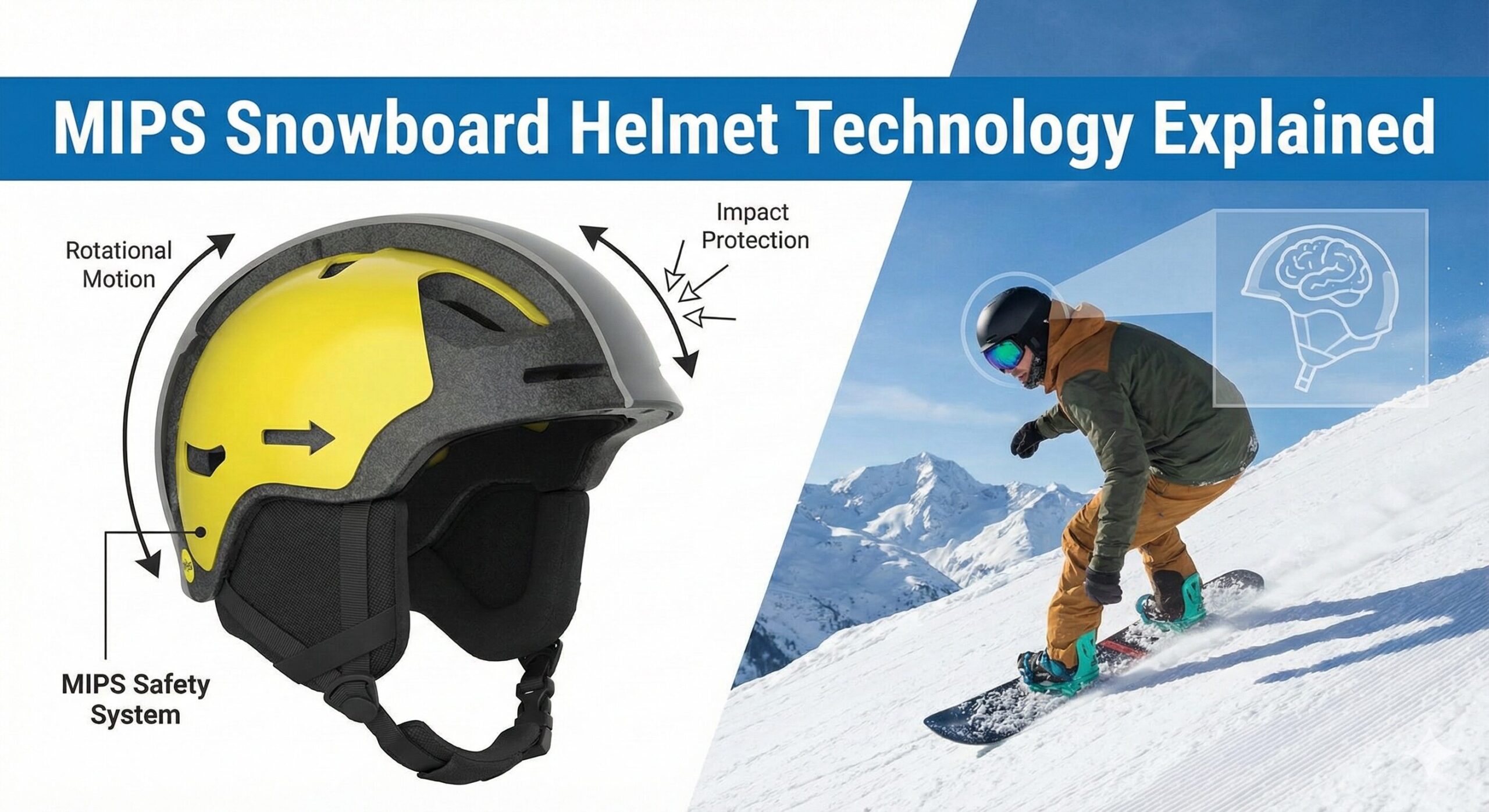
If you have shopped for a new lid recently, you have undoubtedly seen the little yellow dot. It’s omnipresent in the descriptions of the best snowboard helmets on the market. It stands for MIPS (Multi-Directional Impact Protection System), and it represents the biggest shift in head safety technology in the last two decades.
For years, helmets were designed with a singular, somewhat archaic purpose: to prevent skull fractures during a direct, linear hit. Think of running headfirst into a wall. But anyone who understands why snowboarding is dangerous knows that crashes on snow are rarely that simple. You catch an edge. You tumble. You spin. The mountain doesn’t just hit you; it twists you.
This guide dives deep into the physics, the functionality, and the verdict on MIPS technology. Is it just marketing fluff designed to hike up the price, or is it a critical layer of insurance for your brain? We break it all down below.
What Is MIPS Technology?
At its core, MIPS is a brain protection system found inside the helmet, generally located between the comfort padding and the EPS (expanded polystyrene) foam liner. It was developed by neurosurgeons and scientists at the Royal Institute of Technology and the Karolinska Institute in Stockholm, Sweden.
The concept mimics the brain’s own protection system. Your brain is suspended in cerebrospinal fluid, which allows it to slide slightly inside your skull during an impact to protect itself. MIPS replicates this “slip” mechanically.
The Low Friction Layer
The visible part of MIPS is usually a thin, yellow polycarbonate plastic layer inside the helmet. This layer is anchored to the helmet’s foam by flexible elastomers (rubber bands, essentially). These anchors allow the yellow layer to move 10 to 15 millimeters in any direction independently of the helmet shell.
This might sound like a small distance, but in the chaotic microseconds of a crash, those 15 millimeters can be the difference between a concussion and a severe traumatic brain injury.
The Physics of the Crash: Linear vs. Rotational
To understand why MIPS is necessary, we have to look at how we actually crash. Traditional helmet testing standards (like ASTM F2040 for snow) involve dropping a helmet vertically onto a flat anvil. This measures linear acceleration—a straight-on impact.
However, when you are carving down a run or navigating backcountry snowboarding terrain, you are moving forward with speed. If you catch an edge, your head hits the snow at an angle. The helmet grips the snow, stopping instantly, but your head wants to keep rotating.
The Rotational Force Danger
This sudden stop creates rotational motion (or angular acceleration). This force causes the brain to shear or twist inside the skull. Brain tissue is incredibly sensitive to shearing forces—much more so than to direct pressure. This shearing can tear nerve fibers and is a leading cause of severe concussions and diffuse axonal injuries.
Standard helmets without a slip plane are excellent at absorbing linear shock (preventing your skull from cracking), but they are notoriously bad at mitigating this rotational energy. That energy has to go somewhere, and usually, it goes straight into your brain.

Smith Vantage MIPS Snow Helmet
One of the industry leaders incorporating MIPS for maximum safety.
Check Price on AmazonHow MIPS Works in a Crash: A Step-by-Step Breakdown
So, you are riding fast, perhaps wondering is it easier to ski or snowboard when suddenly you catch a toe edge. Here is the sequence of events in a MIPS-equipped helmet:
- Impact: Your head hits the slope at an angle.
- Grip: The outer shell of the helmet catches on the snow and attempts to rotate violently.
- Slip: Instead of transferring that rotation to your head, the MIPS low-friction layer allows the helmet shell to slide those crucial 10-15mm relative to your head.
- Redirection: That sliding motion redirects and absorbs the rotational energy that would otherwise be sent to the brain.
- Result: The strain on the brain tissue is significantly reduced.
Think of it like falling on ice versus falling on pavement. On ice, you slide, and the energy dissipates. MIPS puts the “ice” inside your helmet.
The Evolution: Different Types of MIPS
As the technology has matured, variations have emerged to address comfort and weight. It’s not just the “yellow liner” anymore.
- MIPS Essential (Standard): The classic yellow liner. It sits between the foam and padding. It is effective but can sometimes reduce airflow slightly.
- MIPS Spherical: Found in high-end helmets (like those from Giro). This design eliminates the plastic liner against the head. Instead, the helmet is made of two separate layers of EPS foam (like a ball and socket) that rotate against each other. It is more comfortable and ventilates better.
- MIPS Integra: The slip plane is integrated directly into the helmet’s padding or retention system, making it nearly invisible and lighter.
Pros and Cons of MIPS Technology
While safety is the primary goal, every piece of gear has trade-offs. Here is an honest look at the advantages and disadvantages.
| Advantages | Disadvantages |
|---|---|
| Reduced Brain Trauma: Scientifically proven to reduce rotational motion in angled impacts. | Cost: Typically adds $20 to $50 to the price of a helmet. |
| Industry Standard: Adopted by almost all major brands (Smith, Giro, Oakley, Anon, POC). | Hair Pulling: The exposed yellow plastic in older models can sometimes snag long hair. |
| Peace of Mind: Knowing you have the best available tech allows for more confident riding. | Ventilation: Standard MIPS liners can occasionally block helmet vents if not designed perfectly. |
| Lightweight: Adds negligible weight (usually 20-45 grams) to the helmet. | Sizing Perception: Some riders feel it makes the fit slightly tighter (though brands account for this). |
Compatibility and Practical Use
Does MIPS Affect Fit?
Modern helmets are designed around the MIPS system. If you wear a size Medium in a standard helmet, you will likely wear a Medium in the MIPS version. However, because the system takes up a fraction of a millimeter of space, it is always crucial to try it on. Ensure it doesn’t pinch your forehead.
Integration with Goggles
MIPS does not interfere with the goggle interface. Whether you are rocking the latest best snowboard goggles or comparing Oakley Flight Deck vs Flight Path, the brim of the helmet remains unchanged. The system is internal.
Who Needs It Most?
While we argue everyone should use it, certain riders benefit more:
- Park Riders: Hitting rails and jumps increases the likelihood of awkward falls.
- Beginners: Learning at resorts for beginners means catching edges frequently.
- Tree Riders: Gladed runs present hard, immovable objects.

Giro Jackson MIPS Snow Helmet
Sleek, low profile, and packed with MIPS technology for all-mountain riders.
Check Price on AmazonAre There Alternatives to MIPS?
MIPS is the market leader, but it’s not the only game in town. Other technologies attempt to solve the rotational violence problem:
- WaveCel (Bontrager/Anon): A cellular structure that crushes and glides. It claims to be even more effective than MIPS in certain scenarios but can be heavier and restrict airflow more.
- SPIN (POC): Shearing Pads Inside. POC used silicone-injected pads to allow movement. *Note: POC has recently moved away from SPIN and back toward partnering with MIPS.*
- Koroyd (Smith): Often used with MIPS. Koroyd is a honeycomb structure that crumples to absorb energy. It is excellent for linear impact and ventilation but doesn’t inherently replace the slip-plane function of MIPS.
Frequently Asked Questions About MIPS
Is MIPS worth the extra money for snowboarding?
Yes. Given that snowboarding falls often involve catching an edge and rotational force, the added protection against brain shear provided by MIPS is worth the typically small price increase ($20-$40). When considering the fitness guide for snowboarding and body prep, brain safety should be top priority.
Does MIPS change helmet sizing?
Generally, no. Manufacturers account for the MIPS liner (which is very thin, usually 0.5mm to 0.8mm) within their sizing charts. A size Medium MIPS helmet fits the same head circumference as a non-MIPS Medium.
Can I install MIPS into my old helmet?
No. MIPS is integrated between the foam liner and the padding during the manufacturing process. You cannot retrofit an old helmet with MIPS technology. If your helmet is over 5 years old, check our guide on when to buy gear and replace it.
How do I know if my helmet has MIPS?
Look for the distinct yellow dot logo on the exterior shell, and a yellow plastic liner inside the helmet underneath the comfort padding.
Do I still need other protection if I have MIPS?
Yes. A helmet protects your head, but you should still consider wrist guards and impact shorts for comprehensive protection.
Final Verdict: The Standard for Modern Riding
Snowboarding has evolved. We ride faster, jump higher, and explore steeper terrain than ever before. Helmet technology had to catch up. MIPS is not a cure-all—no helmet can prevent all injuries—but it addresses the specific mechanics of how snowboarders actually crash.
If you are looking to upgrade your setup this season, prioritizing a helmet with MIPS (or an equivalent rotational impact system) is the smartest decision you can make. It is a small investment to protect your most valuable asset.
Don’t wait for a concussion to upgrade. Ride smart, ride safe, and keep shredding.
Ready to protect your dome?
Shop Top Rated MIPS Helmets on Amazon


 Home
Home
 About
About
 My Cart
 Reviews
 Compare