
Photochromic vs. Polarized Snowboard Goggles: The Ultimate Lens Showdown
There is nothing worse than riding “blind.” You drop into a run, the light goes flat, and suddenly you can’t tell a mogul from a hole. Or conversely, you step out on a bluebird day, and the glare off the snow feels like needles in your eyes. Visibility isn’t just a luxury in our sport; it’s a safety requirement.
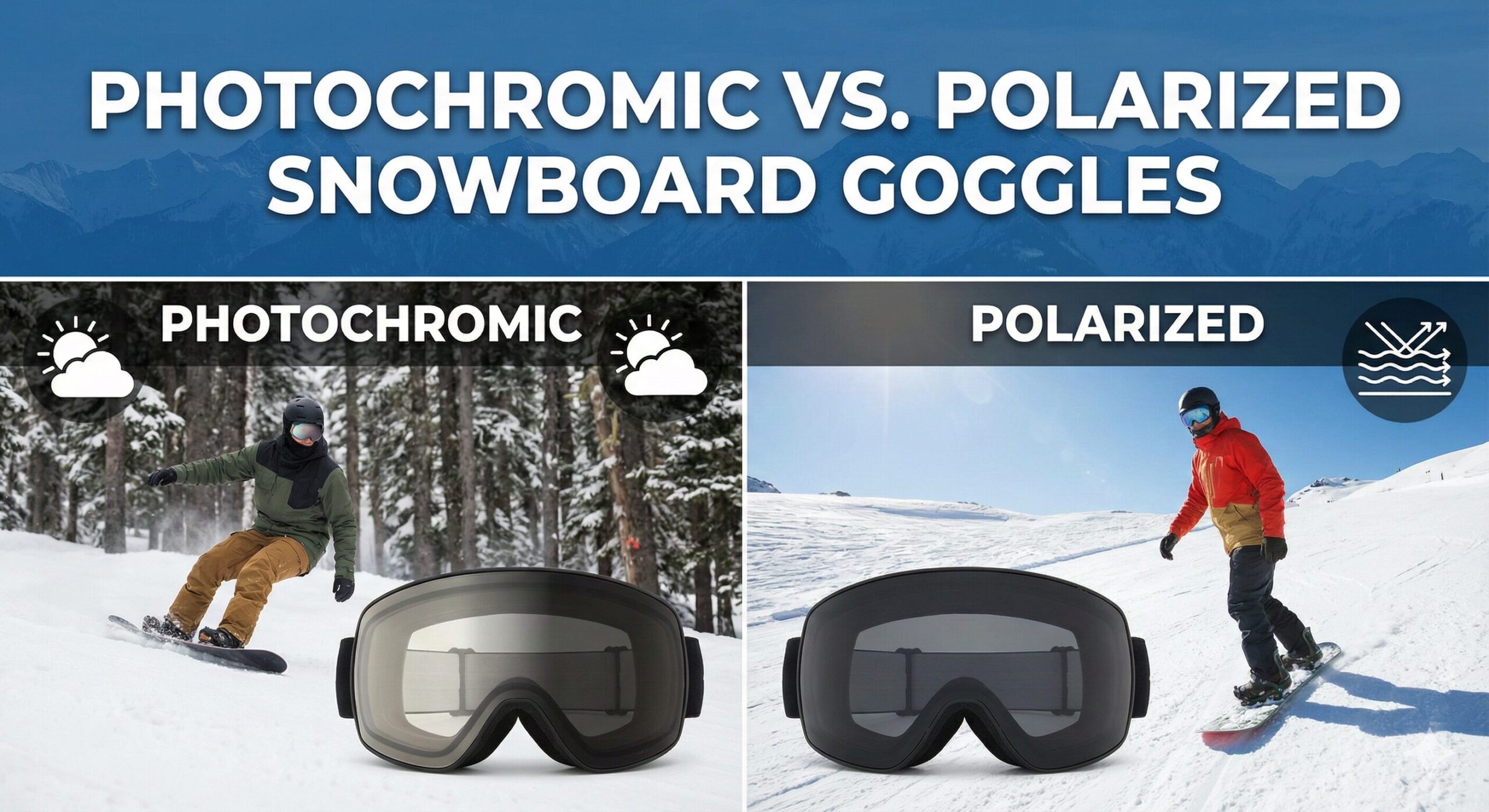
When upgrading your kit, the lens technology is arguably more critical than the frame itself. Two terms dominate the high-end market: Photochromic and Polarized. Both promise superior vision, but they achieve it in radically different ways. One adapts to the light; the other filters it.
If you’ve been reading our guide on best snowboard goggles, you know the options can be overwhelming. In this comprehensive comparison, we are stripping away the marketing jargon to pit Photochromic vs. Polarized technology against each other. We’ll help you decide which one deserves a spot in your gear bag.
At a Glance: The Core Differences
Don’t have time for the deep dive? Here is the cheat sheet.
| Feature | Photochromic Lenses | Polarized Lenses |
|---|---|---|
| Primary Function | Automatically darkens or lightens based on UV intensity. | Filters out horizontal light waves (glare) from snow. |
| Best For | Variable weather, all-day riding without lens swaps. | Bright, sunny “Bluebird” days and high altitudes. |
| Weakness | Can be slow to transition in extreme cold; less effective in cars. | Can hide ice patches; makes phone screens hard to read. |
| Price Point | High ($150 – $300+) | Mid to High ($100 – $250) |
| Convenience | Maximum (set it and forget it). | Medium (may need to swap for low-light lens). |
Contender 1: Photochromic Lenses (The Chameleon)
Imagine owning one pair of goggles that works perfectly during a snowy morning, a sunny lunch break, and a shadowy afternoon run. That is the promise of photochromic technology.
How It Works
Photochromic lenses contain special molecules (typically silver halide or organic molecules) embedded in the lens. When exposed to Ultraviolet (UV) radiation from the sun, these molecules undergo a chemical reaction that causes them to change shape and absorb light, effectively darkening the tint.
When the UV source is removed (you go indoors or a cloud rolls in), the molecules return to their original state, and the lens becomes clear or lighter.
The Advantages
- The “Quiver Killer”: You don’t need to carry a spare lens in your pocket. This is ideal for places with rapidly changing weather, like snowboarding in Colorado where storms roll in fast.
- Continuous Adjustment: They don’t just flip between dark and light; they offer a full spectrum of tints (VLT ranges often span from 15% to 50%).
- Convenience: Less fumbling with lens-change mechanisms means more time riding.
The Disadvantages
- Reaction Time: The transition isn’t instant. It usually takes 20-60 seconds to darken, but can take longer to lighten. If you bomb into a dark forest from a sunny slope, you might be blind for a minute.
- Temperature Sensitivity: Ironically, extreme cold can sometimes affect how fast the chemical reaction occurs.
- Inside the Car: Because car windshields block UV rays, your photochromic goggles won’t darken inside your car, which isn’t a huge deal unless you’re trying to look cool on the drive up.

Top Pick: Julbo Aerospace Photochromic
Julbo is the industry leader in reactivity speed and range.
Check Price on AmazonContender 2: Polarized Lenses (The Glare Killer)
If you are a fisherman, you know polarization lets you see through the water. On the mountain, it lets you see through the blinding white haze.
How It Works
Light from the sun scatters in all directions. But when it bounces off a flat, reflective surface like snow, it becomes “polarized” horizontally. This creates intense glare.
Polarized lenses act like a vertical Venetian blind. They block those horizontal light waves while letting vertical light through. The result is a drastic reduction in “visual noise.”
The Advantages
- Eye Fatigue Reduction: Glare causes you to squint, which leads to headaches and tired eyes. Polarized lenses are significantly more relaxing on bright days.
- Contrast and Saturation: Colors look richer, and the sky looks deeper blue. The visual experience is high-definition.
- Bluebird Perfection: On those bright spring days at top European ski resorts, nothing beats a dark polarized lens.
⚠️ The Ice Patch Controversy
This is the biggest argument against polarized lenses for snowsports. Ice is essentially a flat, reflective surface. Polarization filters the glare off the ice. While this sounds good, that glare is often the visual cue that tells a snowboarder, “Warning: Ice ahead!”
With polarized lenses, an ice patch might look just like matte snow. If you hit it expecting grip, you might wash out. This is why many competitive racers avoid polarization.

Top Pick: Oakley Flight Deck (Prizm Options)
While Prizm isn’t always polarized, their specific polarized options offer incredible clarity.
Check Price on AmazonHead-to-Head: Which One Wins?
Round 1: Versatility
Winner: Photochromic.
A polarized lens has a fixed tint (usually dark). If the clouds roll in or the sun sets, a polarized lens becomes too dark to use safely. A photochromic lens adapts. For the rider who doesn’t want to check the forecast, photochromic wins.
Round 2: Visual Clarity in Sun
Winner: Polarized.
On a bright, high-UV day, a photochromic lens will get dark, but it won’t cut the glare. The polarized lens cuts the reflections, allowing you to see the texture of the snow much better in high-light conditions.
Round 3: Safety (Seeing Terrain)
It’s a Tie (Context Dependent).
If you are riding powder or slush, polarized lenses help you see contours better. However, if you are riding hardpack where ice is a concern (common on the East Coast), the inability to spot ice “glare” with polarized lenses is a safety risk. Photochromic lenses leave the glare intact, helping you spot the slide zones.
Round 4: Price
Winner: Polarized (Slightly).
Generally, photochromic technology is more expensive to manufacture. However, if buying one photochromic lens prevents you from buying two separate standard lenses (one for sun, one for low light), the cost might even out. Read our guide on how expensive is snowboarding to budget accordingly.
Scenario Guide: Which Should You Buy?
The “All-Mountain Cruiser”
Recommendation: Photochromic.
You arrive at the lift at 9 AM and ride until 4 PM. You ride through shadows, open bowls, and maybe a little flat light. You don’t want to carry a backpack with spare lenses. The adaptability is key for you.
The “Spring Breaker” / Fair Weather Rider
Recommendation: Polarized.
You only ride when the sun is out. You enjoy the aprés-ski as much as the riding. You want your eyes to feel rested and the view to look spectacular. Glare reduction is your best friend.
The “Backcountry Explorer”
Recommendation: High-Contrast (Non-Polarized) or Photochromic.
In backcountry snowboarding, reading the snowpack is life or death. You need to see wind slabs and ice crusts. While some backcountry riders love photochromic for the changing weather of an ascent, many avoid polarization to ensure they don’t miss icy cues on critical lines.
The “Park Rat”
Recommendation: Non-Polarized (Standard).
If you are hitting rails and jumps, you need to see the metal and the icy landings clearly. Transitions in lighting in the park are less drastic than on big mountain faces. Standard lenses or high-contrast tech (like Oakley Prizm or Smith ChromaPop) are usually preferred over photochromic or polarized.
The Third Option: High-Contrast Tech
It is important to note that many modern lenses (Oakley Prizm, Smith ChromaPop, Dragon Lumalens) are neither photochromic nor polarized. They use light-filtering dye technology to boost specific colors (contrast) while muting others.
For many riders, this is the “Goldilocks” solution. They offer better definition than standard lenses without the ice-hiding issues of polarization or the transition lag of photochromic lenses. If you are struggling with Oakley Flight Deck vs Flight Path, usually it’s the Prizm tech doing the heavy lifting.
Frequently Asked Questions
Can a snowboard lens be both photochromic and polarized?
Yes, some high-end manufacturers like Julbo and Zeal Optics produce lenses that are both. They are the “Rolls Royce” of lenses, offering glare reduction AND light adaptability, but they come with a hefty price tag.
Why do some snowboarders avoid polarized lenses?
The main argument is the “ice patch” issue. Polarization removes glare, and glare is often how riders identify ice. Without that shine, ice looks like snow, leading to unexpected slip-outs.
Do photochromic goggles work in flat light?
Yes. High-quality photochromic lenses (look for a VLT range that goes up to 50% or higher) will lighten significantly to let more light in, helping visibility in flat light.
Final Verdict
Choosing between photochromic vs polarized snowboard goggles comes down to where and how you ride.
If you value convenience and ride in changing weather conditions, Photochromic is the clear winner. It simplifies your gear and ensures you are never stuck with a dark lens in a storm.
If you value visual comfort and primarily ride on bright, sunny days, Polarized will give you a high-definition experience that is hard to beat.
Whichever you choose, ensure it fits seamlessly with your helmet. Check out our guide on best snowboard helmets to ensure you don’t end up with the dreaded “gaper gap.”
Ready to upgrade your vision?
Browse Top Rated Snowboard Goggles on Amazon


 Home
Home
 About
About
 My Cart
 Reviews
 Compare