
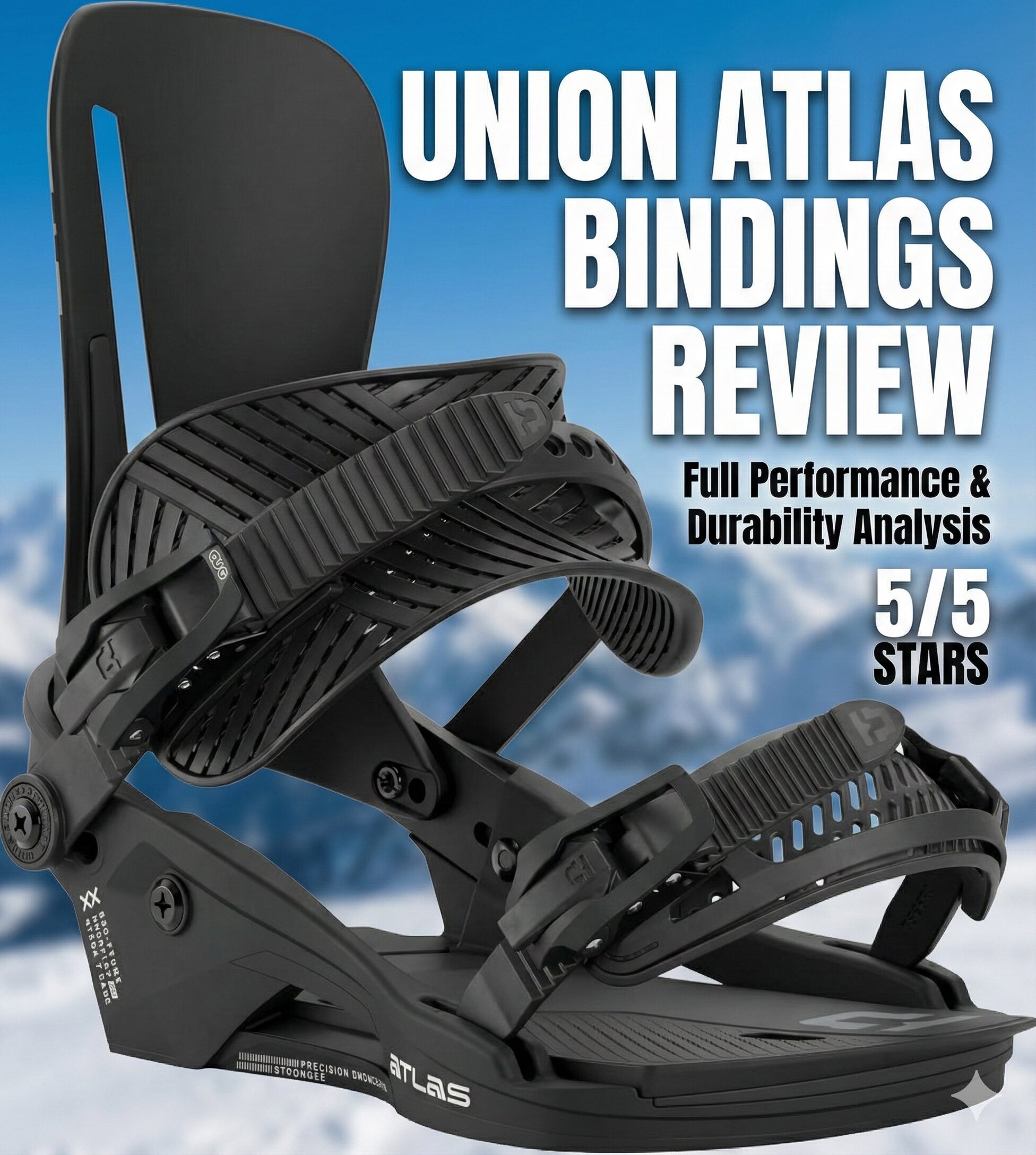
Union Atlas Bindings Review: The All-Mountain Powerhouse
If you have spent any time in a lift line over the past decade, you have undoubtedly seen the “U” logo stamped on the heel cups of countless riders. Union Binding Company has cemented itself as the undisputed king of snowboard bindings, and sitting atop their all-mountain throne is the Union Atlas. For years, the Atlas has been the go-to choice for pros like Kazu Kokubo and Arthur Longo—riders known for going massive, carving hard, and demanding absolute precision from their gear.
But the Atlas isn’t just a pro-model stiff plank. It has evolved. The latest iteration brings the Stage 7 Duraflex CB baseplate to the masses, promising a blend of carbon-infused response and dampening that was previously reserved for the ultra-expensive “FC” (Forged Carbon) lines. This review dissects whether the Atlas is simply a stiff binding for aggressive riders or if it offers enough versatility for the daily driver.
We will break down the molecular composition of the baseplate, the ergonomics of the straps, and exactly how it feels when you lay down a Euro-carve on hardpack. If you are tired of mushy bindings that wash out at speed, or if you are looking to upgrade from a soft park binding to something that can handle the whole mountain, this deep dive is for you. Before we start, if you are unsure about your stance or setup, check out our guide on camber vs rocker to see what board pairs best with this beast.
Who is the Union Atlas For? (The Target Rider)
The Atlas is not a beginner binding. Let’s be clear about that. It is designed for the Intermediate to Expert rider who values response above all else. If you are still learning to link turns, this binding might feel unforgiving because every twitch of your muscle is transferred instantly to the board edges.
This Binding is For You If:
- You Ride Fast: You need a binding that doesn’t chatter or flex when you are bombing groomers at 50mph.
- You Love Carving: You want to lay trenches. The stiffness of the Atlas allows for incredible edge hold and power transfer. Learn more about how to carve on a snowboard to maximize this potential.
- You Ride Bigger Boards: Stiffer, longer boards require stiffer bindings to drive them. The Atlas pairs perfectly with freeride decks.
- You Jump Big: You need a stable platform for landings. The baseplate is robust enough to handle heavy impacts.
Who Should Avoid It? Pure jibbers and rail riders. While you can ride park with the Atlas (Arthur Longo certainly does), the stiffness makes tweaking grabs and buttering significantly harder than with a softer binding like the Union Strata. If you want a surfy, loose feel, look elsewhere.
Tech Specs & Materials
Union manufactures everything in-house at “The Box” in Italy, ensuring zero tolerance for error. The Atlas is a showcase of their advanced material engineering.
| Component | Material / Technology |
|---|---|
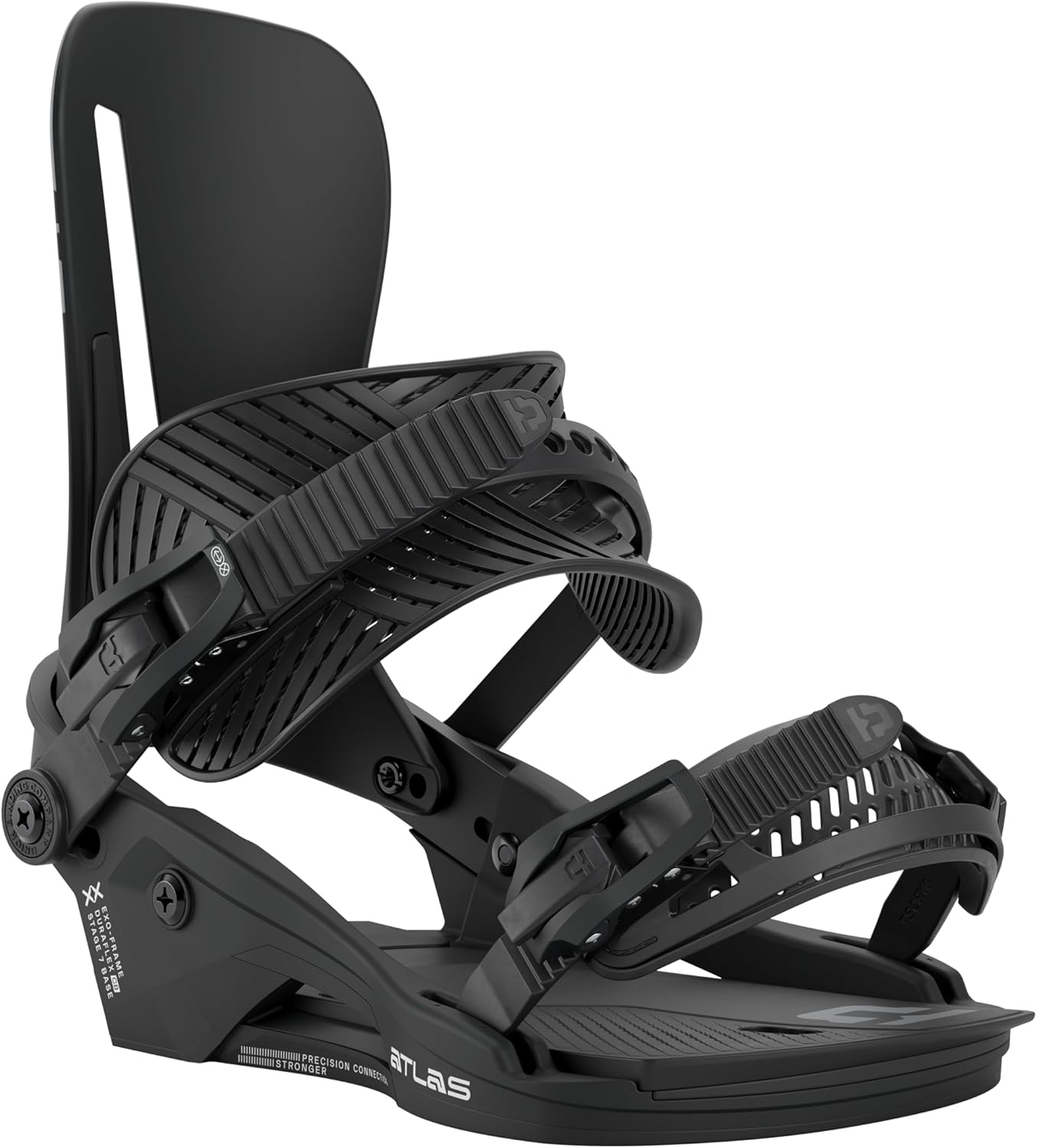
| Baseplate | Stage 7 Duraflex CB (Carbon Blended) |
| Bushing | Vaporlite HD (High Density) |
| Heelcup | Extruded 3D Aluminum |
| Highback | Atlas Duraflex CB |
| Ankle Strap | Exoframe 3.0 |
| Toe Strap | TS 2.0 Tiles |
| Ratchets | Magnesium S1 with Aluminum Base |
| Disk Type | Camber Disk (Compatible with 4×4, 2×4, and Channel) |
| Flex Rating | 8/10 (Stiff) |
The Power of Stage 7 Duraflex CB
The magic of the Atlas lies in the “CB” – Carbon Blended nylon. Standard bindings use pure nylon or fiberglass blends. By injecting carbon fiber into the Duraflex nylon, Union creates a baseplate that is incredibly stiff and responsive but significantly lighter than traditional materials.
This stiffness means that when you lean into a toe-side turn, there is zero lag. The energy transmission is instantaneous. However, unlike pure carbon fiber which can feel brittle and “twitchy,” the nylon blend retains enough dampening to absorb the chatter of uneven terrain. It is the perfect balance for aggressive all-mountain riding.
The Vaporlite HD Bushing: Sitting between that stiff baseplate and your board is a high-density foam bushing. This does two things: it dampens vibrations (saving your knees) and it allows the board to flex naturally underfoot, preventing the “dead spot” common in stiff bindings.
Atlas Duraflex CB Highback: Locked and Loaded
The highback on the Atlas continues the Carbon Blended theme. It is rigid. If you try to twist it laterally with your hands, it barely moves. This is exactly what you want for heelside response. When you drive your calf into this highback, the board engages immediately.
It features a tool-less forward lean adjuster that is integrated seamlessly into the design. It’s easy to adjust on the fly if you want to crank it forward for a pipe run and back it off for the lift line. The ergonomic shape follows the contour of your boot, and the minimal padding ensures there is no wasted energy compressing foam before the binding reacts. Make sure you pair this with a supportive boot; check our guide on best snowboard boots for recommendations.
Exoframe 3.0 & TS 2.0 Straps
Ankle Strap: The Exoframe 3.0 is a multi-layered, injection-molded strap. It has no stitching, which means it cannot absorb water and freeze, nor can threads unravel. It is wide and supportive, spreading pressure evenly across the boot to prevent pressure points. It feels stiff and locked-in, contrasting with the cushy “pillow” straps of freestyle bindings.
Toe Strap: The TS 2.0 Tiles strap is thermoplastic anti-slip material. It can be positioned over the top of the foot or over the toe cap. Most riders prefer the toe cap position as it pulls the boot back into the heel cup. The material grips the boot rubber aggressively—once it’s ratcheted down, it does not move.
Performance on Snow
How does all this tech translate to the mountain?
Carving
This is where the Atlas earns its paycheck. On hardpack and ice, the edge hold is phenomenal. You can trust the binding to hold a high-speed line without washing out. The canted footbeds align your knees and ankles, allowing you to drive more power into the turn with less fatigue.
Freeride & Powder
In deep snow, the response is excellent for navigating tight trees or technical chutes. When you need to make a split-second adjustment to avoid a rock or tree well, the Atlas obeys instantly. It’s a reliable companion for backcountry snowboarding missions.
Shock Absorption
Despite being a stiff binding, the Vaporlite HD bushings do a remarkable job of smoothing out the ride. It isn’t a “cushy” ride like the Strata, but it takes the harsh edge off landing jumps or riding through chunder.
Union Atlas vs. The Competition
Union Atlas vs. Union Force
The Union Force is the legendary workhorse. It is slightly softer and uses standard Duraflex (no carbon blend).
Verdict: Choose the Force if you want to save money and ride more park. Choose the Atlas if you want maximum response and speed.
Union Atlas vs. Union Strata
The Strata uses a Mini-Disc and softer bushings for a surfy feel.
Verdict: Strata for park/buttering/playfulness. Atlas for charging/carving/steeps. Read our full Union Strata review for a deeper comparison.
Union Atlas vs. Burton Cartel X
The Cartel X is Burton’s direct competitor. It is also very stiff and responsive.
Verdict: The Atlas baseplate is more adjustable (heel cup slides) than the Cartel X, making it easier to center different boot brands.
Pros & Cons Summary
Pros
- Incredible response and power transfer.
- Duraflex CB material is light and bombproof.
- Canted footbeds reduce knee fatigue.
- Magnesium ratchets are smooth and durable.
- Adjustable heel cup for perfect centering.
Cons
- Too stiff for beginners or pure jibbers.
- Forward lean adjuster can be tricky to use with gloves.
- Price point is high (but worth it).
Setup & Compatibility
The Atlas uses a Camber Disk. This is compatible with:
- Standard 4×4 Insert Pattern
- 2×4 Insert Pattern
- The Channel (Burton Boards)
Pro Tip: When setting up, always center your boot first by adjusting the aluminum heel cup. Loosen the screws on the side of the binding, slide the heel cup in or out until your boot overhang is equal on toe and heel, then lock it down. This ensures you have equal leverage for turning.


 Home
Home
 About
About
 My Cart
 Reviews
 Compare