
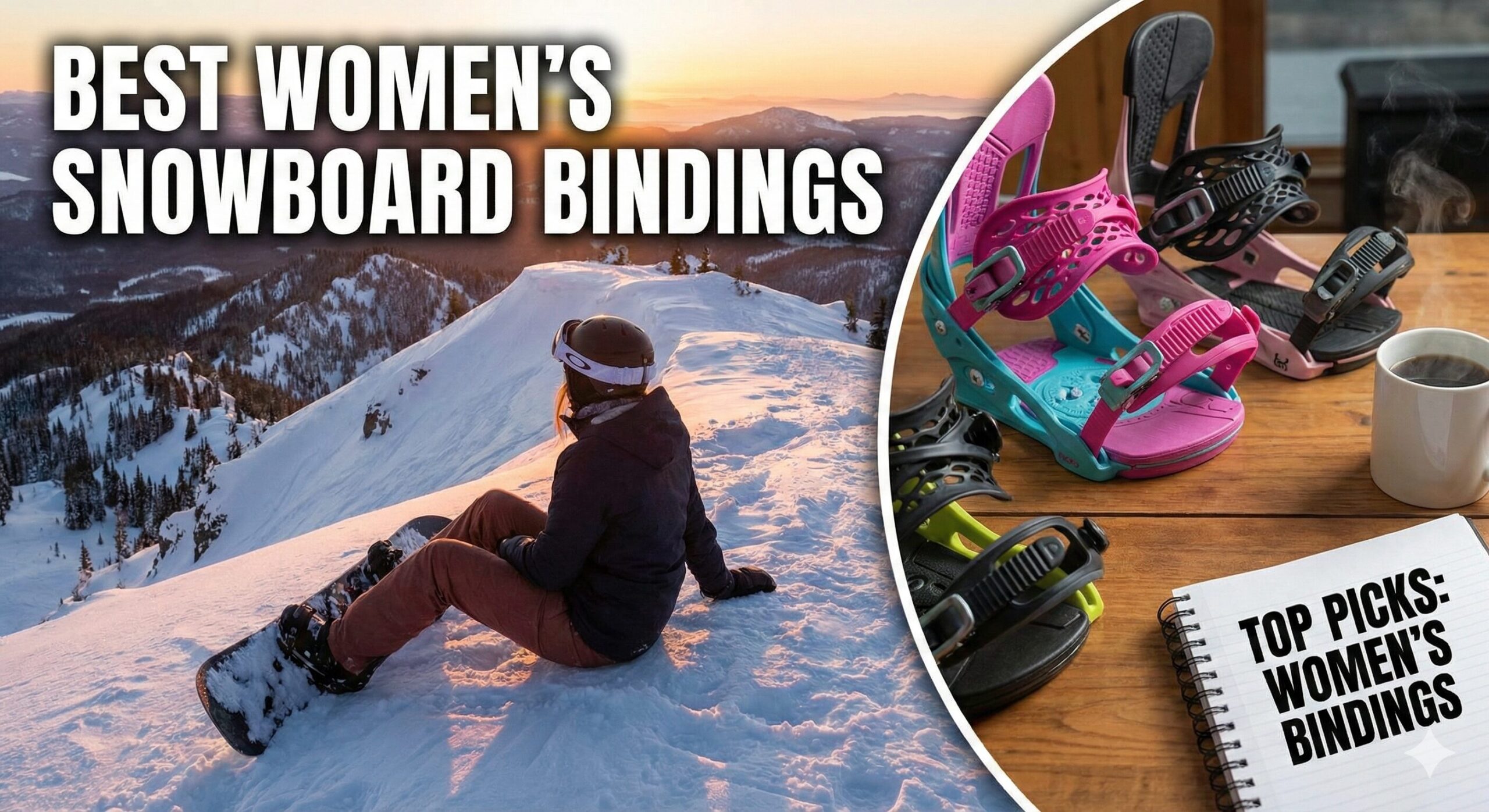
For years, the snowboard industry operated on the “shrink it and pink it” philosophy—taking men’s gear, making it smaller, painting it pastel, and calling it a women’s product. Fortunately, in 2026, those days are long gone.
Modern women’s bindings are engineered from the ground up to match female biomechanics. They feature lower highbacks to accommodate lower calf muscles, specific flex patterns for lighter weight ratios, and narrower heel cups for secure boot fit. Choosing the right binding is the critical link between your body and your board; get it right, and your board feels like an extension of your mind.
Why do women’s bindings have shorter highbacks? Biologically, women’s calf muscles sit lower on the leg than men’s. A men’s highback often digs into a woman’s calf, causing pain and forcing an upright stance. Women-specific highbacks feature a distinct “U” shape or shorter profile to provide response without the bite.
1. Union Trilogy
Best Overall
The Gold Standard for All-Mountain Performance
If you walk into the locker room of any major slopestyle contest or look at the setups of backcountry guides in Alaska, you will see one binding dominate the field: the Union Trilogy. It has earned its reputation not through flashy gimmicks, but through bombproof reliability and a flex pattern that feels “just right” for 90% of riding scenarios.
The “Duraflex ST” Difference:
The core of the Trilogy’s performance lies in the “Stage 4 Duraflex ST” baseplate. “ST” stands for Super Tough. Union blends nylon with more fiberglass than their standard bindings, creating a base that is incredibly responsive edge-to-edge but retains enough torsional flex to be playful when you want to tweak a grab. Unlike carbon-injected bases which can feel brittle and “chattery” on hard ice, the Duraflex material dampens vibrations, acting like a suspension system for your feet. After a long day of riding chopped-up groomers, your feet will thank you.
Strap Tech & Comfort:
For 2026, the updated Exoframe 6.0 Ankle Strap is a masterpiece of minimalism. It uses a multi-layered geometric shape that acts as a suspension system over your boot. Because there is no stitching or padding to pack out, the response remains consistent from day 1 to day 100. It molds perfectly to the shape of your boot, eliminating the “pressure bite” over the instep that plagues cheaper bindings. Paired with the magnesium ratchets (which are lighter and stronger than aluminum), strapping in feels mechanical, smooth, and secure.
On-Snow Feel:
Ride them, and you’ll notice the Canted Footbeds immediately. The footbed is angled slightly inward (3 degrees), aligning your knees and ankles in a more natural stance. This reduces joint fatigue and allows you to drive more power into the nose and tail of the board for ollies. Whether you are laying deep trenches on morning corduroy or navigating tight tree runs where split-second reaction time is key, the Trilogy feels like an extension of your body. It disappears underneath you—which is the highest compliment you can pay a binding.
Pros
- Bombproof durability (Lifetime baseplate warranty).
- Magnesium buckles never freeze or stick.
- Canted footbeds save your knees.
- Responsive without feeling “twitchy.”
Cons
- Pricey investment for casual riders.
- The stiff heel cup can be tricky to adjust perfectly.
If you love the Union brand but want something softer for park riding, you might also consider the Union Legacy bindings, which offer a more surfy feel.
Check Price on Amazon2. Burton Step On Re:Flex
Best Convenience
The Revolution Is Here to Stay
When Burton first launched the Step On system, skeptics called it a gimmick. Years later, those skeptics are eating their words while Step On riders are already halfway down the mountain before the strap-in crew has even sat down. This isn’t just about speed; it’s about a fundamental shift in how energy is transferred from boot to board.
How It Works (The Mechanics):
The system relies on three connection points: two toe hooks and one heel cleat. When you step in, the heel cleat locks into the highback first, followed by the toe hooks engaging with the sides of the boot. Because the boot is mechanically anchored to the highback, there is zero “play” or lag. When you lean back on your heel edge, the response is instantaneous. There are no straps to stretch or loosen. This creates a ride that feels incredibly precise, almost like driving a sports car with stiff suspension.
The “Re:Flex” Advantage:
Burton uses their “Re:Flex” baseplate technology here, which removes the rigid materials from under your foot and replaces them with cushioning. This allows the board to flex naturally under the binding, rather than creating a “dead spot” of rigid plastic. This is crucial for Step Ons, as the direct connection could otherwise feel too harsh. The cushioning smooths out the ride, making it enjoyable for all-day cruising.
Living With Step Ons:
The learning curve is surprisingly short. You will likely struggle the first 3 times you try to get in, but by the end of day one, it becomes muscle memory. Getting out is equally easy—lift the lever on the highback, lean forward, and step out. This system is a game-changer for riders who ski with friends (no more making skiers wait), instructors who need to get in and out constantly, or older riders who find bending over to strap in painful on their back. It keeps your butt off the cold snow, keeping you warmer and drier throughout the day.
Pros
- Unbeatable convenience and speed.
- Zero pressure points (no straps cutting off circulation).
- Direct energy transfer improves heel-side turns.
- No loose straps to step on while skating.
Cons
- Must buy specific Step On boots ($$$).
- Deep powder entry requires practice (clearing snow).
- Cannot adjust forward lean on the fly.
Before investing in this system, it is crucial to understand the trade-offs. Read our deep dive on Burton Step On Bindings: Pros and Cons to see if they fit your riding style.
View Step On Collection3. Burton Lexa X Re:Flex
Best Freeride
For The Rider Who Charges Hard
The standard Burton Lexa has been a staple for decades, but the Lexa X takes the platform and injects it with steroids. This binding is not for the timid. It is stiff, reactive, and designed for women who ride fast, jump big, and demand absolute control in high-consequence terrain.
The “Heel Hammock” Tech:
The secret sauce of the Lexa X is the Heel Hammock. Look closely at the highback, and you will see a rubberized, suspended mesh sitting inside the plastic frame. This hammock grips the heel of your boot like a vice. It provides such incredible hold that you can actually ride with your ankle straps slightly looser than normal for comfort, without sacrificing any response. When you lean into a heel-side turn on steep ice, the Hammock locks you in, ensuring zero lag between your movement and the board’s edge.
Double Take Buckles & Asym Strap:
Burton’s “Double Take” buckles are an engineering marvel. They use helical teeth on the ladder straps (teeth on both sides) which allows for immediate engagement. You don’t have to fish around to get the buckle to catch; it grabs instantly and cranks down fast. The Asym Hammockstrap ankle strap is minimal but supportive. It can be flipped—wear it one way for more power, or flip it for more mobility during park laps. This customizability allows expert riders to fine-tune the binding to the day’s conditions.
Damping & Comfort:
Despite its stiffness, the Lexa X is surprisingly comfortable thanks to the B3 Gel cushioning in the footbed. This is the same gel found in high-end running shoes, designed to withstand impacts without breaking down in cold temperatures. If you overshoot a jump or ride through chattery frozen crud, the B3 Gel eats the vibration so your knees don’t have to.
Pros
- Unmatched edge hold and response.
- Heel Hammock improves comfort and grip.
- Best-in-class ratchet system.
- B3 Gel saves your knees on hard landings.
Cons
- Unforgiving for beginners (catch edges easily).
- Stiff flex can feel harsh at slow speeds.
4. Jones Aurora
Best Surf Feel
The Science of SKATETECH
Jones (founded by freeride legend Jeremy Jones) doesn’t do “normal.” The Aurora binding features SKATETECH technology, originally licensed from NOW Bindings. Instead of a static baseplate screwed flat to the board, the binding sits on a central kingpin—exactly like the trucks on a skateboard. This allows the binding to rock back and forth, transferring energy directly from your foot to the board’s edges through four rubber bushings.
Why Different is Better:
The result of this tech is a ride that feels incredibly “surfy” and efficient. Because the hanger pivots, you don’t have to press as hard to engage a turn. This significantly reduces foot fatigue. You can ride longer, harder days because the binding is doing the mechanical work for you. It excels in powder, where that subtle rocking motion allows for smooth, fluid slashes that feel more like surfing water than riding snow.
Customizable Bushings:
The Aurora comes with interchangeable bushings (Soft and Hard).
Surf Mode (Soft): Put the soft bushings in for maximum tweakability. This setup allows the binding to roll deeply, perfect for powder days and creative riding.
Freeride Mode (Hard): Swap in the hard bushings for a direct, responsive feel. This is ideal for technical steeps or icy days where you need instant edge engagement. Essentially, you are getting two bindings for the price of one.
The “Halo Hanger 3.0” base is wider than previous iterations, accommodating wider modern snowboard boots without pinching. The Intelligent Straps (which flop open when unbuckled) make stepping in easy, preventing you from stepping on your straps in the lift line.
Pros
- Reduces foot fatigue significantly.
- Unique surf-like sensation in turns.
- Two modes (Surf/Freeride) add versatility.
- Straps stay open for easy entry.
Cons
- Heavier than traditional bindings.
- Setup is more complex (kingpin adjustment).
5. Union Rosa
Best Budget / Beginner
Lightweight Progression
There is a misconception that “budget” means “bad.” The Union Rosa proves this wrong. It is consistently one of the lightest bindings on the market, regardless of price point. For a beginner rider, removing weight from your feet makes learning to turn, stop, and maneuver the board significantly easier physically. Less weight means less fatigue, which means more runs.
Forgiveness is Key:
The Rosa features a soft flex rating (around 4/10). Why do you want this? When you are learning, you make mistakes. You might lean too far back or twitch your foot. A stiff binding would instantly transfer that mistake to the board, causing you to catch an edge and slam. The Rosa’s softer highback and baseplate offer a bit of “give,” smoothing out those inputs and keeping you upright. It is forgiving, playful, and confidence-inspiring.
Thermoformed EVA Bushings:
Underfoot, Union uses a Thermoformed EVA bushing system. Unlike paint-dipped baseplates found on other cheap bindings, this EVA foam provides genuine shock absorption. It dampens the vibrations from rough snow, preventing that “rattling bone” feeling in your feet. It also allows for true board flex, meaning the binding won’t create a dead spot in the middle of your snowboard, helping you learn how to flex and pop the board properly.
Aluminum vs. Plastic:
Even at this entry-level price, Union equips the Rosa with Aluminum ratchets. Most competitors in the sub-$180 range use plastic ratchets that strip and break in the cold. Union’s commitment to using aluminum here ensures the binding will last for multiple seasons of progression, giving you incredible value for money.
Pros
- Incredible value for the quality.
- Forgiving flex helps beginners learn faster.
- Aluminum buckles (rare at this price).
- Extremely lightweight.
Cons
- Not stable at high speeds (get chatter).
- Minimal padding on ankle straps.
- Simple highback lacks advanced adjustment.
For a complete breakdown of why this is the ultimate starter binding, check our full Union Rosa Bindings Review.
Check Low PriceThe Complete Buyer’s Guide: Setup & Fine Tuning
Buying the binding is step one. Setting it up correctly is step two. Even the most expensive binding will feel terrible if it isn’t adjusted to your specific boots and riding style. Here is what you need to know beyond just “Small, Medium, or Large.”
1. The “Q-Angle” Factor & Canting
Women generally have wider hips than men relative to their knees. This creates a steeper angle from the hip to the knee, known as the Q-Angle. When you strap into a snowboard with a wide stance, this angle puts significant stress on the outside of your knees.
Look for Canted Footbeds: Bindings like the Union Trilogy or Burton Lexa X feature footbeds that are angled inward (usually 2.5 to 3 degrees). This subtle tilt aligns your ankle, knee, and hip joints in a straight line. It creates a more natural standing position, allowing you to ride longer without joint pain and giving you more leverage over the nose and tail of the board.
2. Highback Rotation: The Pro Secret
Most riders bolt their bindings on and go. But pro tuners know about Highback Rotation. Your feet are angled (e.g., +15° / -15°), but your board’s edge is straight. If you don’t rotate your highbacks, they will be misaligned with your heel edge, losing power.
The Fix: Almost all premium bindings allow you to rotate the highback independently of the baseplate. You want to rotate them so the back of the binding is parallel to the heel edge of your snowboard. This ensures that when you lean back, 100% of your energy goes into the edge, rather than twisting the binding frame.
3. Mini-Disc vs. Full-Size Disc
You will see terms like “Mini-Disk” (Union) or “Re:Flex” (Burton).
Standard Full Discs: Offer maximum stability and response. They feel solid but create a “dead spot” underfoot where the board cannot flex naturally.
Mini-Discs: Reduce the contact footprint. This allows the board to flex more naturally under your feet, providing a “surfier” feel and better board feel on rails. However, Mini-Discs are generally not compatible with the older 4×4 insert patterns found on cheap or vintage boards.
A common mistake for women is setting the stance too wide, which limits your ability to flex the board.
Park/Freestyle: Slightly wider than shoulder width (stability).
Freeride/Powder: Slightly narrower or set back (float).
The Test: Jump down from a small step. Where your feet land naturally to catch your weight is usually your ideal stance width.
Frequently Asked Questions
Over the toes (Cap Strap). 99% of modern bindings are designed this way. Placing the strap over the front of your boot toe pushes your heel back into the heel cup, locking you in securely. Placing it on top of your foot (old school style) crushes your toes, cuts off circulation, and causes cold feet.
When your boot is strapped in, you should have equal overhang on the toe and heel side. If your toes hang way over, you will catch them in the snow when carving (“toe drag”).
The Fix: Most bindings have an adjustable heel cup (Union) or an adjustable gas pedal/footbed (Burton). Slide these forward or backward until your boot is perfectly centered over the board’s width.
Yes. Plastics degrade over time due to UV exposure and cold cycles. A binding that is 10+ years old is a safety risk; the plastic straps becomes brittle and can snap mid-turn. Generally, if you ride 20 days a season, expect 4-5 years of peak performance before straps start wearing out. Aluminum heel cups (like on Union bindings) last essentially forever.
It depends on the hole pattern.
2×4 and 4×4 (Standard): Fits 95% of bindings.
The Channel (Burton): Needs a compatible disk (usually included).
3D Pattern (Old Burton): Requires a specific 3D disk that is rarely included in new boxes; you usually have to order it separately from the manufacturer.
This usually happens when snow gets between the binding and the board, or the hardware loosens. Remove the binding, dry everything thoroughly, and re-tighten the screws. Adding a tiny bit of wax to the mounting disk can also silence the plastic-on-board friction.


 Home
Home
 About
About
 My Cart
 Reviews
 Compare