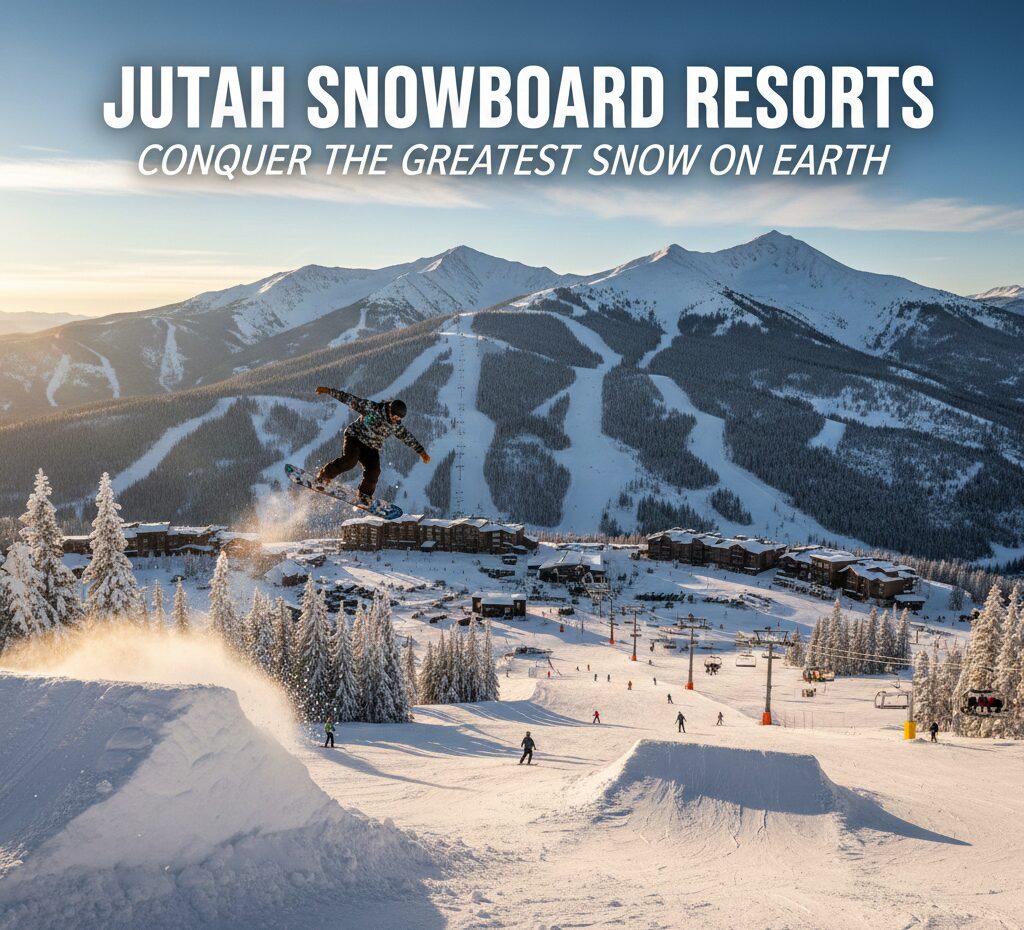
Utah Snowboard Resorts: Conquer The Greatest Snow on Earth
From the massive terrain of Park City to the legendary steep and deep of Snowbird, this guide unlocks the best Utah snowboard resorts for every type of rider.
1. Why Utah’s Snow is Legendary: The Lake Effect
Utah’s claim to “The Greatest Snow on Earth” is backed by science. Storms sweep across the Great Salt Lake, picking up moisture that falls as ultra-light, low-density powder on the Wasatch Mountains. This creates an average of 500 inches of annual snowfall with a moisture content often below 8%—making it some of the driest, most forgiving powder in the world. It’s not just marketing; it’s meteorology.
Pro Tip: Utah’s dry snow is perfect for learning to ride powder. It’s less dense and more forgiving than coastal snow. A good all-mountain board with a directional twin or directional shape works wonders here. For more on choosing the right profile, check out our guide on camber vs rocker snowboard profiles for control and float.
2. When to Go & What to Expect
The season runs from mid-November to late April. Prime time is January through March, with the deepest base and most frequent storms. February is typically the snowiest month. Spring riding in March and April offers longer, sunnier days and corn snow. Crowds peak around holidays (Christmas, New Year’s, President’s Day). For fewer crowds and good snow, target late January or early March.
3. Resort Overview: The Big Players
Utah’s resorts are concentrated in two main areas: The Park City Area (east of Salt Lake City) and Little Cottonwood & Big Cottonwood Canyons (southeast of SLC). Park City offers convenience and massive interconnected terrain. The Cottonwood Canyons deliver the steepest, deepest, and most challenging terrain, but are subject to canyon road closures during storms.
4. Park City Mountain: The Colossus
As the largest resort in the US (over 7,300 acres), Park City Mountain (PCMR) is a behemoth. It’s actually two historic mountains (Park City and Canyons) connected by a gondola. You’ll find everything: perfectly groomed cruisers, massive beginner areas, eight world-class terrain parks, and hidden powder stashes in the trees. The town of Park City is a major perk, with top-tier dining, lodging, and apres.
Park City Mountain Quick Facts
Best For: Everyone, especially intermediates, park riders, and those who want a vibrant town.
Terrain: 7,300+ acres, 17% Beginner, 44% Intermediate, 39% Advanced.
Pass: Epic Pass.
Vibe: Upscale, bustling, convenient.
5. Deer Valley: Skiers Only (A Note for Snowboarders)
Deer Valley is a world-class, luxury ski resort that does not allow snowboarding. It’s important to know this when planning, as it’s a major resort in the Park City area. Snowboarders should focus their attention on the other incredible resorts that welcome us.
6. Snowbird: The Expert’s Playground
Snowbird is legendary for its steep, technical terrain, deep powder, and long vertical drops. The tram accesses 3,240 vertical feet of some of the most challenging in-bounds terrain in North America. It’s less about parks and more about big-mountain riding. Mineral Basin offers expansive, sun-soaked advanced terrain. The snow here is often the deepest in the state. Not for the faint of heart.
7. Alta: Another Skiers-Only Sanctuary
Adjacent to Snowbird, Alta is also skiers-only. However, it’s worth mentioning because a combined Alta-Snowbird pass exists for skiers, and snowboarders staying nearby may have friends who ski. For snowboarders, the terrain between the two resorts is not interconnected for us.
8. Brighton & Solitude: The Local Favorites
Located in Big Cottonwood Canyon, these sister resorts (on the Ikon Pass) offer a more laid-back, local vibe with fantastic terrain.
Brighton is a snowboarder’s paradise. It’s incredibly beginner-friendly yet has gnarly advanced terrain in the Milly Bowl and Snake Creek areas. The night riding is some of the best in the country, and the park scene is strong.
Solitude lives up to its name. It’s quieter, with fantastic tree skiing and a charming European-style village. Honeycomb Canyon offers serious advanced terrain that often holds powder days after a storm.
9. Snowbasin & Powder Mountain: The Northern Gems
About an hour north of Salt Lake City, these resorts offer a different experience.
Snowbasin (Ikon Pass) is opulent, with stunning lodges and Olympic legacy. The terrain is vast and varied, with incredibly long, groomed runs and challenging chutes. Crowds are minimal.
Powder Mountain (Independent) is the anti-resort. It limits daily lift ticket sales, preserving its 8,464 acres of raw, untracked terrain. A true adventure, with cat-skiing and hike-to terrain that makes you feel like you’re in the backcountry. A must for purists seeking solitude.
Local Secret: Powder Mountain’s vibe is unmatched. To truly experience it, plan to stay nearby in Eden or Ogden Valley. The lack of crowds and abundance of untouched snow is a throwback to snowboarding’s golden era.
10. Ikon vs. Epic Pass: Choosing Your Access
Your pass choice dictates your resort access. The Epic Pass gives you Park City Mountain. The Ikon Pass gives you access to Snowbird, Brighton, Solitude, Snowbasin, Alta (skiing only), and Deer Valley (skiing only). Many Utah locals opt for the Ikon Base Pass or the Mountain Collective (which includes Snowbird and Alta). If you’re visiting for a week, crunch the numbers—a multi-resort pass often pays for itself.
11. Transportation & Staying: SLC vs. Park City
Staying in Salt Lake City (SLC): More affordable, with endless dining options. You’ll have a 30-60 minute drive up the canyons each morning. Check canyon road conditions (UDOT Cottonwoods) before you go—4WD/traction laws are strictly enforced during storms.
Staying in Park City: More expensive, but you can often walk to lifts or take free buses. Ideal for accessing PCMR and a more immersive resort experience.
Renting a car is recommended for flexibility. The best ski and snowboard racks can make shuttling gear with a group much easier.
12. Pro Tips & Local Secrets for Your Trip
1. Start Early: Utah powder gets tracked out by midday. Be on the first lift.
2. Respect the Canyon Closures: If UDOT closes Little or Big Cottonwood for avalanche control, don’t try to go up. Wait it out.
3. Altitude Hydration: You’re at 7,000-11,000 feet. Drink twice as much water as you think you need.
4. Sunscreen is Non-Negotiable: High altitude + sun reflection off snow = instant burn.
5. Explore Beyond the Obvious: At Park City, venture into the Canyons side. At Snowbird, don’t miss Mineral Basin.
6. Après Scene: Hit the Hog Wallow Pub near Brighton, or No Name Saloon in Park City.
Final Advice: Utah delivers a snowboarding experience that balances epic terrain with surprising convenience. Whether you’re hunting for steep chutes, perfect park laps, or endless powder fields, you’ll find it here within an hour of a major airport. That’s the magic of the Wasatch.
Utah Snowboard Resorts: Your Questions Answered
What is the best Utah resort for snowboarders?
It depends. Park City Mountain is best for overall variety, parks, and town life. Brighton is the local snowboarder favorite with a great vibe and night riding. Snowbird is for experts seeking steep, deep terrain. Powder Mountain is for adventure and untracked lines.
Can you snowboard at Alta or Deer Valley?
No. Both Alta and Deer Valley maintain a skiers-only policy. They are two of the last major resorts in the US with this restriction. Snowboarders should focus on the many other incredible resorts that welcome us.
Which is better, the Ikon or Epic Pass for Utah?
If you want to ride Park City, you need the Epic Pass. If you want to ride Snowbird, Brighton, Solitude, and Snowbasin, you need the Ikon Pass. If you have time, you could buy both or get individual lift tickets.
Is it better to stay in Salt Lake City or Park City?
SLC is cheaper and closer to the Cottonwood Canyon resorts (Snowbird, Brighton, etc.). Park City is more expensive but offers ski-in/ski-out convenience and a vibrant walkable town. Choose based on which resorts you plan to ride most.
How bad are the crowds in Utah?
Park City and the Cottonwoods can get very crowded on weekends and holidays. To avoid crowds: ride on weekdays, start early, head to less popular resorts like Solitude or Snowbasin, or explore the further reaches of each mountain.
Do I need a 4×4 vehicle to get to the resorts?
During or immediately after a storm, yes. Utah law requires 4WD or approved traction devices (snow chains/tires) in the Cottonwood Canyons. If you don’t have 4WD, you may be turned around. For Park City, the roads are generally well-plowed and less restrictive.
What’s the best time of year for powder in Utah?
January and February are the most reliable months for consistent powder days. The “January thaw” is less pronounced in Utah, so conditions stay cold and dry. March can also have epic powder storms, especially in the higher elevations of Snowbird.
Are there good terrain parks in Utah?
Absolutely. Park City Mountain has one of the world’s best park systems. Brighton has innovative parks and a dedicated culture. Even Snowbird has a decent park. Utah is a top destination for park riders.
Can beginners have fun at Utah resorts?
Yes! Park City and Brighton have massive, well-groomed beginner areas. The easy runs are wide, gentle, and meticulously maintained. Utah’s dry snow is also softer to fall in. Don’t be intimidated.
How does Utah compare to Colorado for snowboarding?
Utah generally has drier, lighter snow and resorts are closer to the airport (SLC). Colorado has more high-alpine terrain and a wider variety of massive resort towns. Both are world-class. Utah wins on snow quality and convenience; Colorado wins on sheer number of huge, iconic resorts.


 Home
Home
 About
About
 My Cart
 Reviews
 Compare