
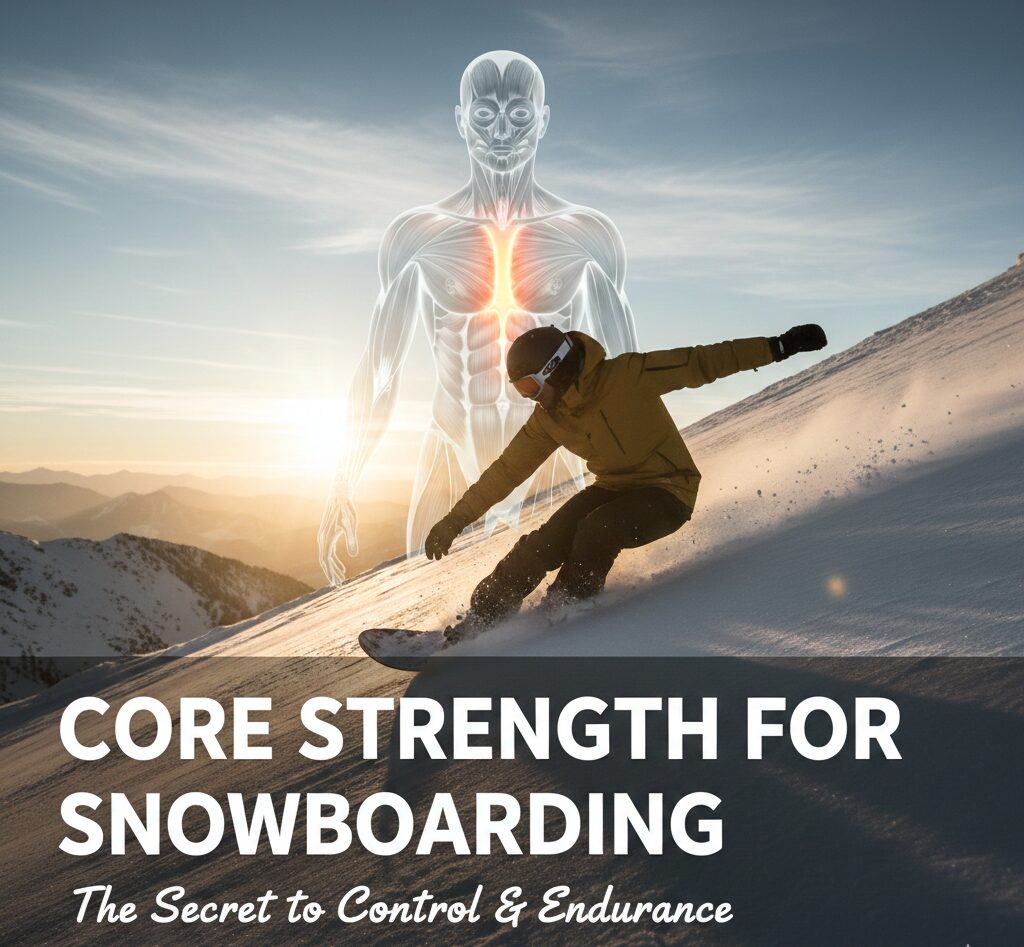
Core Strength for Snowboarding: The Secret to Control & Endurance
Stop getting thrown off balance. A strong, reactive core is the difference between fighting your board and flowing down the mountain. This guide builds the foundation.

1. Why Core Matters Most: It’s Your Control Center
Snowboarding is a constant battle against rotational forces. Your core—everything from your hips to your ribs—is the vital link between your upper and lower body. It transfers energy from your legs to your board, stabilizes you during turns, absorbs landings, and keeps you balanced in variable terrain. A weak core leads to over-reliance on your legs (causing fatigue), back pain, and poor board control.
The Truth: Core strength isn’t about six-pack abs. It’s about functional stability—the ability to resist unwanted movement and generate power efficiently. This is what lets you carve on a snowboard with proper edge control and angulation.
2. Anatomy of Your Snowboard Core: Beyond the Abs
You must train the entire system:
Anterior Core: Rectus abdominis (the “six-pack”), responsible for flexion.
Lateral Core: Obliques (internal and external), critical for twisting and resisting side-to-side movement.
Posterior Core: Erector spinae, glutes, and lats – these stabilize your spine and power your posture.
Deep Core: Transverse abdominis and pelvic floor, your body’s natural weight belt.
Neglecting any part creates imbalance and instability.
3. Pre-Season Foundation: Building from the Ground Up
Start 8-12 weeks before your first trip. Focus on compound movements that build overall stability: planks (all variations), dead bugs, bird-dogs, and glute bridges. Consistency beats intensity. Aim for 3 short sessions per week (20-30 minutes) rather than one long, exhausting workout. This builds the muscular endurance you need for full days on the mountain.
Foundational Exercise: The Dead Bug
Why: Teaches pelvic stability while moving opposite limbs, mimicking the independent motion of snowboarding.
How: Lie on your back, arms extended to ceiling, knees bent at 90°. Slowly lower right arm and left leg toward the floor while keeping your lower back pressed down. Return and switch. Perform 3 sets of 10 per side.
4. Anti-Rotation Exercises: The Key to Stability
Snowboarding isn’t about crunches; it’s about resisting the forces that want to twist you off your board. Anti-rotation training teaches your core to stay solid. The Pallof Press is the gold standard. Stand perpendicular to a cable machine or resistance band anchored at chest height. Hold the handle with both hands at your sternum and press straight out, resisting the pull to rotate. Hold for 3 seconds, return. 3 sets of 12 per side.
5. Rotational Power: For Spins & Quick Turns
Once you can resist rotation, you can control it. Develop explosive rotational power for initiating spins and snapping quick turns. Medicine ball throws (rotational slams, side throws) and cable wood chops are excellent. Focus on generating power from your hips and core, not just your arms. This translates directly to popping off jumps and powerful turn initiation.
6. Stability & Mobility: The Hip Connection
Your hips are part of your kinetic chain. Tight hips force your lower back to compensate, leading to pain and reduced performance. Pair core stability with hip mobility work. Incorporate deep lunges with rotations, pigeon pose, and 90/90 stretches. A mobile hip allows your core to work efficiently. Consider using a balance board for snowboarders to integrate stability and mobility simultaneously.
🔄 Shop Foam Rollers on Amazon7. Balance Training: The Final Integration
Static core work is useless if you can’t apply it on an unstable surface. Integrate balance tools: wobble boards, balance boards (like the Indo Board), or simply standing on one leg while performing movements. Try doing a Pallof press while standing on a balance pad. This directly mimics the unstable platform of a snowboard and trains the reactive muscles that keep you upright.
8. In-Season Maintenance: Keeping the Engine Running
During the season, switch from building strength to maintaining it and promoting recovery. Do two short (15-minute) sessions per week focused on activation and stability. Dynamic warm-ups before riding (leg swings, torso twists, planks) are crucial. Avoid heavy, fatiguing core workouts that will hinder your performance on the mountain the next day.
9. Post-Ride Recovery: Stretch & Reset
Your core muscles get tight from bracing all day. Post-ride stretching is non-negotiable. Focus on: Cat-Cow stretches for the spine, seated twists for the obliques, and figure-four stretches for the glutes and hips. Use a foam roller on your thoracic spine (upper back) to improve rotation and counteract the forward-leaning riding stance. This speeds recovery and prevents injury.
10. Equipment for Home: Minimalist & Effective
You don’t need a gym membership. A few key items are sufficient:
Resistance Bands: For Pallof presses, rotational work.
Medicine Ball (8-12 lbs): For power throws.
Balance Board: For integrated stability training.
Yoga Mat: For comfort during floor work.
Foam Roller: For recovery.
This setup costs less than a single day lift ticket.
11. Common Mistakes That Waste Your Time
1. Only Doing Crunches: Crunches train flexion, which you rarely use snowboarding. Focus on stability.
2. Holding Your Breath: You must breathe! Exhale during exertion to maintain intra-abdominal pressure.
3. Neglecting Your Glutes: Your glutes are part of your posterior core. Weak glutes = back pain.
4. Training to Failure: You want endurance, not maximal strength. Use moderate weight and higher reps.
5. Skipping the Warm-Up: Cold muscles are inefficient and prone to strain. Always activate first.
12. The 15-Minute Pre-Season Sample Routine
Do this circuit 3x per week. Rest 60 seconds between circuits.
1. Dead Bug: 45 seconds on, 15 sec rest.
2. Side Plank with Rotation: 30 sec per side.
3. Glute Bridge March: 45 seconds.
4. Bird-Dog: 45 seconds.
5. Standing Band Pallof Press: 12 reps per side.
Final Word: Building core strength for snowboarding is a year-round investment that pays dividends in every run. You’ll ride longer, with more precision, and with less pain. It’s the single best off-snow training you can do to elevate your on-snow performance. For a complete fitness plan, see our full pre-season snowboard fitness checklist.
Core Strength for Snowboarding: Your Questions Answered
How often should I train my core for snowboarding?
In the pre-season (8-12 weeks before riding), aim for 3 sessions per week. During the season, shift to 1-2 maintenance sessions focused on activation and recovery. Quality and consistency are more important than daily grinding.
What’s the single best core exercise for snowboarding?
The Pallof Press (anti-rotation hold). It directly trains your core’s ability to resist twisting forces, which is exactly what happens when you carve and get hit by variable snow. It builds the stability that prevents you from being thrown off balance.
Will core exercises help prevent back pain while snowboarding?
Absolutely. Most snowboarding back pain comes from a weak posterior core (glutes, lower back) and tight hips, forcing the spine to absorb impact and torque. Strengthening your entire core and improving hip mobility is the best prevention.
Can I build a snowboard-ready core without equipment?
Yes, you can make great progress with bodyweight exercises: planks, side planks, dead bugs, bird-dogs, and hip bridges. To advance, add instability (like doing them on a cushion) or get a simple resistance band for anti-rotation work.
How long until I see results on the mountain?
With consistent training (3x/week), you should feel a noticeable difference in stability and endurance within 4-6 weeks. The feeling of being “connected” to your board and fatiguing less quickly will be the most immediate benefit.
Should I do core workouts on riding days?
Not intense ones. Do a brief activation warm-up (5-10 mins of dynamic stretches and light core engagement) before you ride. Save strengthening workouts for your off days or after riding, focusing on light recovery and stretching instead.
What’s the role of balance boards in core training?
Balance boards force your core (and entire lower body) to make constant micro-adjustments, training reactive stability. This is directly transferable to staying balanced on a snowboard. They are one of the most sport-specific tools you can use.
Are sit-ups or crunches useful for snowboarding?
Minimally. Snowboarding rarely involves spinal flexion (curling forward). You’re far better off spending your time on anti-rotation, stabilization, and rotational power exercises that mimic the actual demands of the sport.
How does core strength help with landing jumps?
A strong, braced core acts like a shock absorber. It transfers the impact force evenly through your body instead of letting it jolt your spine. It also allows you to maintain control and balance in the air to set up for a clean landing.
Can good core strength prevent injuries?
Yes, significantly. A stable core protects your spine from shear forces during falls and awkward landings. It also reduces strain on your knees and ankles by ensuring proper alignment and energy transfer. It’s your body’s best protective armor.


 Home
Home
 About
About
 My Cart
 Reviews
 Compare