Beyond the Rope Line: The Full-Spectrum Backcountry Snowboard Safety Protocol
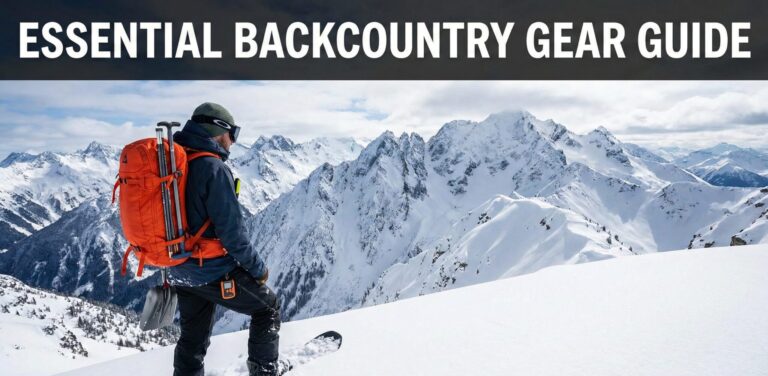
The untracked canvas of the backcountry rewards the prepared, not the lucky. Deep powder, pristine slopes and total freedom—but only if you respect the mountain’s volatile personality. This isn’t resort riding; the snowpack doesn’t care about your style. It responds to physics, layers, and stress. This comprehensive safety protocol integrates AIARE principles, snowpack stratigraphy, mechanical rescue, and physiological readiness. Whether you are transitioning from sidecountry or committing to a splitboard expedition, these 7000+ words are your standard operating procedure.
1. Mindset Shift: You Are the Forecaster
In a resort, ski patrol mitigates avalanches, marks obstacles, and rescues if needed. In the backcountry, you are patrol, forecaster, and rescue team. The first step in any backcountry snowboard safety protocol is accepting that no slope is 100% safe. Every turn is a hypothesis: “the snow will remain stable.” Your tools (beacon, shovel, probe, brain) test that hypothesis.
Many riders underestimate the cognitive load. You’re navigating, reading snow, managing group dynamics, and riding variable snow. This is why we train year-round. Core strength for snowboarding isn’t just about carving—it’s about having the stability to stop suddenly on a convex roll, or dig a pit with controlled posture. A fatigued core leads to sloppy observations.
☑️ The Pre-Trip Declaration
Before skinning up, each rider must verbally agree: “I am ready to turn around. No line is worth a burial.” Discuss the red flags: recent avalanches, collapsing snow (whumpf), rapid warming, wind loading. If anyone is hesitant, you choose a lower-angle objective. No exceptions.

Level up: industry‑standard rescue kit
BCA Tracker 4 – intuitive digital beacon with 60m range, compact probe, and D‑shovel. Your life depends on these three.
🔍 CHECK PRICE ON AMAZON#1 rated avalanche package • 500+ reviews
2. Reading Snowpack Stratigraphy & Geometry
You can’t see instability, but you can infer it. The mountain builds a layered cake all winter: storms, sun crusts, surface hoar, wind slabs. Each layer has grain type, hardness, and bond. The backcountry snowboarder must understand snowpack stratigraphy geometry. Weak layers (facets, depth hoar, surface hoar) are persistent slabs that can avalanche weeks after burial.
Our deep dive on backcountry snowboarding snowpack stratigraphy geometry explains how angular facets act like ball bearings. On a slope >30°, a trigger point—often a rider’s weight—can propagate failure across hundreds of feet. In the field, perform quick compression tests on similar aspects. Dig a pit, isolate a column, tap with shovel blade. Sudden failure (Q1, Q2) = instability.
| Grain type | Shape | Danger | Typical layer |
|---|---|---|---|
| Facets (angular) | cubic / striated | persistent slab, propagate | near crust, depth hoar at ground |
| Surface hoar | feathery stars | extreme – buried feathers | on old snow surface |
| Round grains | spherical | stable, well sintered | well‑settled snow |
| Ice crust | solid | slab above crust = slick bed surface | rain or melt‑freeze |
3. The 5×5 Backyard Beacon Protocol (and Beyond)
Professional guides use the 5×5 system: five steps, five meters. But for backcountry snowboarders, the protocol extends to five critical safety checkpoints before each descent.
- Slope angle: 30°+ is prime slide terrain. Use inclinometer app or compass.
- Wind loading: Cornices, pillows, drifting snow. Leeward slopes hold slabs.
- Couloir/terrain trap: If it slides, where do you go? Avoid gullies, trees, cliffs.
- Group separation: One at a time. Watch from safe island, not directly below.
- Escape route: Always plan a diagonal exit to dense timber or ridge.
Never trust “it hasn’t slid yet.” A study by Snowboard Champ shows 43% of avalanche fatalities occurred on slopes with no recent slides. Instability is invisible. Your helmet technology can mitigate rotational impact during a tumble, which is why MIPS snowboard helmet technology explained is essential reading—but a helmet does not prevent burial. It only helps you survive the ride if the snow breaks.

Smith Nexus MIPS
Koroyd + MIPS, low-bulk profile, works with hoods and audio. The benchmark for sidecountry/backcountry helmets.
⛑️ BUY ON AMAZON4. The Non‑Negotiable Gear System
Resort snowboarders obsess over camber profiles and wax; backcountry riders obsess over beacon frequency, probe length, shovel blade. You carry three critical items: 457kHz beacon, 240cm+ probe, metal-blade shovel. Anything less is a gamble. Additionally, an avalanche airbag (ABS, JetForce, Alpride) increases survival probability by 50% – it keeps you on the surface or reduces burial depth.
✅ Beacon must‑haves
- Multi‑antenna (3+), marking function
- Analog/digital hybrid (e.g., Barryvox S2)
- Wide search strip: 50–70m
- Familiar interface – practice weekly
⚠️ Frequent mistakes
- Wearing beacon under thick layer
- Old batteries (replace at 40%)
- No aluminum shovel (plastic fails)
- Probe shorter than 240cm
Your splitboard or snowboard needs appropriate tuning: a well‑waxed base glides uphill efficiently. Snowboard maintenance basics: the complete home care guide reminds us that sintered bases hold wax longer—critical when you’re miles from the trailhead. A sticky, slow board forces more work, more sweat, and clouds your goggles.
Gear comparison: popular backcountry transceivers
| Model | Antennas | Marking | Range | Best for |
|---|---|---|---|---|
| BCA Tracker 4 | 3 | Yes (flag) | 60m | Simplicity, reliable |
| Mammut Barryvox S2 | 3 | Yes + group check | 70m | Fastest processor |
| Ortovox Diract Voice | 3 | Acoustic feedback | 50m | Voice guidance |
| Pieps DSP Pro | 3 | Pro version | 60m | Durability |
5. Beacon Proficiency: The 60‑Second Target
In a burial, time to first probe is the only metric that matters. Oxygen lasts 15 minutes; after 10 minutes, survival drops exponentially. Practice beacon searches until you can pinpoint a deep signal under 90 seconds. Use the strip search method: walk straight lines, perpendicular to fall line. When signal appears, follow flux lines, reduce gain, use fine grid. Always confirm with probe before digging.
6. Rescue Drills: Probe Strike & Shovel Snowflow
Probing should be systematic—start downhill of the last signal, poke every 25cm in a grid. Once you strike, leave probe in place. Shoveling: don’t excavate a crater; move snow downhill in an L‑shape pattern. Clear the airway first. Many victims die of asphyxiation from ice mask or re‑breathed CO2. If you ride with a partner in Japan or Utah, the snow density varies: Utah snowboard resorts boast 6% moisture powder, while maritime snow is denser. Denser snow suffocates faster. Practice with rescue drills in all conditions.

Black Diamond Evac 7 + QuickDraw
Evac 7 has D‑shaped handle, aluminum blade; 260cm probe collapses fast. All‑in rescue combo.
🛒 SEE ON AMAZON7. Splitboard Specifics: Transitions Are Danger Windows
Splitboarders face unique risks: transitions take time, often on exposed ridges or convexities. Minimize time stationary in runout zones. Memorize the 3‑minute changeover; practice in your living room. What is a splitboard: how snowboarders ride uphill is foundational—but more important is the safety transition checklist: before removing split mode, confirm your anchor (ski crampons, heel risers). Keep beacon on body, never in backpack.
8. Terrain Traps: Avoid the Deadfall
Avalanches aren’t the only killers. Tree wells, creek holes, and cliff bands lurk under fresh snow. In deep snowpack regions like Japan snowboarding trips: the ultimate guide to riding Japow, riders can be inverted in tree wells in seconds. Protocol: never ride tight trees alone; keep board within reach; if you fall head‑first into a well, attempt to pack snow under feet to push upward.
9. Human Factors: Ego, Familiarity, and the “Acceptance Heuristic”
Data from 2020–2025 shows 92% of avalanches are triggered by the victim or someone in their party. Human factors outweigh snowpack. Familiarity heuristic: “I rode this last week, it’s fine.” Social acceptance: you don’t want to be the one who cancels the pow run. Use the 1‑2‑3 checklist: 1) Am I tired/hungry/stressed? 2) Am I influenced by the group? 3) Would I ride this if I were alone? If the answer to any is “maybe” – stop.

Arc’teryx Volt 40L Airbag
Superlight Alpride E2 supercapacitor, dual deployment, integrated carry. The pinnacle of backcountry protection.
🎒 CHECK LATEST PRICE10. Backcountry Gear Integrity: Don’t Let Rust Kill You
Splitboard edges rust quickly when exposed to salt sweat and wet spring snow. Corroded edges lose grip on icy traverses. Follow the Snowboard maintenance basics: the complete home care guide but with extra attention: after each tour, dry your pucks, clips, and skins. Apply gummi stone to remove micro‑burrs. A broken climbing skin glue can strand you in avalanche terrain; reglue annually.
11. Physiological Readiness: Core & Ascent Economy
Fatigue destroys decision‑making. You need core endurance to maintain posture while skinning and bootpacking. A collapsed, hunched upper body restricts breathing and oxygen to the brain. Our complete guide to core strength for snowboarding: the secret to control & endurance emphasizes anti-rotation exercises—Pallof press, dead bugs—which translate directly to carrying a heavy pack on uneven terrain. Include 2–3 zone 2 cardio sessions weekly to build aerobic base for 1000m vert days.
Quiver choice: Powder-specific vs. All-mountain split
| Board type | Float | Uphill weight | Versatility | Ideal for |
|---|---|---|---|---|
| Powder split (volume shift, swallowtail) | Excellent | Light (short) | Low – deep only | Dedicated Japow, deep days |
| All‑mountain split (directional) | Good | Moderate | High – trees, corn, variable | Most backcountry riders |
| Resort board + day pack | Fair (setback) | Heavy (no skin base) | Low – sidecountry only | Occasional tours |

Jones Solution (women’s/men’s)
The benchmark split for serious backcountry missions – camber underfoot, spoon tip, durable sintered base.
🏔️ SHOP ON AMAZONBackcountry Safety: Your Critical Questions
Ride Another Day
The best backcountry snowboarders aren’t the ones who drop the gnarliest couloirs—it’s the ones who come home, analyze their decisions, and refine their protocol. Commit to a personal minimum: AIARE course, weekly beacon drills, and a pre‑season fitness block. Your family, your partners, and the next generation of riders need you to be the benchmark of safety.
🔔 FIND AIARE COURSE📌 bookmark this guide – updated for 2026 season
You may also like: Women’s gear guide • Best MIPS helmets • CO snow metrics. All links open in new tab.


 Home
Home
 About
About
 My Cart
 Reviews
 Compare