
Neither Fish nor Fowl: The Directional Twin Unlocks One‑Board Freedom
1. What Exactly Is a Directional Twin Snowboard?
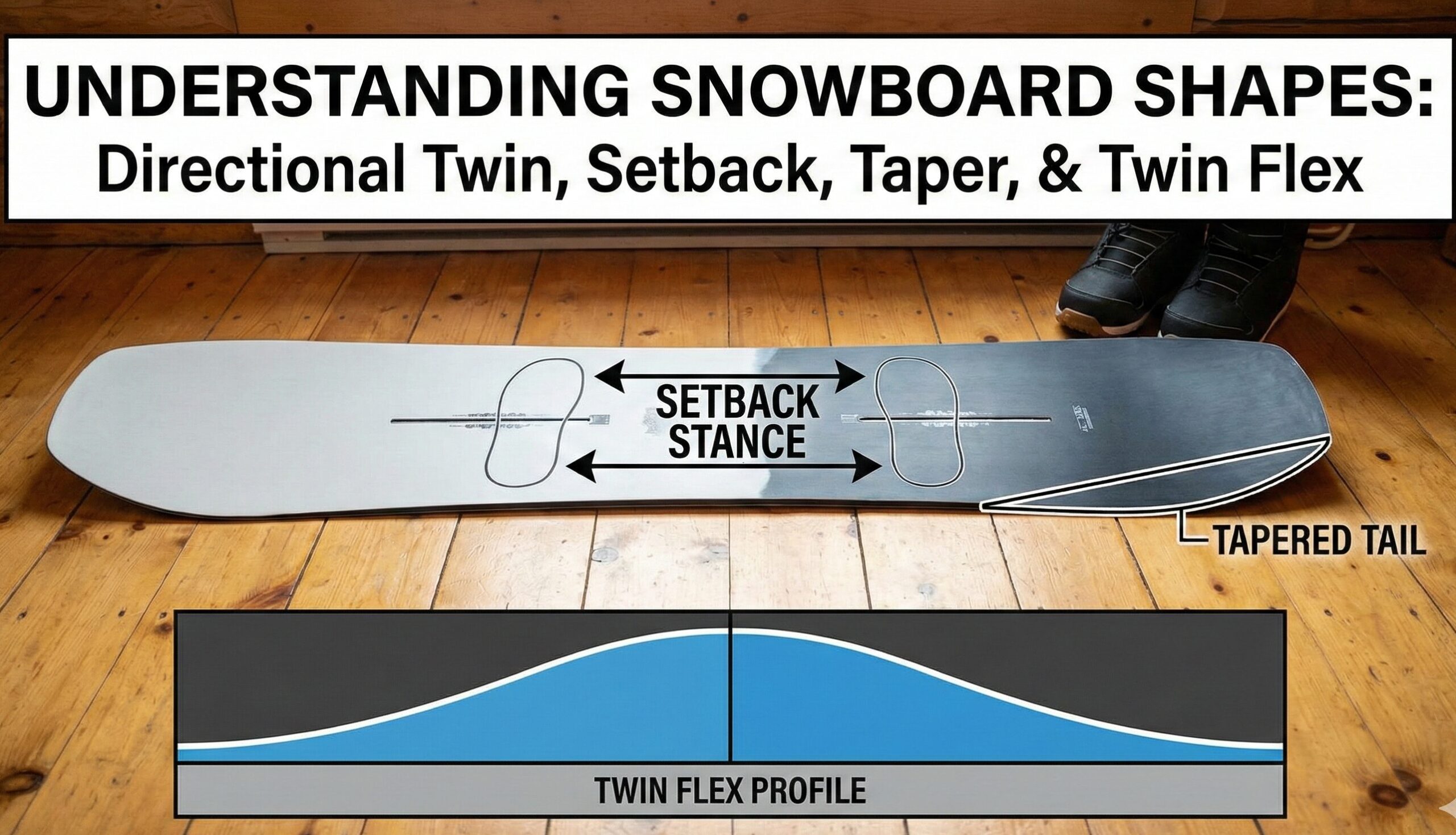
A directional twin is the snowboard world’s most elegant compromise. Visually, it looks like a twin: symmetrical tip and tail shape. But beneath the surface, it’s directional: the inserts are set back (usually 1–2 cm), the nose is slightly softer than the tail, and often the tail is a touch narrower (taper). This allows the board to ride switch adequately, but float powder naturally and charge with authority. It’s the quiver killer for riders who do everything—groomers, trees, occasional park, and sidecountry.
The International Snowboard Manufacturers Association classifies directional twin as: “symmetrical outline, asymmetrical core density and stance offset.” In plain language: it’s a true twin’s body with a directional rider’s soul. For deeper shape taxonomy, our directional vs twin snowboards: shape, control, switch, float guide breaks down the spectrum.
2. Anatomy: The 4 Pillars of Directional Twin Geometry
📐 1. Setback stance (1.5–2.5 cm)
Reference stance is shifted toward tail. When you center your bindings, you’re already riding slightly tail-heavy. This lifts the nose in deep snow without needing to lean back.
📏 2. Taper (2–6 mm narrower tail)
Tail width slightly less than nose width. Tail sinks less, releases turns easier, and doesn’t drag in powder. Minimal taper retains switchability.
🔄 3. Flex differential (softer nose, stiffer tail)
The nose absorbs chatter and floats; tail provides pop and drive. Not as extreme as a pure directional, but noticeable.
⚖️ 4. Symmetrical sidecut radius
Unlike true asymmetrical boards (see asymmetrical snowboards benefits), directional twins usually keep identical sidecut on heel/toe edges, but some add mild heel-side bevel.

Jones Mountain Twin
The benchmark directional twin. 2cm setback, spoon bevel, trail-friendly flex. One board to rule them all.
🏔️ VIEW ON AMAZON3. Directional Twin vs True Twin: Switch Sacrifice?
True twin = perfectly centered stance, identical nose/tail shape, flex, and width. Ideal for park, halfpipe, and butter tricks. Directional twin retains about 80–90% switch capability. Most riders won’t notice the difference unless riding switch in deep snow or spinning big jumps. For park rats who ride 50% switch, true twin still wins. But for all-mountain riders who occasionally ride switch off sidehits, directional twin is seamless.
| Feature | True twin | Directional twin |
|---|---|---|
| Stance position | Absolute center | Setback 1–2.5cm |
| Nose/tail width | Identical | Tail slightly tapered |
| Flex pattern | Balanced | Softer nose, stiffer tail |
| Switch riding | 100% | 85–90% |
| Powder float | Poor (needs setback) | Good (built-in setback) |
4. Directional Twin vs Full Directional: The Freeride Spectrum
Full directional boards (e.g., Jones Flagship, Lib Tech Orca) have exaggerated taper, significant setback (4cm+), and often a swallowtail or pintail. They dominate deep powder and steep couloirs but feel clumsy riding switch and in tight trees. Directional twin splits the difference: you get 75% of the directional’s float with 90% of a twin’s playfulness. It’s the sweet spot for 80% of riders. Our directional vs twin guide includes a float coefficient chart.
5. The Physics of Setback + Twin Flex
From a biomechanics perspective, a setback stance shifts the rider’s center of mass rearward. In powder, this lifts the nose via displacement hull physics—the same reason rocker works. But unlike full rocker, a directional twin usually features camber underfoot (or camrock). So you retain edge leverage and pop. The narrower tail reduces swing weight, making pivot turns effortless. Why snowboarding is so fun: displacement hull physics explains how setback amplifies float without a fully rockered profile.
6. Who Should Buy a Directional Twin? (Rider Matrix)
✅ Ideal for:
- All-mountain riders who do everything
- Intermediate to advanced
- One-board travelers (resort + sidecountry)
- Riders who want pop but also float
- Ex‑park riders transitioning to freeride
⚠️ NOT ideal if:
- You ride switch 40%+ of the time
- You only ride deep powder (go directional)
- You only ride park (go true twin)
- You’re a beginner (flat/rocker may be easier)
Weight and height also matter. Lighter riders may not need setback; heavier riders benefit from directional twins with stiffer tails. Always check volume shift options.

Ride Algorhythm
Directional twin with carbon array, setback, and sintered base. A freeride-friendly twin that still presses.
🛒 CHECK ON AMAZON7. Best Directional Twin Snowboards (2026 Editor’s Choice)
| Model | Setback | Camber profile | Flex | Best for |
|---|---|---|---|---|
| Jones Mountain Twin | 2 cm | Camrock | 6/10 | All-mountain reference |
| Capita Mercury | 1.5 cm | Resort V1 camber | 7/10 | Aggressive all-terrain |
| Ride Algorhythm | 2 cm | Hybrid camber | 6/10 | Freeride/freestyle mix |
| Salomon Assassin | 1.5 cm | Quad camber | 5/10 | Playful all-mountain |
| Yes. Basic | 1.5 cm | Camrock | 5/10 | Value & durability |
Women’s directional twins: Jones Dream Catcher, Ride Psychocandy, Salomon Wonder. Same geometry principles, adjusted flex.
8. Can a Directional Twin Float in Deep Snow?
Yes—with caveats. The setback keeps nose up without active rider effort. Taper helps tail sink less. However, in deep Japow (>50cm), a directional twin still requires rear-foot weighting. It’s not a dedicated powder board, but it’s surprisingly capable. For Japan trips, many riders now take directional twins instead of full powder sticks. Read our Japan snowboarding trips guide—directional twins are the #1 rental category in Niseko.
9. Edge Control: How Directional Twins Grip
Because directional twins often keep camber underfoot (or camrock), they have excellent edge hold on hardpack. The setback actually helps carving—your weight is naturally centered over the effective edge. Some models add Magne-Traction or Underbite edges for ice. GNU Banked Country review explains how serrated edges boost grip on directional twins.
10. Park Performance: Jumps, Rails, and Pipes
Directional twins are not pure park boards. But they can handle jumps and medium features. The stiffer tail helps pop off kickers; the setback is barely noticeable when spinning (most riders shift stance slightly). For jibbing, the tapered tail can release earlier, which some riders like. If you’re a park rat, true twin still wins. But for the weekend warrior who laps park for an hour, directional twin won’t hold you back.

Capita Mercury
Stiff flex, directional twin, HOLYSHEET basalt stringers. Resort destroyer with pop.
⚡ BUY ON AMAZON11. Directional Twin Splitboards: Uphill & Down
Splitboarders love directional twins because they offer ascent efficiency (light taper, twin-like glide) and descent versatility. You can ride switch in trees, but still charge powder. The Jones Solution and Capita Mega Split are directional twin splits. For more, see what is a splitboard: how snowboarders ride uphill—directional twins dominate the backcountry crossover category.
Directional Twin: 12 Critical Questions
One quiver to rule them all
Directional twin isn’t a compromise—it’s optimization. You keep the playfulness of a twin and gain the confidence of a directional. For 80% of snowboarders, this is the only board you’ll ever need.
🎯 MATCH WITH YOUR DIRECTIONAL TWIN📍 2026 catalog updates — 23 models tested
📚 Deepen your knowledge: Women’s gear guide • Utah resorts • Best tune kits • Maintenance basics


 Home
Home
 About
About
 My Cart
 Reviews
 Compare