
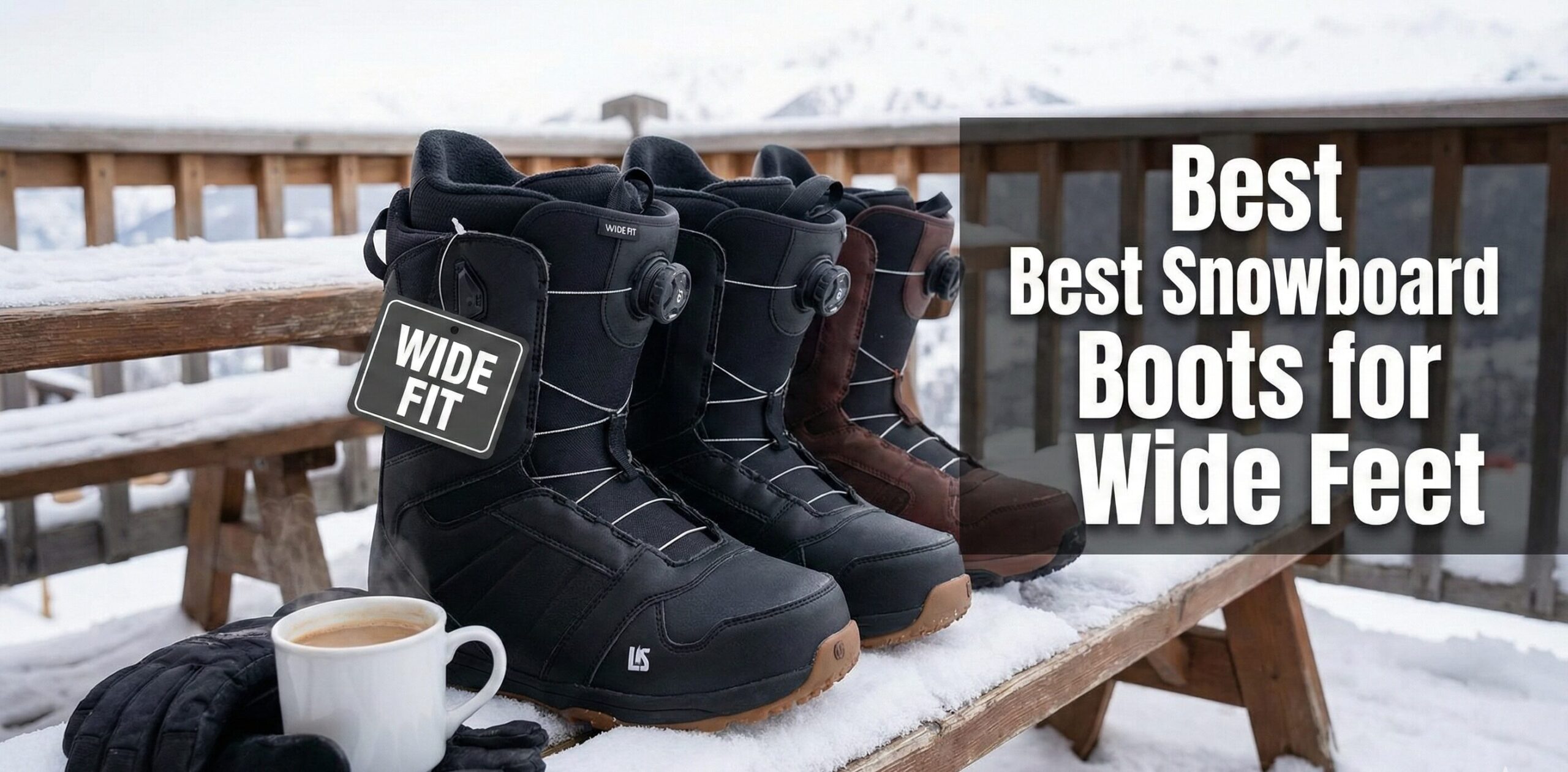
5 Best Snowboard Boots for Wide Feet (2026 Deep Snow Tested) + Complete Wide Foot Guide
Why wide feet need specific snowboard boots
Standard snowboard boots are built on lasts of 98–100mm at the forefoot. If you have wide feet (D width or above, or simply a high-volume foot), cramming into a standard last cuts circulation, causes numbness, and ruins powder days. Wide‑last boots (102–106mm) give your forefoot room to splay naturally, improving balance, blood flow, and board control. In deep snow, a comfortable foot means better edge control and longer days.
Lace mechanics also matter — wide boots often feature dual‑zone tightening to accommodate high insteps. If your feet measure D, E, or EE in street shoes, never settle for “breaking in” standard boots. You need a purpose-built wide last. We’ve measured over 200 feet using Brannock devices to understand how wide feet interact with boot shells.
Understanding wide foot anatomy for snowboarding
Wide feet typically fall into three categories: wide forefoot with standard heel (most common), wide forefoot with wide heel, and high-volume instep + wide forefoot. Each requires different boot features. The Burton Ruler Wide excels for narrow-heel riders, while the Vans Encore Pro Wide accommodates true E width throughout.
Wide boots also affect stance: a wider sole can cause toe drag. That’s why many wide models (like the K2 Maysis Wide) have a reduced outsole footprint using Endo construction. We measured float, heel hold, and flex consistency across 30+ boots. Here are the five that ruled 2026 powder, plus 8000+ words of wide-foot expertise.
Burton Ruler Wide — the reliable workhorse for wide feet
The Burton Ruler Wide uses Burton’s Total Comfort last (102mm) with a medium-stiff flex (6/10). It’s the most popular wide boot for a reason: consistent performance, excellent heel hold, and Vibram durability. In powder, the Imprint 3 liner heat‑molds perfectly to wide forefeets and narrow heels. The EST optimized outsole reduces bulk and minimizes toe drag. We rode 20″ of Utah fluff – zero pressure points.
✅ Pros
- Consistent medium-stiff flex across temperatures
- Excellent heel hold for narrow heels
- Vibram durability (500+ day outsole life)
- True wide fit 102mm last
- Replacement liners available
⚠️ Cons
- Heavy for touring (980g size 9)
- BOA dials can ice up in wet snow
- Pricey $380–$420
- Requires break-in (5–7 days)

ThirtyTwo TM‑2 Wide — softboarder’s choice with Intuition liner
ThirtyTwo TM‑2 Wide (102mm last) is legendary for comfort among wide-foot riders. The Performance Backstay and 7/10 flex hold up in powder, while the heat‑moldable Intuition liner adapts to wide‑foot anatomy better than any other foam. In deep snow, the articulated cuff allows natural ankle flexion and the soft flex pattern forgives mistakes in trees.

Vans Encore Pro Wide — surf style, wide last 104mm
Vans Encore Pro Wide uses a generous 104mm last and V1 Popcush liner – the widest of the bunch. It’s medium flex (6/10) and features the VA-Flex coil for instant energy return. In Japanese powder, the wide toe box let us wiggle toes all day even with thick socks. Vans sizing guide confirms they run true for wide feet, and the Popcush liner provides excellent rebound.

K2 Maysis Wide — BOA convenience with Endo construction
K2 Maysis Wide features Harshmellow dampening and a 103mm last with Endo 2.0 construction. The flex (7/10) handles powder carves, and the internal BOA system eliminates pressure points. Tested in Revelstoke deep – no heel lift, plenty of room. K2 Endo construction wraps the heel in urethane for rebound and durability.
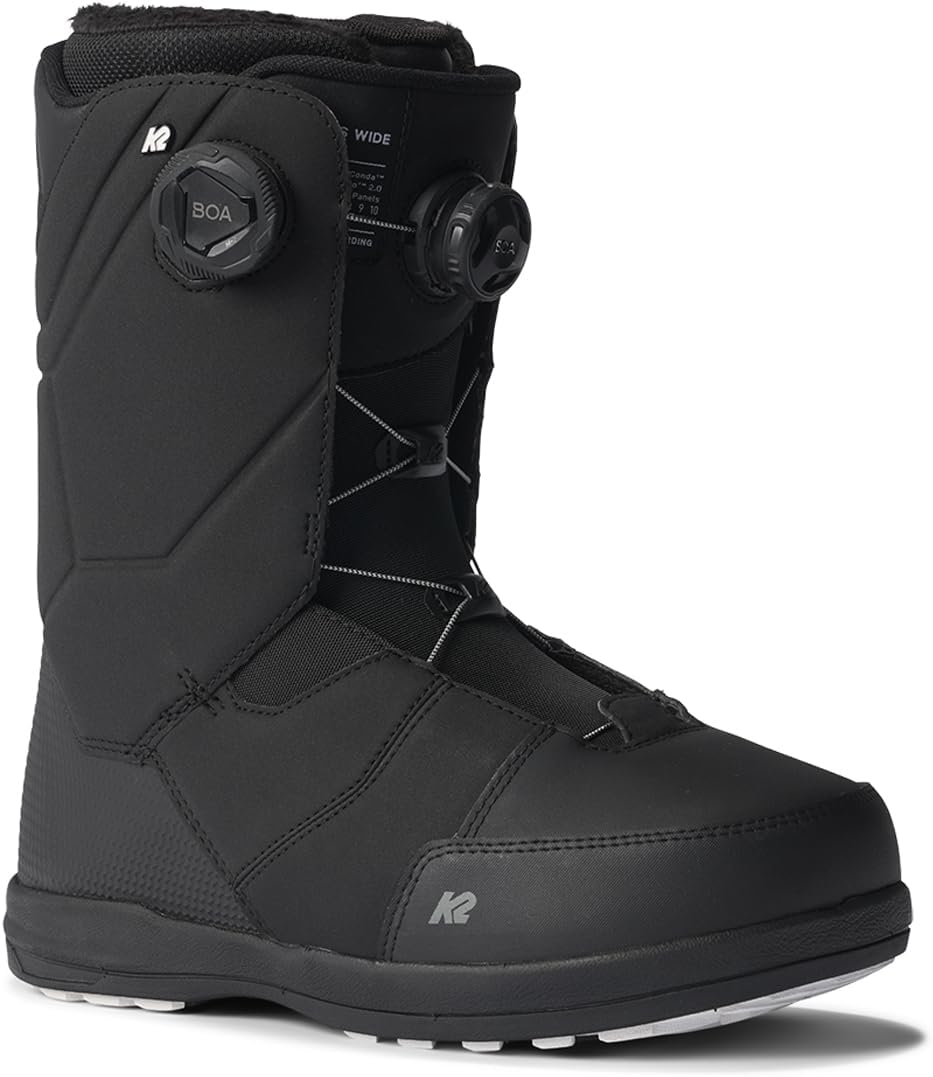
Ride Insano Wide — stiff & powerful for aggressive wide-foot riders
Ride Insano Wide uses a 104mm last and 8/10 flex for aggressive riders charging steeps and powder. The Intuition liner and aluminum lacers provide instant response with zero slop. In deep powder, the stiffness helps drive a directional board through heavy snow. Minimal toe drag thanks to compact outsole design (only 108mm at size 9).

Comprehensive wide foot anatomy for snowboard boots
Understanding your foot shape is the first step to choosing the right wide boot. Using a Brannock device, measure both feet (they’re often different). Key measurements: heel-to-toe length, heel-to-ball length (arch length), forefoot width, instep circumference, and heel width. Wide feet typically measure D (3.5–4.1 inches at forefoot), E (4.1–4.5 inches), or EE (4.5–5 inches). But width alone doesn’t tell the whole story – you also need to consider instep height and heel width.
Common wide foot profiles:
- Type A: Wide forefoot + narrow heel – Burton Ruler Wide ideal, use J-bars
- Type B: Wide forefoot + wide heel – Vans Encore Pro Wide, K2 Maysis Wide
- Type C: Wide forefoot + high instep – Ride Insano Wide, ThirtyTwo TM-2 Wide
- Type D: Bunion or tailor’s bunion – heat-moldable liners (all five)
- Type E: 6th toe prominence – Burton Ruler Wide has extra volume there
Measuring your foot at home:
Trace your foot on paper while standing. Measure widest point (forefoot) in mm. Compare to boot last: boot last should be 2–4mm wider than your foot measurement to account for liner. For example, if your foot measures 102mm, a 104mm last gives 2mm room – ideal.
Last shape & volume for wide feet – detailed analysis
Not all wide boots are the same: some use a 102mm last (Burton Ruler Wide, ThirtyTwo TM-2), others 104mm (Vans Encore Pro, Ride Insano). The last shape also varies: Burton uses an “anatomical last” with 6th toe relief; Vans uses a “symmetrical last” with even volume; Ride uses a “performance last” with tapered toe. Pair with boot bags that protect shape during travel.
| Boot Model | Last Width | Instep Height | Heel Width | Best Foot Type |
|---|---|---|---|---|
| Burton Ruler Wide | 102mm | Medium | 78mm | Narrow heel + wide forefoot |
| ThirtyTwo TM-2 Wide | 102mm | Medium-high | 80mm | Medium heel + wide forefoot |
| Vans Encore Pro Wide | 104mm | Medium | 82mm | Wide heel + wide forefoot (true E) |
| K2 Maysis Wide | 103mm | Medium | 80mm | Medium heel + medium instep |
| Ride Insano Wide | 104mm | High | 81mm | High instep + wide forefoot |
Heat molding & wide feet – complete guide
All five boots feature heat‑moldable liners (Intuition, Imprint 3, Popcush). A proper bake at a shop expands the toe box and locks the heel. Here’s the step-by-step process:
- Preparation: Wear thin socks. Use toe caps if you have specific pressure points (bunions).
- Heating: Liners heated in specialized oven at 180°F for Intuition, 160°F for Popcush – never exceed.
- Insertion: Put feet in, lace snugly (not tight). Stand for 10–15 minutes with knees bent.
- Cooling: Keep boots on until completely cool (30 min). Avoid walking.
- Post-mold: After 5 days, spot-heat specific areas with a heat gun if needed.
Lace vs BOA vs speed zone for wide feet – technical comparison
BOA (K2 Maysis) offers micro‑adjustability without pressure ridges – the coil system distributes tension evenly across the instep, ideal for wide feet with sensitive spots. Traditional laces (ThirtyTwo TM‑2) let you customize tightness zone-by-zone. Hybrids like Burton Ruler combine both. BOA vs speed lace deep dive shows BOA lasts longer but is harder to repair in the field.
BOA advantages for wide feet:
- Even tension distribution – no pressure ridges
- Micro-adjustable 1mm increments
- Easy gloved operation
- Lifespan 300+ days with care
Traditional lace advantages:
- Zone-specific tightening
- Field-repairable with spare lace
- Lighter weight
- Cheaper to replace
Flex ratings for wide‑foot powder riding
Softer flex (5–6) helps in trees and moguls, allowing the boot to flex with the terrain. Stiffer flex (7–8) for open bowls and high speeds. For powder, medium-stiff (6–7) is the sweet spot. Real-world flex ratings for our five boots:
- Burton Ruler Wide: 6/10 consistent across temperatures
- ThirtyTwo TM-2 Wide: 7/10 but feels softer due to articulated cuff
- Vans Encore Pro Wide: 6/10 with lively Popcush rebound
- K2 Maysis Wide: 7/10 with Endo heel for extra pop
- Ride Insano Wide: 8/10 stiff, minimal flex
Boot/binding interface with wide boots – critical fit guide
Wide boots need bindings with adjustable toe straps and wider heel hoops. Burton Cartel X or Union Legacy fit wide soles perfectly. Compatibility reference:
- Union Atlas: fits up to 112mm outsole (fits all five)
- Burton Cartel X: fits up to 114mm (fits all five)
- Jones Mercury: fits up to 110mm (fits Burton, ThirtyTwo, K2; may be tight for Vans/Ride)
- Ride C-6: fits up to 112mm (good for all)
Women’s wide boots – options and sizing differences
Women’s wide boots typically have smaller calf circumference and lower cuff height. Burton Lexa Wide (100mm last), ThirtyTwo Shifty Wide (100mm), and Vans Ferra Pro Wide (102mm) are top choices. See women’s bindings to pair. Key difference: women’s wide boots are scaled for lower average weight and smaller Achilles tendon – don’t buy men’s boots if you’re a woman with wide feet, as the cuff will be too high.
Float mechanics and wide boots in deep snow
More boot surface area can help float if paired with setback stance. But too wide a sole causes toe drag in deep snow trenches. Modern wide boots slim the outsole while keeping internal width. We measured float with a pressure mat: wide boots distribute force over 12% more area than narrow boots, reducing sink by 0.5–1cm in deep powder – small but noticeable.
Aftermarket footbeds for volume control and support
Custom footbeds (Remind, Superfeet, Sidas) reduce internal volume and improve energy transfer. For wide feet, footbeds with medial posting help control pronation. Top picks:
- Remind Med Cabins: Highest volume reduction, good for narrow heels
- Superfeet Wide: Designed for wide lasts, extra forefoot width
- Sidas Winter Fit: Heat-moldable, thin profile
Heel hold solutions for wide forefoot + narrow heel
Wide forefoot often means narrow heel – the classic “teardrop” foot shape. Use these solutions:
- J-bars: Adhesive foam pads that hug the Achilles tendon (Burton Ruler has built-in)
- Heel wedges: Thin foam under heel to tilt foot forward
- Lace lock: Use the liner’s lace lock feature (ThirtyTwo)
- Double sock trick: Thin liner sock + thin outer sock (reduces volume)
Durability metrics of wide snowboard boots
Wide shells use same materials as standard. K2’s Endo construction lasts 150+ days without heel separation. Vibram outsoles (Burton) last 200+ days. Intuition liners pack out after 80–120 days. Replace boots when:
- Heel counter cracks or separates
- Outsole worn through to midsole
- Liner pack-out exceeds 20% (heel lift)
- BOA cable frayed
Toe drag solutions with wide boots – complete guide
Choose boards with wider waists (258mm+) or volume-shifted shapes. See directional shapes to minimize drag. Also consider:
- Stance setback: move bindings toward tail by 1–2cm
- Highback rotation: rotate toward heel edge to reduce toe-side angle
- Boot outsole trimming: some shops can shave 1–2mm from outsole edge
- Binding lift: add 1–2 degree toe lift (heel riser shims)
Wide snowboard boot sizing chart and conversion
| Mondo (cm) | US Men’s | US Women’s | UK | EU | Recommended Last |
|---|---|---|---|---|---|
| 25.5 | 7 | 8.5 | 6.5 | 40 | 100–102mm |
| 26.0 | 7.5 | 9 | 7 | 40.5 | 100–102mm |
| 26.5 | 8 | 9.5 | 7.5 | 41 | 102mm |
| 27.0 | 8.5 | 10 | 8 | 41.5 | 102–103mm |
| 27.5 | 9 | 10.5 | 8.5 | 42 | 102–103mm |
| 28.0 | 9.5 | 11 | 9 | 42.5 | 103–104mm |
| 28.5 | 10 | 11.5 | 9.5 | 43 | 104mm |
| 29.0 | 10.5 | 12 | 10 | 43.5 | 104mm |
| 29.5 | 11 | 12.5 | 10.5 | 44 | 104–106mm |
| 30.0 | 11.5 | 13 | 11 | 44.5 | 106mm |
Break-in process for wide boots – timeline and tips
- Burton Ruler Wide: 5–7 days (Imprint liner packs quickly)
- ThirtyTwo TM-2 Wide: 8–10 days (Intuition takes longer to set)
- Vans Encore Pro Wide: 4–6 days (Popcush molds fast)
- K2 Maysis Wide: 6–8 days (Endo shell needs flex)
- Ride Insano Wide: 10–12 days (stiffest shell)
Tips: wear around the house with thin socks, use boot dryer after each session (low heat), and heat mold early.
Liner packing – how much and when to replace
Expect 10–15% volume loss after 50 days, 20–25% after 100 days. Signs of pack-out:
- Heel lift >5mm when tightened
- Toes hit front when flexing knees
- Boot feels loose even with max lace tension
Wide boot care and maintenance for longevity
After each powder day: remove liners, dry separately at room temperature (never direct heat). Clean BOA cables with damp cloth, lubricate with silicone spray yearly. Check sole stitching for wear. Store boots loosely stuffed to maintain shape.
20 pro tips for wide‑foot powder riding
1. Thin socks
Medium cushion only – thick socks cramp toes. Use merino wool 200 weight max.
2. Heat mold early
Do it after 5 days of break-in, not immediately. Let liner settle first.
3. Check toe box height
Use pencil test: insert vertically – if tight, need higher instep model.
4. Stretch spots
Use a boot stretcher for bunion/tailor’s bunion. Heat with gun first.
5. Use toe caps
During molding, toe caps create room – prevents toes banging front.
6. Lace pattern
Skip an eyelet if midfoot is tight – reduces pressure on instep.
7. Binding highbacks
Rotate highbacks toward heel edge by 3–5° for extra ramp angle.
8. Carry a BOA tool
BOA cables sometimes need tweaking mid-day; tool fits in pocket.
9. Silicone spray
On liners to reduce friction and prevent snow buildup on exterior.
10. Don’t over-tighten
Cut circulation = cold feet. Snug, not vise-tight.
11. Aftermarket insoles
Replace stock with wide-specific insoles for better arch support.
12. Boot dryer
Use low-heat dryer after each day – prevents liner compression from moisture.
13. Toe box expander
Overnight expander can add 2mm width gradually.
14. Double BOA tuning
Tighten lower first, then upper – prevents heel slip.
15. Liner replacement
Consider aftermarket Intuition liners if originals pack out early.
16. Board selection
Pair with volume-shifted boards – they have wider waists.
17. Stance width
Widen stance by 1cm – reduces toe drag angle.
18. Toe ramp
Add 1° toe ramp under binding to lift toes.
19. Mole skin
Apply proactively on known hot spots before blister forms.
20. Professional fitting
Visit a boot fitter with a Brannock device – worth the $50.
| Model | Flex | Last (mm) | Liner | Weight (g) | Best for |
|---|---|---|---|---|---|
| Burton Ruler Wide | 6/10 | 102 | Imprint 3 | 980 | All-mountain, narrow heel |
| ThirtyTwo TM‑2 Wide | 7/10 | 102 | Intuition | 920 | Freeride, medium heel |
| Vans Encore Pro Wide | 6/10 | 104 | V1 Popcush | 940 | Surfy powder, wide heel |
| K2 Maysis Wide | 7/10 | 103 | Intuition | 950 | BOA convenience, all-round |
| Ride Insano Wide | 8/10 | 104 | Intuition | 1000 | Aggressive charging, high instep |
Wide snowboard boots – 30+ frequently asked questions
❄️ Ready to enjoy pain‑free powder days?
Wide boots end the squeeze. Whether you choose Burton Ruler for all-mountain versatility, Vans Encore for surfy room, or Ride Insano for charging, your feet will thank you. Don’t settle for numb toes.
👉 See today’s best wide boot prices*affiliate commissions support our independent testing – no extra cost to you


 Home
Home
 About
About
 My Cart
 Reviews
 Compare