Why Wax Your Snowboard? The Ultimate Guide to a Faster, Healthier Board
Every experienced rider knows the “catwalk crawl”—that agonizing moment on a flat section where your board begins to grab the snow, your momentum dies, and you’re forced to unstrap and skate while skiers breeze past you effortlessly. While many beginners view waxing as an optional luxury or a “pro-only” ritual, it is actually the most fundamental aspect of snowboard maintenance. In this 2026 masterclass, we will explore the microscopic science behind base friction, the preservation of expensive P-Tex materials, and how a properly tuned board fundamentally changes your carving mechanics. Waxing is the difference between fighting your equipment and flowing with the mountain.
The “Why”: What Does Wax Actually Do?
To understand the necessity of wax, we must first look at a snowboard base under a microscope. A common misconception is that a snowboard base is a solid, plastic sheet. In reality, modern bases are comprised of millions of tiny pores and channels. Without wax, these pores are empty, creating a high-friction surface that behaves like a dry sponge against the snow. Here is the deep technical breakdown of why wax is non-negotiable.
1. Hydrophobic Performance and Friction Reduction
Contrary to popular belief, you aren’t actually sliding on ice or snow crystals. As your board moves across the surface, the pressure and kinetic energy generate a microscopic layer of water. You are essentially “hydroplaning.” Wax is a hydrophobic hydrocarbon; it repels water. When your base is saturated with wax, it prevents the microscopic water layer from “suctioning” to your board. Unwaxed bases create a vacuum effect, pulling against the snow rather than gliding over it. By applying temperature-specific wax, you optimize this water-repellency, ensuring the board stays on top of the moisture film regardless of whether the snow is a dry powder or a wet spring slush.
2. Structural Integrity and Oxidation Prevention
P-Tex (polyethylene) is susceptible to a process called “base burn” or oxidation. When a base is left dry, the plastic is exposed to oxygen and friction-generated heat. Over time, the material becomes brittle, white, and “fuzzy.” This isn’t just a cosmetic issue; oxidized P-Tex loses its ability to ever hold wax again, effectively killing the board’s performance. Waxing fills these pores, acting as a sealant that prevents oxygen from reaching the plastic. Think of it as a protective sacrificial layer—instead of the mountain grinding away your board’s core material, it grinds away the wax, which can easily be replaced.
3. Dynamic Turn Initiation and Edge Control
A waxed board is more predictable. When you initiate a turn, you are transitioning from the flat base onto your metal edges. If the base is “sticky,” this transition is jerky and requires more muscular effort to break the friction. A properly waxed board allows for a smooth, progressive “roll” onto the edge. This is particularly critical in technical terrain like tight trees or steep icy couloirs, where a split-second delay in board response can lead to a caught edge. Professional racers and park riders wax frequently not just for speed, but for the consistency of the board’s slide-to-grip ratio.
Sintered vs. Extruded: Does Your Base Type Matter?
Understanding your base type is essential for your maintenance schedule. Extruded bases are created by melting polyethylene pellets and punching them into a sheet. They are less porous and “harder,” making them durable and low-maintenance, but they have a lower speed ceiling. Sintered bases are created by crushing pellets under high pressure without melting them, leaving massive amounts of “empty” space between molecules. These pores are designed to drink wax. A sintered base is much faster when waxed, but becomes a liability when dry—dropping in speed significantly more than an extruded base would. If you own a high-end board, you likely have a sintered base that demands frequent attention.
The “When”: How Often Should You Wax?
The frequency of your waxing schedule depends on your “Snowboarding DNA”—how often you ride, where you ride, and how fast you want to go. While the 3-5 day rule is standard, environmental factors can shorten this window. For example, man-made snow is much more abrasive than natural snow; it acts like sandpaper on your base. If you ride on hard-pack eastern ice, you may need to wax every two days to keep your edges hydrated.
Keep a close eye on the “Contact Points” (the widest parts of your board near the tip and tail). These areas experience the most friction during turns and will be the first to show signs of dryness. If the black base of your board starts to look grey or ash-colored, you have already waited too long. In 2026, many riders are adopting “Hot Scraping”—a technique used to clean the base while simultaneously hydrating it—as a weekly ritual during the height of the season.
The “What”: Tools You Need for Hot Waxing
Professional results require professional tools. While you can “hack” a wax job, investing in a dedicated kit prevents damage and ensures your wax penetrates deeply into the P-Tex structure. Modern wax irons are designed with thick baseplates that hold heat longer, preventing the “cycling” effect of a clothing iron that causes uneven absorption.
Temperature-Regulated Waxing Iron
This is your most important tool. A dedicated iron has a precise thermostat that keeps the wax at its melting point without hitting the “smoke point” which destroys the wax’s chemical polymers. It ensures the heat reaches the board base without delaminating the core.
Hydrocarbon or Fluoro-Free Wax
In 2026, environmentally friendly waxes are the standard. Choose “All-Temp” for versatility, or “Cold” wax (blue) for mid-winter and “Warm” wax (red/yellow) for spring. Each has a different hardness level to match the snow crystal shape.
6″ Plexiglass Scraper
A sharp scraper is the difference between a 10-minute job and an hour of frustration. Use a plastic scraper (not metal!) to remove surface wax. Remember: the wax that makes you fast is *inside* the board, not the thick layer on top.
Multi-Brush System (Brass, Nylon, Horsehair)
Brushes create “structure” in the wax. A brass brush cleans old dirt; a nylon brush removes excess wax from the base’s micro-channels; a horsehair brush provides a high-speed polish for the final finish.
The “How”: A Step-by-Step Guide to Hot Waxing
Critical Warning: Overheating the Base
Your snowboard is a sandwich of wood, fiberglass, and epoxy. If you leave a hot iron in one place for more than 2 seconds, you risk a “core bubble”—where the internal glues fail. Always keep the iron moving!
- Base Preparation & Cleaning: Start by securing your board in vises or on two sturdy blocks. Use your brass brush to scrub from tip to tail; this opens the pores and pulls out embedded dirt. Wipe the board with a base cleaner or a clean rag. If you see white “base burn,” spend extra time brushing to remove the dead plastic fibers.
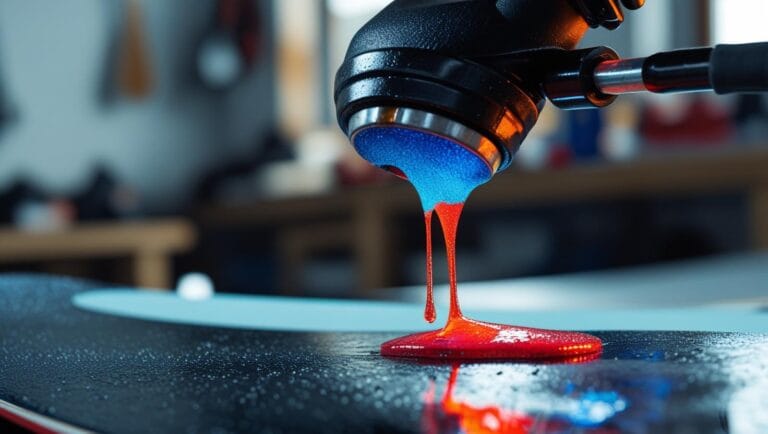
- The Drip Method: Hold the iron vertically over the board. Press your wax bar against the iron plate, letting the molten wax drip onto the base. Create a “snake” pattern or zig-zag along the length of the board. You don’t need a puddle; a steady line of drips is enough.
- Thermal Distribution (Ironing): Place the iron on the base and slowly spread the wax. You should see a “wet trail” about 3-4 inches long following the iron. Move the iron constantly. Your goal is to heat the P-Tex so it expands, allowing it to “drink” the liquid wax. The topsheet of the board should feel lukewarm, indicating the heat has fully penetrated.
- The 45-Minute Cure: This is where most beginners fail. As the wax cools, the P-Tex pores contract, “locking” the wax inside. If you scrape while the board is still warm, you pull the wax right back out of the pores. Let it sit until the board is cold to the touch.
- Precision Scraping: Hold your plexiglass scraper at a 45-degree angle. Push with both thumbs away from you, working from tip to tail. Scrape until the base looks like it has no wax on it at all. If you leave a thick layer, it will actually make you *slower* by creating more suction.
- Structuring (Brushing): Use your nylon brush with significant downward pressure. This removes the “micro-excess” from the base’s structure lines. Follow up with a horsehair brush for a mirror-like finish. Your board is now a hydrophobic weapon.
Professional Snowboard Maintenance FAQ
1. Do I need to wax a brand-new snowboard?
Yes, absolutely. Manufacturers apply a “factory wax” which is actually a cheap paraffin designed to prevent the base from drying out in a warehouse or during shipping. It is not meant for performance. A “hot wax” before your first day will saturate the pores and provide a much better baseline for the rest of the board’s life.
2. What happens if I use a clothing iron?
Clothing irons have wide temperature fluctuations and “steam holes” that trap wax. More dangerously, they can easily exceed 300°F, which is the point where P-Tex melts and the board’s epoxy begins to fail. A $40 waxing iron is much cheaper than a $500 replacement board.
3. Can I “over-wax” my board?
You cannot over-wax in terms of frequency; the base can only absorb so much. However, you *can* over-wax by not scraping enough. Too much surface wax creates a “sticky” feeling and attracts dirt, which will quickly slow you down and gum up your base structure.
4. Why is my base turning white even after I waxed it?
This is usually “base burn.” It occurs when the base has been dry for too long and the plastic fibers have been physically damaged by friction. You may need to have your board stone-ground at a professional shop to shave off the dead layer and expose fresh, healthy P-Tex.
5. Should I remove my bindings before waxing?
It is recommended. The binding screws pull the base slightly inward, creating “suck-back” or dimples. If you wax with bindings on, you won’t get a perfectly flat surface, and you risk the heat expanding the metal inserts against the core. At the very least, loosen the screws.
6. What is “All-Temperature” wax?
All-temp wax is a blend of hard and soft hydrocarbons designed to perform in the most common range (approx. 15°F to 35°F). It’s perfect for most resort riders. However, if you ride in sub-zero temps or 50°F slush, temp-specific wax will be noticeably faster.
7. Is “Rub-on” wax as good as hot waxing?
No. Rub-on wax only sits on the very surface and usually wears off within 1-2 runs. It’s a great “emergency” fix for a slow afternoon, but it does nothing to hydrate the base or provide long-term protection like a proper hot iron application.
8. How do I know when I’ve scraped enough?
Keep scraping until you literally cannot see any more wax shavings coming off. The base should look smooth and matte. You are trying to get down to the level where the only wax remaining is the wax inside the P-Tex pores.
9. Does waxing help with scratches and gouges?
Only very minor ones. Wax can fill tiny scratches, but for anything deep (a “core shot” where you see wood), you need a P-Tex candle or a professional base weld. Wax will not stay inside a deep gouge for more than a few turns.
10. Why do my edges rust if I wax my board?
Wax doesn’t prevent rust; drying does! After waxing, ensure you wipe your metal edges dry. If you store your board in a wet bag after waxing, the moisture trapped against the steel will cause oxidation regardless of how much wax is on the base.


 Home
Home
 About
About
 My Cart
 Reviews
 Compare