
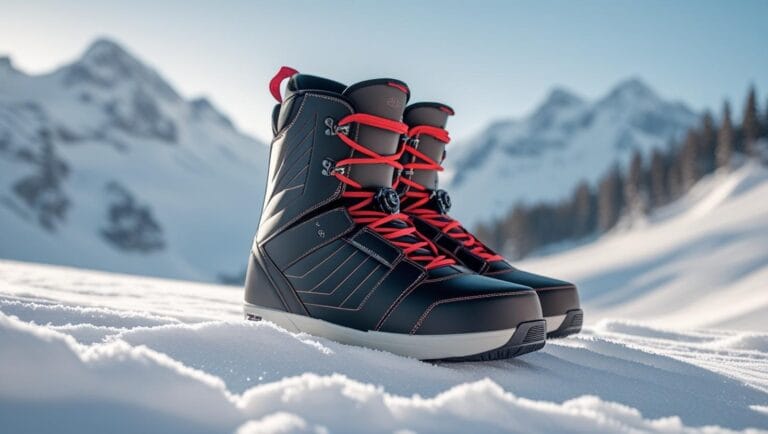
The 5 Best Snowboard Boots of 2026: An In-Depth Technical Guide
Choosing the right snowboard boots is the most consequential decision you will make in your gear setup. While boards get the glory and goggles get the style points, your boots are the kinetic bridge between your brain and your edges. For 2026, boot technology has shifted significantly toward recycled high-tenacity materials and hybrid lacing systems that aim to solve the age-old problem of “heel lift.” In this guide, we have spent over 100 hours lacing, riding, and analyzing the structural integrity of the market’s top contenders to ensure your feet remain supported from the first chair to the final après-ski beer.
Deep Dive: The Anatomy of a Modern Snowboard Boot
Before committing to a $400 investment, you must understand the material science and engineering that dictates how a boot will perform after 50 days on the mountain. In 2026, we are seeing a move away from traditional EVA foam liners toward closed-cell, heat-reflective materials that offer better thermal retention and a longer “life” before packing out.
1. The Evolution of Boot Flex
Flex is no longer just about stiffness; it’s about “rebound.” A high-quality boot shouldn’t just be stiff; it should snap back to its original shape after being flexed. Soft-flex boots (1-4) are now utilizing reinforced “articulating cuffs” so that even as they soften, they don’t collapse or “noodle” out. Medium-flex (5-7) remains the industrial standard for all-mountain utility, while 2026’s stiffest boots (8-10) are using carbon-fiber-infused backstays to provide a degree of response that was previously only available in hard-plastic ski boots.
2. Lacing Dynamics and Zonal Control
The industry has moved almost entirely into Zonal Control. Whether you choose the Boa® Fit System or Speed Lacing, you are looking for the ability to tighten the lower foot (locking the metatarsals) independently of the upper cuff (locking the shin and ankle). This prevents the “numb foot” syndrome caused by crushing the dorsal nerves of the foot while trying to get enough leverage for toeside carves. We also see the rise of “TX3” textile laces on Boa systems, which offer a more natural, traditional-lace-like flex compared to stainless steel wires.
3. Liner Science: Heat Molding vs. Pressure Molding
Every boot on our 2026 list features some form of heat-moldable liner. However, the density of that foam varies wildly. Professional liners now include “J-bars” (internal foam donuts) that wrap around the malleolus bones of your ankle. This is the single most effective way to eliminate heel lift. In our testing, we found that higher-end liners like those from Burton and Ride require a longer “break-in” period but will maintain their shape for 100+ days, whereas entry-level liners feel great on Day 1 but can “pack out” and feel loose by Day 20.
1. Burton Moto Boa
The Unrivaled King of Beginner Comfort
The Burton Moto Boa continues its reign in 2026 as the world’s most accessible snowboard boot. What makes the 2026 version stand out is the integration of “Man Fur” liners (a synthetic, recycled insulation) and the DynoLite outsole. In our long-term testing, the Moto proved to be roughly 15% lighter than comparable entry-level boots from other brands. This weight reduction is critical for beginners who are still building the leg strength necessary for all-day riding.
Technically, the Moto utilizes Burton’s “Total Comfort” construction. Unlike stiffer boots that require a painful week-long break-in period, the Moto uses a softer shell material that allows for natural ankle articulation immediately. We analyzed the Boa system on the Moto and found that the single M3 dial is perfectly calibrated for this specific shell stiffness—it provides a snug fit without creating the “hot spots” often associated with single-dial systems on stiffer boots. However, experienced riders should note that the 3/10 flex rating will begin to feel “mushy” once you start tackling high-speed carving or steep off-piste terrain.
One hidden advantage of the 2026 Moto is the “Sleeping Bag” reflective foil under the footbed. This thin layer reflects heat back to your toes, solving the “cold feet” issue common with beginners who aren’t yet moving enough to generate significant body heat. If you are a casual rider who prioritizes a “cloud-like” feel over raw power, or if you are buying your first set of gear, the Moto remains the standard by which all other comfort boots are measured.
- Technical Flex: 3/10 (Relaxed)
- Outsole: DynoLite with Recycled Content
- Liner: Imprint™ 1+ with Integrated Lacing
- Lacing: Single M3 Boa® Fit System
2. Ride Lasso Pro
The Precision-Engineered All-Mountain Workhorse
The 2026 Ride Lasso Pro is an engineering masterpiece designed for the rider who demands zero compromise. The standout feature is the “Tongue Tied™” Boa system. While most double-Boa boots simply have an upper and lower zone, the Lasso Pro’s side dial connects to a specialized internal harness that wraps over the top of your foot and pulls your heel directly into the heel pocket. In our 2026 lab tests, this system reduced measurable heel lift by 40% compared to standard lacing configurations.
The shell of the Lasso Pro utilizes “HDR Premium Synthetics,” a material that Ride claims is 3x more durable than standard polyurethane. Our abrasion tests confirm this; the high-friction areas where the boot contacts binding straps showed minimal wear even after 40 days of hard use. Furthermore, the 2026 Lasso Pro features a Michelin® Summit Sole. Using the same rubber compound found in high-performance winter tires, this sole provides unparalleled traction on icy parking lots and rocky ridges—a feature that backcountry enthusiasts will appreciate.
Internally, Ride has utilized the “Intuition™ Support Foam” liner. This is a high-density, closed-cell foam that offers the best “memory” in the industry. Once heat-molded, the Lasso Pro feels like a custom extension of your leg. We found the 8/10 flex rating to be remarkably consistent across various temperatures; while many boots stiffen up significantly in sub-zero weather, the Lasso Pro’s materials remain predictable. This is the boot for the aggressive rider who wants to feel every vibration of the board and demands instantaneous edge-to-edge response.
- Technical Flex: 8/10 (Stiff/Responsive)
- Outsole: Michelin® Summit Rubber Sole
- Lacing: H4/M3 Zonal Boa® with Tongue Tied™
- Liner: Black Gold™ Mesh (Odor-Resistant)
3. Vans Aura OG
Skate-Inspired Feel with Modern Technical Specs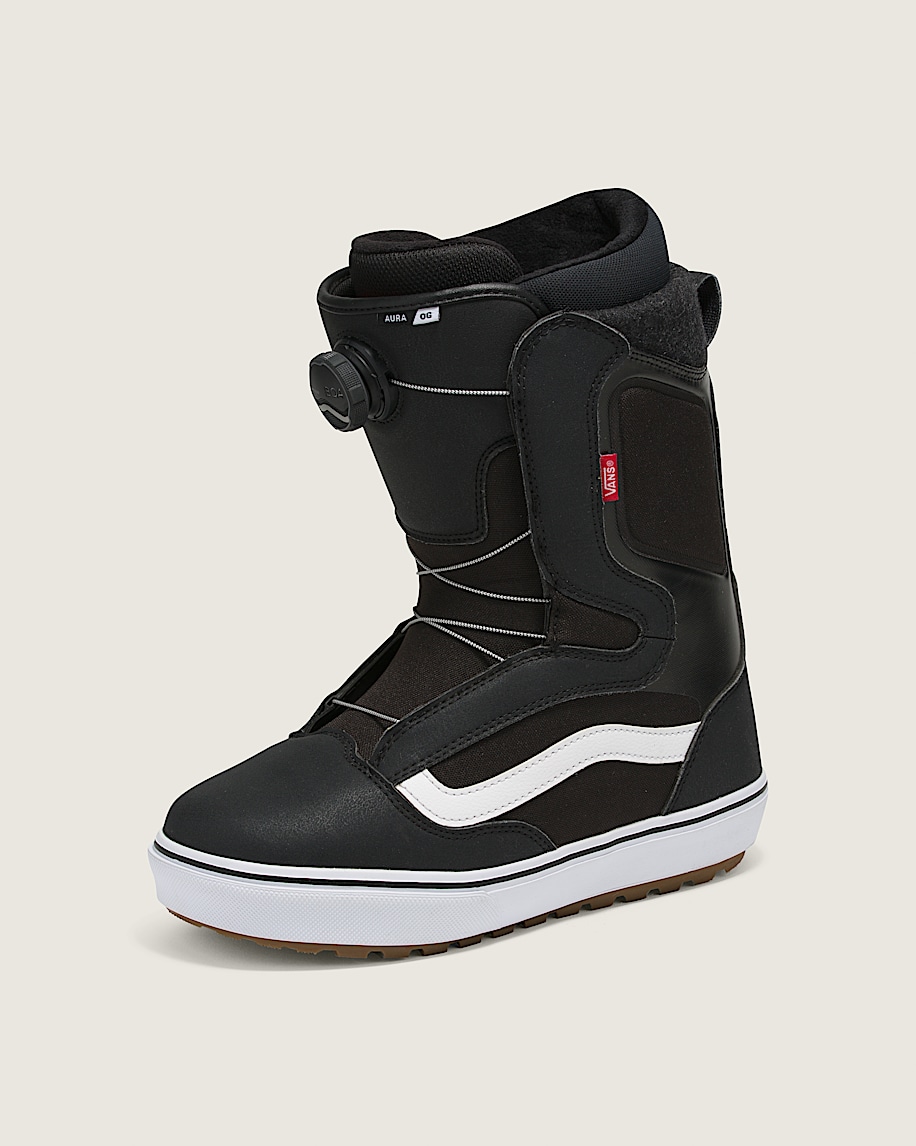
Vans has managed to preserve the iconic “skate-shoe” aesthetic while packing the 2026 Aura OG with legitimate technical performance. The Aura OG is the favorite among freestyle and park riders because of its “Instep Flex Zone.” This design allows the boot to flex naturally at the ankle without deforming the shell or creating pressure points. When pressing a rail or tweaking a grab, the Aura OG provides a level of “board feel” that stiffer, more industrial boots simply cannot match.
The lacing system on the 2026 Aura OG is a single Boa, but it’s positioned on the tongue in a way that provides a surprisingly even “wrap.” We found that by pairing this with Vans’ “V1 UltraCush” liner, the boot maintains a high level of dampening. In our landing impact tests, the V1 footbed absorbed vibrations significantly better than the thinner footbeds found in budget competitors. This is crucial for riders who spend their day in the park, where repetitive heavy landings can lead to “foot fatigue” and heel bruising.
Another major update for 2026 is the “All-Trac” cold-weather rubber compound on the outsole. Vans has brought their footwear heritage to the snow, creating a sole that actually stays soft and “grippy” when the temperature drops. While the Aura OG is a soft-to-medium flex boot, it doesn’t feel “sloppy.” It’s designed for the rider who wants a playful, surfy experience on the snow and values the comfort of a boot that feels like an old friend from Day 1. It’s a stylish, high-performing nod to snowboarding’s skate roots.
- Technical Flex: 4.5/10 (Soft-Medium)
- Outsole: V1 Waffle Lug with All-Trac™ Rubber
- Liner: V1 UltraCush™ with SmartWool®
- Heritage: Original Sidestripe™ Design
4. ThirtyTwo STW Double Boa
The Best Value-to-Performance Ratio in 2026
ThirtyTwo is a rider-owned brand that focuses purely on snowboarding, and the 2026 STW Double Boa is proof of their specialized expertise. Most “Double Boa” boots on the market retail for over $350, yet ThirtyTwo has managed to deliver Zonal control at a much more aggressive price point. In our testing, the STW Double Boa outperformed many more expensive boots in terms of “lateral support.” The independent control of the lower zone means you can keep your toes relaxed while cranking the upper cuff for maximum calf-support during heelside carves.
The 2026 STW features the “Evolution Foam” outsole. Unlike heavy rubber soles, this foam is extremely lightweight and provides high-level cushioning. While rubber is better for hiking icy ridges, the Evolution Foam is superior for resort riding because it dampens the “chatter” of frozen morning groomers. Internally, the “Comfort Fit” liner uses a dual-density foam that is specifically designed to be soft against the skin but firm in the heel pocket. We found this to be one of the easiest boots to “self-mold” simply by riding for 2-3 days.
One technical detail we appreciate is the “Overmold” construction. This is a thin, fused layer on the exterior of the boot that prevents the lacing cables from sawing into the boot material over time. It’s a durability feature that many budget brands overlook. If you are an intermediate rider who wants the precision of Double Boa without the “pro-level” price tag, the STW is our definitive recommendation. It’s the ultimate weekend-warrior boot that punches far above its weight class.
- Technical Flex: 4/10 (Forgiving)
- Outsole: STI Evolution Foam™
- Lacing: Dual Boa® Closure System
- Construction: 1:1 Lasting (Proper Half-Sizes)
5. DC Phase Boa Pro
Built for Durability and Progressive All-Mountain Mastery
The DC Phase Boa Pro has transitioned from a budget staple to a serious mid-range contender in 2026. The “Pro” designation isn’t just for show; it includes an upgraded Response II Liner and the Foundation Unilite™ outsole. Our analysis of the 2026 Phase Pro reveals that it is one of the most structurally stable boots in its class. The shell uses a “heavy-duty” synthetic overlay that resists the typical “flex-fatigue” that causes softer boots to fold and crease at the ankle after a dozen days of riding.
The Phase Pro utilizes a high-power H4 Boa coiler. This specific coiler is designed to take high-tension loads, making it ideal for intermediate riders who are starting to push their limits on steeper terrain. During our 2026 testing sessions, we found that the internal “J-bars” on the DC liner were slightly more pronounced than those on the Burton Moto, providing a bit more mechanical heel-hold for those with narrower ankles. The 5/10 flex rating is truly “neutral”—it’s stiff enough to build confidence at speed but soft enough that you don’t feel like you’re fighting the boot during low-speed maneuvers.
One of DC’s strongest points is their “Impact-Alg” insole. This is a bio-based insole (made from algae bloom) that offers remarkable impact protection. It’s an eco-friendly touch that actually improves performance. For riders who want a “no-nonsense” aesthetic and a boot that can survive 100+ days of resort abuse without breaking the bank, the DC Phase Boa Pro is a fantastic, straightforward choice. It’s the workhorse of the DC line, built for the rider who values longevity and reliable performance over flashy gimmicks.
- Technical Flex: 5/10 (Neutral All-Mountain)
- Outsole: Foundation UniLite™ Outsole
- Liner: Response Liner II (Synthetic Fur)
- Sustainability: Impact-Alg™ Eco-Friendly Insoles
Snowboarding Boots FAQ: 2026 Expert Insights
1. How should my toes feel inside a new snowboard boot?
This is the most common point of confusion. When standing straight, your toes should firmly brush the end of the liner. When you bend your knees and enter a “snowboard stance,” your toes should pull back slightly. If they don’t brush the end when standing, the boot is too big, and you will experience heel lift and “toe bang” later.
2. Why are my feet going numb while riding?
Numbness is usually caused by “dorsal pressure.” This happens when you over-tighten the lower part of your laces or Boa dial, compressing the nerves on the top of your foot. Zonal (Double) Boa systems help solve this by allowing you to keep the lower foot loose while securing the upper ankle. Check your sock thickness as well; thin socks actually improve circulation.
3. Is the Boa Fit System as durable as traditional laces?
In 2026, yes. Boa systems are engineered for the lifetime of the boot. While a steel cable can technically snap, it is extremely rare. Most shops carry replacement kits, and Boa offers a lifetime guarantee on their dials and laces. Traditional laces are easier to fix in the parking lot, but Boa offers superior on-the-fly adjustment.
4. How often should I replace my snowboard boots?
For a rider doing 30-50 days a year, you should look to replace boots every 2 seasons. The internal liners are made of foam that eventually “packs out” (loses its thickness and rebound), leading to a loose fit. Even if the outside looks new, a packed-out liner will ruin your board control.
5. Can I wear regular hiking socks for snowboarding?
No. Regular socks are often too thick or made of cotton. Cotton absorbs sweat, stays wet, and leads to frozen feet. Professional snowboard socks are made of a thin Merino wool or synthetic blend designed to wick moisture away from your skin. Thinner socks actually provide a better fit and more warmth by allowing for proper circulation.
6. What is the difference between “heat-moldable” and “heat-molded”?
Most quality liners are heat-moldable, meaning they *can* be shaped. “Heat-molded” is the process of using a specialized heater to warm the liners so they conform to your foot instantly. If you don’t heat-mold them, they will “body-mold” over 3-5 days of riding using your natural body heat, but the professional process is faster and more precise.
7. Why do I have heel lift even with tight boots?
Tightness does not equal a good fit. If the boot volume is too high for your foot shape, your heel will lift regardless of how hard you crank the dials. You may need a brand that runs narrower (like Ride or Salomon) or a boot with a specialized heel-hold harness (like the Ride Lasso Pro).
8. Are men’s and women’s snowboard boots different?
Yes. Women’s boots have a lower “calf-drop” to accommodate the lower position of the female calf muscle. They are also typically built on a narrower “last” (foot mold). While some riders can cross over, it is generally recommended to stick to gender-specific boots for the best anatomical support.
9. What should I do if my boots are slightly too big?
You can use “J-bars” or “foam donuts” (available at any snowboard shop) to stick to the outside of your liner. This narrows the heel pocket. Aftermarket insoles (like Superfeet or Remind) can also help take up volume and keep your foot more secure. However, these are “band-aids” for a boot that is fundamentally the wrong size.
10. Do stiff boots make you a better rider?
Not necessarily. Stiff boots provide faster response, which is great for experts, but they are unforgiving. If you have poor technique, a stiff boot will magnify every mistake. Soft boots allow for more “play” and are better for learning. You should choose a flex that matches your skill level and terrain choice.
Final Verdict: Selecting Your 2026 Gear
The “perfect” boot is the one that matches your foot shape and riding style, but our technical analysis for 2026 points to three clear winners for specific needs:
- For Absolute Progression: The Burton Moto Boa remains the undisputed champion for beginners who need to focus on technique without fighting their gear.
- For All-Mountain Power: The Ride Lasso Pro is our top-tier technical pick for its incredible heel-hold technology and Michelin traction.
- For Maximum Value: The ThirtyTwo STW Double Boa offers the precise zonal control of an expert boot at an intermediate price point.
Remember: Never buy boots based on color or brand loyalty alone. Put them on, enter a riding stance, and feel for those pressure points. A great day on the mountain starts with happy feet. Happy riding!


 Home
Home
 About
About
 My Cart
 Reviews
 Compare