
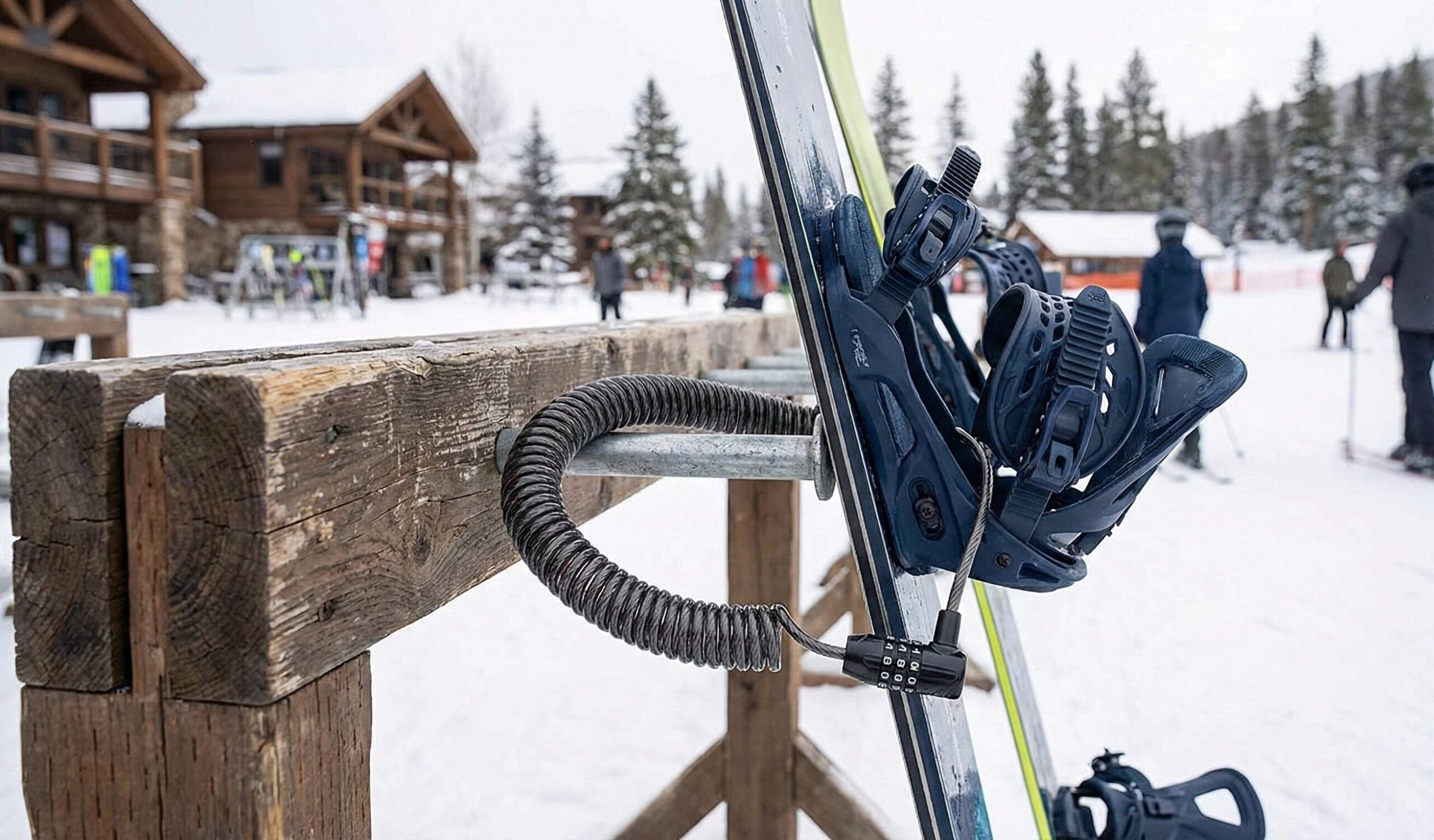
Secure Your Ride: The 5 Best Snowboard Locks of 2026
Snowboarding is an expensive passion. Between the board, bindings, and boots, your setup can easily exceed $1,000. Yet, many riders leave their gear completely unsecured outside the lodge while they grab lunch. It is a harsh reality that snowboard theft is common at resorts worldwide. Thieves rely on the “grab and go” method—walking off with a loose board in a crowded rack.
For the price of a lodge burger, a snowboard lock provides essential peace of mind. While no cable lock is bolt-cutter proof, they act as a massive deterrent against opportunistic thieves. In this guide, we break down the most reliable options to protect your investment, considering portability, cable strength, and ease of use.
2. Understanding Lock Types
Not all locks serve the same purpose. Choosing the right one depends on where you ride and how much bulk you are willing to carry.
- Retractable Cable Locks: The industry standard. Small, lightweight, and fits in a pocket. The cable is thin but sufficient to stop a quick snatch.
- Rack-Specific (Ski Key): These lock your gear directly into compatible racks found at many resorts. Extremely secure but only works with specific infrastructure.
- Fixed Loop Cables: Stronger and thicker than retractable ones, but bulkier to carry.
Just as you would calculate the amortization and life cycles of your gear, consider a lock as a small insurance premium to ensure that life cycle isn’t cut short by theft.
3. Dakine Micro Lock
The Dakine Micro Lock is likely the most recognizable lock on the mountain. Its popularity stems from its form factor—it is barely larger than a car key fob.
It features a retractable 30-inch steel cable and a customizable 3-digit combination. While the cable is thin, the housing is durable ABS plastic that can withstand cold temperatures without cracking.
Pros
- Extremely compact; unnoticeable in a pocket.
- Retract mechanism is smooth and reliable.
- Cable length allows locking two boards together.
Cons
- Thin cable is easily cut with tools (deterrent only).
- Tiny dials can be hard to operate with gloves.
4. Burton Tether Lock
Burton’s take on security is slightly more robust than the Dakine micro. The housing feels more substantial in the hand, and the lock mechanism has a satisfying “click” that confirms engagement.
It acts as a great accessory to your other snowboard tune kits and essentials. The 3-digit combo is easy to set, and the cable loop is wide enough to wrap around bench legs or thick rack bars.
Pros
- High-quality build materials.
- Ergonomic shape is easy to grip.
- Available in bright colors (visual deterrent).
Cons
- Slightly bulkier than the Dakine.
- Cable retraction can sometimes jam if dirty.
5. The Ski Key System
If you frequent resorts that have Ski Key racks (yellow locking bars usually found in Canada and the US East Coast), this is the gold standard. It is not a cable lock; it is a rigid plastic device that locks your board into the rack itself.
Unlike cables which can be cut, this system physically traps your board. It’s essentially the same concept as heavy-duty home storage racks, but portable.
Pros
- Impossible to cut (no exposed cable).
- Extremely fast to use (key entry, no dials).
- Highest level of security available.
Cons
- Useless if the resort doesn’t have compatible racks.
- You must carry a physical key (risk of losing it).
6. Lewis N. Clark Retractable Cable Lock
While not a dedicated “snowboard brand,” Lewis N. Clark makes travel security gear that often outperforms sport-specific locks. This unit features a braided steel cable coated in sturdy vinyl, which is crucial for preventing scratches on your board’s top sheet graphics.
The standout feature here is the dial ergonomics. The numbers are slightly raised and larger than competitors, making it much easier to operate when your fingers are frozen or while wearing thin liner gloves. It is a pragmatic choice for riders who prioritize function over brand names.
Pros
- Glove Friendly: Larger dials are easier to spin in the cold.
- Vinyl Coating: Protects gear from scratches.
- Metal Housing: Feels more durable than plastic alternatives.
Cons
- Heavier than the Dakine Micro.
- Retraction spring can weaken after heavy use.
7. Bosvision 4-Digit Combination Lock
For those who want slightly higher entropy, the Bosvision offers a 4-digit code (10,000 possible combinations vs the standard 1,000). This added layer of complexity makes “guessing” the code statistically impossible for a thief in a hurry.
The cable head is ultra-compact, designed originally for luggage zippers. This makes it incredibly easy to thread through tight spots, like binding heel cups or the zipper pulls on durable snowboard bags during air travel.
Pros
- Higher Security: 4-digit combo is harder to crack.
- Versatile: Fits luggage zippers and snowboard bindings.
- Cable Length: 36 inches (longer than average).
Cons
- Cable is thinner (easier to cut with tools).
- Tiny lock head can be fiddly to handle.
8. Comparison: Top 5 Locks
| Model | Type | Cable Length | Lock Mech | Best For |
|---|---|---|---|---|
| Dakine Micro | Retractable | 30 in | 3-Digit | Pocketability |
| Burton Tether | Retractable | 30 in | 3-Digit | Reliability |
| Ski Key | Rack Insert | N/A | Keyed | High Security |
| Lewis N. Clark | Retractable | 30 in | 3-Digit | Ease of Use |
| Bosvision | Retractable | 36 in | 4-Digit | Travel/Bags |
9. Where to Lock Up
A lock is only as good as the object you attach it to. Always lock your board to a fixed, immovable object. The best racks are cemented into the ground. Avoid locking your board to a loose bench or a wooden fence slat that can be easily kicked out.
If racks are full, you can lock your board to your friend’s board. A thief is unlikely to try and carry away two awkward, locked-together snowboards (the “buddy system”).
10. Alternatives to Locking
If you forget your lock, you can use the “Split” method. If you are riding with a friend who has the same stance, swap one binding setup or simply separate your boards by placing them in racks on opposite sides of the lodge. A thief looking for a quick steal won’t hunt for a mismatched pair.
Another option is a snowboard leash. While primarily for safety, some modern leashes for Step-On bindings have integrated locking loops that add a layer of theft prevention.
11. Insurance & Identifying Your Gear
Even the best lock can be defeated. It is vital to take photos of your board’s serial number (usually found near the binding inserts or on the sidewall). This is crucial for police reports and insurance claims.
Many homeowners or renters insurance policies cover sports equipment theft, even if it happens off-property. Check your policy deductible; if your deductible is $500 and your board is worth $600, a claim might not be worth it.
Conclusion
The best snowboard lock is the one you actually carry. The Dakine Micro Lock wins our top recommendation because its tiny size means you’ll never leave it in the car. For riders at specific resorts, the Ski Key offers unbeatable protection.
Investing $20 to protect a $1,000 setup is simple math. Don’t let a thief ruin your powder day—lock it up, go inside, and enjoy your après in peace.


 Home
Home
 About
About
 My Cart
 Reviews
 Compare