
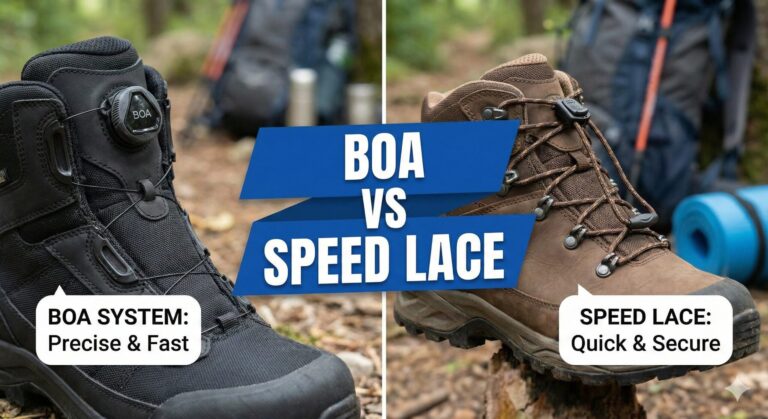
BOA vs. Speed Lace: The Ultimate 2026 Snowboard Boot Lacing Guide
There is a specific moment of dread every snowboarder knows. It’s 8:30 AM in the parking lot. It’s 10 degrees below freezing. You have your baggy snowboard pants on, and you are trying to jam your cold foot into a stiff boot. The struggle is real, and as we move deeper into 2026, the technology has reached a pinnacle where choosing between BOA and Speed Lace is no longer just about convenience—it’s about biomechanical efficiency.
Choose BOA for unparalleled ease of use and micro-adjustments. Modern H4 Coiler systems have virtually eliminated the “snapping” issues of the past, making them the top choice for all-mountain riders.
Choose Speed Lace if you are a freestyle purist or backcountry explorer who needs independent tension zones and a “softer” lateral flex that only textile cords can provide.
1. The BOA System: Engineering the Perfect Fit
The BOA Fit System has undergone a massive evolution. In 2026, we aren’t just looking at a dial and a wire; we are looking at a system engineered to distribute pressure across the dorsal bridge of the foot. The mechanical advantage provided by the dial allows riders to achieve a level of tightness that is physically impossible with traditional laces. This is crucial for high-speed carving where even a millimeter of “heel lift” can result in a lost edge.
The physics of the BOA system relies on low-friction guides. Unlike speed laces that can catch on eyelets, the BOA cable glides smoothly, ensuring that the tension applied at the dial is distributed evenly to the very toe of the boot. However, this “evenness” was historically a drawback, leading to the development of the multi-zone BOA. By 2026 standards, a single BOA is considered entry-level, while Triple-BOA systems are emerging for professional freeriders who need to lock down the ankle, the forefoot, and the upper cuff independently.
Furthermore, the durability of these systems has been reinforced. Modern cables are often braided with ultra-high-molecular-weight polyethylene (UHMWPE), making them stronger than steel per weight unit. If you’re tackling backcountry snowboarding, the security of knowing your lacing won’t fail in sub-zero temperatures is worth the premium price point. We’ve seen a shift where the “failure points” are now the plastic guides rather than the cables themselves, a testament to how far the hardware has come.
2. Speed Lace: The Choice of Precision and Feel
Speed Lace systems (like Burton’s New England Ropes or Nitro’s TLS) continue to dominate among riders who prioritize “feel.” While BOA provides a rigid, mechanical lock, Speed Lace utilizes nylon or Dyneema cords that possess a natural, microscopic elasticity. This allows the boot to move slightly with the rider’s natural ankle articulation, providing a more “organic” connection to the board. For park riders who spend their day tweaking grabs and landing in high-impact scenarios, this subtle give can be the difference between a landed trick and a bruised shin.
The 2026 iteration of Speed Lace has solved the “slip” issue that plagued older models. Advanced locking cleats now utilize serrated teeth that bite into the lace, ensuring that the tension you set at 9:00 AM is the same tension you have at 4:00 PM. The primary advantage remains the “Zonal Control.” You can leave the bottom zone loose—allowing your toes to move and stay warm—while cranking the upper zone to maximum tightness for immediate toe-side response. This customization is often the key to solving why feet hurt when snowboarding.
Weight is another factor often overlooked. Speed Lace systems are inherently lighter than the mechanical dials and internal housing required for BOA. In the world of 2026 gear, where “light is right,” many touring and splitboarding enthusiasts stick to Speed Lace to shave off every possible gram for the ascent. The repairability also remains a massive “Pro”; a spare lace and a multi-tool are all you need to fix a break in the middle of a forest, whereas a BOA failure often requires a specific replacement kit.
3. Traditional Laces: The Immortal Standard
Traditional laces remain the benchmark for reliability in 2026. While they may seem “slow,” many professional riders refuse to switch. Why? Because you can customize the tension at every single eyelet. By using different knots (like the “surgeon’s knot”), a rider can create five or six different tension zones. This level of granularity is unmatched even by Triple-BOA systems. If you’re wondering how long snowboard boot laces are, they are typically 90 to 110 inches, providing ample length for custom wrapping techniques.
The affordability of traditional laces also keeps them relevant. As the cost of high-end boots pushes toward $600+, lace-up models offer a “pure” riding experience at a fraction of the cost. They are the ultimate “failsafe.” In 2026, we see many “Hybrid” models—boots that use traditional laces for the main closure but include a small BOA dial specifically for heel retention (the “Conda” system). This marriage of old and new tech offers the best of both worlds: the reliability and flex of laces with the mechanical heel-lock of BOA.
Comparison Table: The 2026 Breakdown
| Feature | Dual/Triple BOA | Modern Speed Lace | Traditional Lace |
|---|---|---|---|
| Precision | Micro-adjustable (1mm clicks) | Zonal (Top/Bottom) | Infinite Customization |
| Reliability | High (Lifetime Warranty) | High (Field Repairable) | Maximum (Universal Parts) |
| Primary Use | All-Mountain / Beginners | Park / Freestyle / Touring | Street / Pro / Budget |
| Cold Weather | Excellent (Gloves on) | Good (Requires pull) | Poor (Requires bare hands) |
Top Rated Boots of 2026

Burton Moto BOA
The gold standard for progression. Its 2026 iteration features a reinforced heel cup and the latest BOA H4 dial for effortless entry.
View on Amazon
ThirtyTwo Lashed
The freestyle king. Known for its heat-moldable liners and the most reliable speed-lace cleats in the industry.
View on Amazon
Dakine Boot Locker
Essential for 2026 travel. Keep your high-tech boots protected from moisture and impact during transit.
View on AmazonFrequently Asked Questions (FAQ)
Yes. BOA provides free repair kits under their lifetime warranty. While it requires a specific hex tool (usually included), most riders can complete the repair in 15 minutes.
It can. Because BOA is mechanical, it’s easy to over-tighten. Modern boots use “The Coiler” and textile paths to mitigate this, but user error is still the main cause of pressure points.
With heavy use, a set of speed laces will last 2-3 seasons. Check for fraying at the locking cleats regularly to prevent mid-day snaps.
Pros value the specific “flex” and the ability to tie the boot differently for different terrains (e.g., looser for rails, tighter for big jumps).
Absolutely. Single BOA often overtightens the top while leaving the bottom loose. Double BOA is the minimum we recommend for intermediate riders.
In an emergency, yes, but standard laces are too thin and stretchy. Use dedicated heavy-duty snowboard laces for safety and response.
Heel lift is when your heel rises inside the boot during a turn. BOA systems with a dedicated “heel lock” dial are generally the best at eliminated this.
Technically, the steel cables don’t insulate as well as nylon laces, but modern boot liners are so advanced that the difference in warmth is negligible.
Lower-end models might, but high-end boots from Burton or Nitro use locking mechanisms that actually get tighter as you lean forward into the boot.
BOA is the undisputed winner for kids. It allows them to tighten their own boots without needing the hand strength required for speed laces or traditional knots.


 Home
Home
 About
About
 My Cart
 Reviews
 Compare