
Burton Step On Bindings Pros and Cons: Are They Finally Worth the Hype?
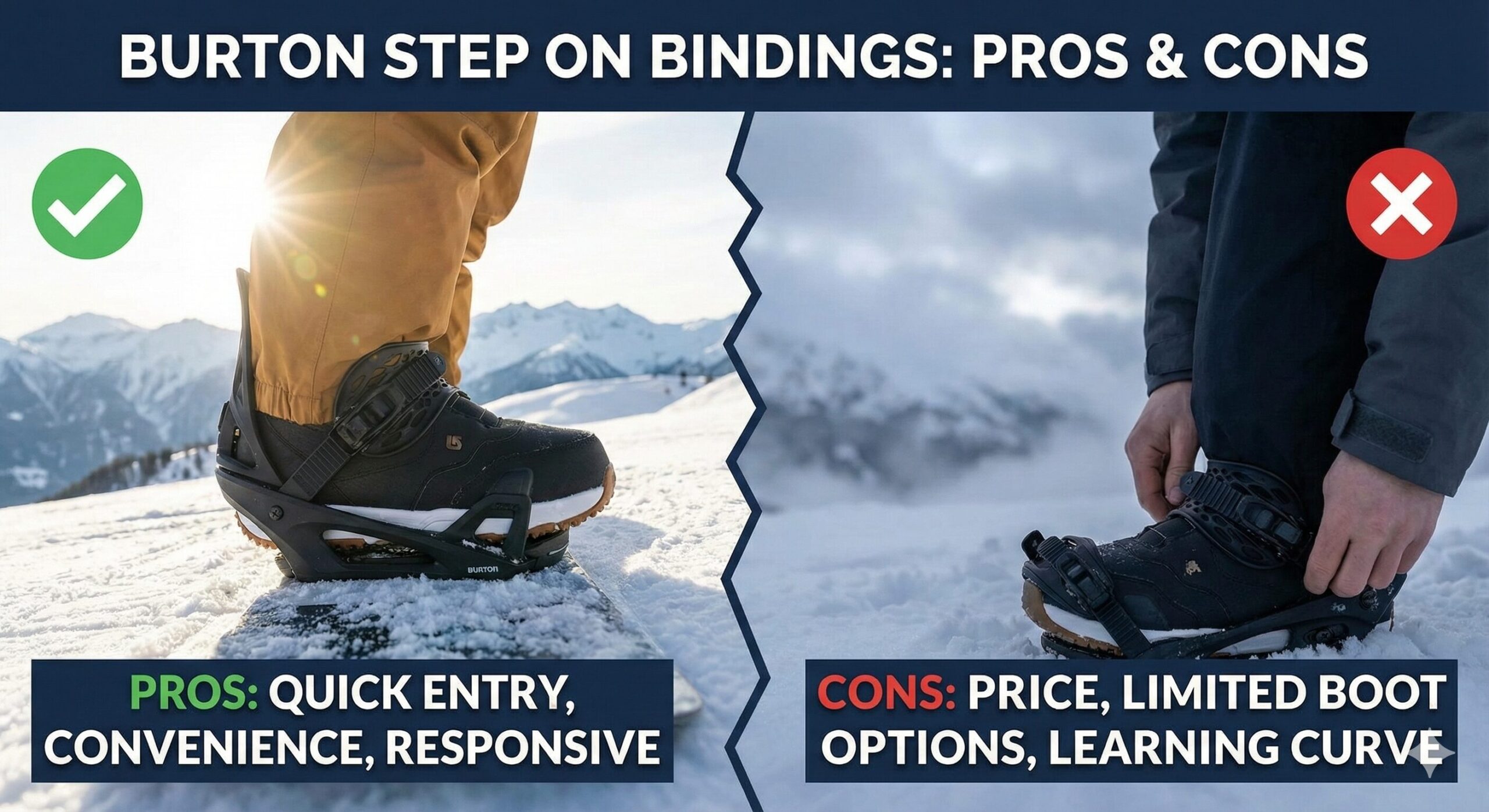
The most comprehensive analysis of the strapless revolution. We break down every click, cleat, and carve to help you decide if it’s time to ditch the straps.
For decades, the ritual was the same. Get off the lift, sit down in the snow (getting your pants wet), crank down on ratchets until your hands were cold, and then finally stand up to ride. If you were a skier converting to boarding, this inefficiency was baffling. If you were a veteran rider, it was just the “tax” you paid for the joy of surfing the mountain.
Then came the Burton Step On system. It wasn’t the first attempt at a strapless interface—the 90s were littered with the failed carcasses of Step-In bindings that clogged with snow and lacked response—but it was the first to actually work. Now, several seasons deep into their existence, the Step On system has moved from a “gimmick” to a legitimate industry standard seen everywhere from beginner slopes to backcountry kickers.
But is it right for you? Changing your entire setup is a significant investment. In this massive guide, we are looking strictly at the Burton Step On bindings pros and cons, dissecting the technology, the feel, the compatibility, and the long-term durability. Whether you are wondering is it easier to ski or snowboard regarding equipment management, or you’re a seasoned pro looking for efficiency, this guide covers it all.
How the Technology Actually Works
Before we weigh the good against the bad, you need to understand the mechanics. Unlike the old-school systems that relied on a metal bar under the sole of the boot, the Burton Step On system utilizes a three-point connection system.
The 3-Point Connection
- Toe Cleats: Two hooks located on the toe box of the compatible boots lock into toe hooks on the binding baseplate.
- Heel Cleat: A single connection point on the heel of the boot creates the primary retention, locking into the highback.
- Release Lever: A small lever on the side of the binding baseplate that, when pulled up, resets the locking mechanism, allowing you to step out.
The brilliance of this design is that it doesn’t just hold your foot down; it holds your boot against the highback. This eliminates the “dead space” often found in strap bindings. When you lean forward or backward, the engagement is instant. For riders asking how to stop heel lift in snowboard boots, this system offers a mechanical solution that straps sometimes struggle to match.

At a Glance: The Pros and Cons
If you are in a rush to get back to the slopes, here is the high-level breakdown of what makes this system shine and where it falls short.
| The Pros (Why You Want Them) | The Cons (Why You Might Hesitate) |
|---|---|
|
|
Deep Dive: The Major Advantages
1. The “Ski-Like” Efficiency
The most obvious benefit is speed. If you ride with skiers, you know the pain of them waiting for you at the top of every run. With Step Ons, you glide off the lift, stomp your back foot down, hear the click-click, and you are gone. This changes the flow of your day. You get more vertical feet in because you aren’t spending 2 minutes strapping in every run. Over a season, that adds up to hours of extra riding.
2. Eliminating Foot Pain
One of the most common complaints riders have is foot agony. We have an entire guide on why do my feet hurt when I snowboard, and a major culprit is overtightening straps. Riders crush their instep trying to get response. Because the Step On system anchors the boot at the toe and heel, there is absolutely no downward pressure on the top of your foot. Blood flow is maintained, feet stay warmer, and you can ride longer.
3. Incredible Edge Response
There is a misconception that these are “beginner” bindings. That is false. Because the boot is mechanically bolted to the highback, the response is arguably faster than traditional bindings. There is no strap stretch. When you lean into a heelside turn, the board engages instantly. For those learning how to carve on a snowboard, this instant feedback can accelerate the learning curve.
4. Durability and Simplicity
Traditional bindings have ladders (the plastic ridged straps) that strip, springs in the buckles that freeze, and screws that come loose. Step Ons have… a lever. There are fewer dangly bits to break. While you still need to know how to wax a snowboard at home and maintain your board, your binding maintenance drops to near zero.
Deep Dive: The Critical Disadvantages
1. The “Ecosystem” Lock-In
This is the dealbreaker for many. You cannot use your favorite ThirtyTwo or Vans boots (unless they are the specific Step On collab models). You must buy a Step On compatible boot. If you have weird feet and Burton boots don’t fit you well, you used to be out of luck. However, with DC and Nitro now making compatible boots, this is less of an issue, but check if Vans snowboard boots are true to size regarding their Step On models before buying.
2. The Deep Powder Struggle
If you fall in waist-deep powder, getting back up is hard enough. Getting into a Step On binding in deep powder requires you to clear the snow from the footbed to get the “click.” Unlike straps where you can just smash your boot in and ratchet it down over the snow, the Step On mechanism needs a relatively clean interface. If you are exclusively into backcountry snowboarding, this is a consideration, though experienced users learn to clear the baseplate quickly.
3. The Price Barrier
We often discuss how expensive is snowboarding, and Step On adds to that. You aren’t just buying $300 bindings; you are buying $300 bindings plus $400+ boots. It is a system purchase.
4. The “Click” Nuance
The heel mechanism has two positions: Position 1 (light engagement) and Position 2 (performance engagement). If you only click into Position 1, you might feel a bit of play. You need to stomp firmly to get that second click. It takes practice, similar to learning BOA vs speed lace systems—it becomes muscle memory, but the first few days can be tricky.

Performance Analysis: Who is it For?
For Beginners
Is it good for newbies? Yes and no. The ease of use is incredible for snowboarding resorts for beginners where you are getting on and off lifts constantly. However, the response is very direct. Beginners sometimes benefit from the “slop” of a strap binding which is more forgiving of mistakes. Step Ons do exactly what you tell them to do, immediately.
For Park Riders
Can you tweak? Absolutely. Burton has released softer boots and bindings specifically for park riders. The lack of ankle straps allows for significant tweak-ability in grabs. If you are working through your list of snowboarding tricks, Step Ons hold up. They are secure enough for large jumps and responsive enough for technical rail riding.
For All-Mountain Riders
This is the sweet spot. If you cruise groomers, dip into the trees, and hit the occasional side hit, Step On is king. The consistent connection makes the board feel like an extension of your body. It pairs exceptionally well with versatile boards. For instance, putting these on a Capita Mercury or Jones Mountain Twin creates a setup that can destroy the entire mountain.
Comparison: Step On vs. The World
Step On vs. Traditional Straps
Traditional straps (like the Union Legacy or Burton Cartel) offer infinite adjustability. You can tweak how tight the toe strap is versus the ankle strap. Step On is a “set it and forget it” system. If you are a tinker who loves adjusting gear at the top of every run, stick to straps. If you just want to ride, go Step On.
Step On vs. Nidecker Supermatic
The Nidecker Supermatic is the main competitor. It is a “step-in” that uses regular straps.
Nidecker Advantage: You can use ANY boot.
Burton Advantage: Step On is significantly lighter and less bulky. The Supermatic is heavy and complex. If weight matters to you, Burton wins.
Step On vs. Clew
Clew bindings separate the highback from the baseplate.
Verdict: Burton’s engineering is vastly more mature. The Step On system feels more integrated, whereas Clew can feel like you are walking around with a plastic bucket strapped to your leg.
Frequently Asked Questions
Do Burton Step On bindings pop out?
No. The system is incredibly secure. Once the heel cleat and toe cleats are engaged, it is mechanically locked. There have been virtually no reports of unintentional releases when the system is used correctly.
Can I use Step On bindings with normal boots?
No. You must use Step On compatible boots from Burton, DC, or Nitro. These boots have the specific cleats required to interface with the binding. If you are looking for standard boots, check out our guide to best snowboard boots for traditional bindings.
Does snow and ice get stuck in the binding?
Ice buildup can occur in the heel cup (the “gas pedal” area), preventing the second “click”. However, it is easily cleared with a gloved hand or by stomping the binding pad before entering. It is rarely a ride-ending issue, even when snowboarding in Colorado powder.
What happens if the lever breaks?
The lever is robust, but if it breaks, the binding fails “safe” (locked). You can still ride down. Burton offers excellent warranty support and replacement parts are available.
Final Verdict: Should You Switch?
After reviewing the Burton Step On bindings pros and cons, the conclusion is clear: This is the future for 90% of recreational snowboarders.
If you are a purist who needs the specific feel of a leather strap, or a backcountry guide who worries about mechanical failure in the middle of nowhere, traditional straps are still your friend. But for the rider who wants to maximize time on snow, eliminate foot pain, and enjoy a seamless connection to their board, the Step On system is worth every penny.
It transforms the experience from a “stop-and-go” sport to a fluid, continuous motion. Just remember to budget for the boots!
Ready to upgrade your gear? Make sure you also check out the best time to buy snowboarding gear to get the best deals on your new setup.


 Home
Home
 About
About
 My Cart
 Reviews
 Compare