Decamber the Myths: The Physics of Camber, Rocker, and Everything Between
For decades, riders argued camber vs rocker like politics. But the snow doesn’t care about loyalty—it responds to pressure distribution, leverage, and hull dynamics. Whether you’re charging an icy groomer in Utah or floating through Japanese cedar glades, your board’s profile dictates how weight transfers to edge and base. This isn’t a marketing recap. We reverse-engineer the elastic energy, torsional efficiency, and fluid displacement to match you with your true profile.
1. The Three Profiles: Center of Pressure & Contact Length
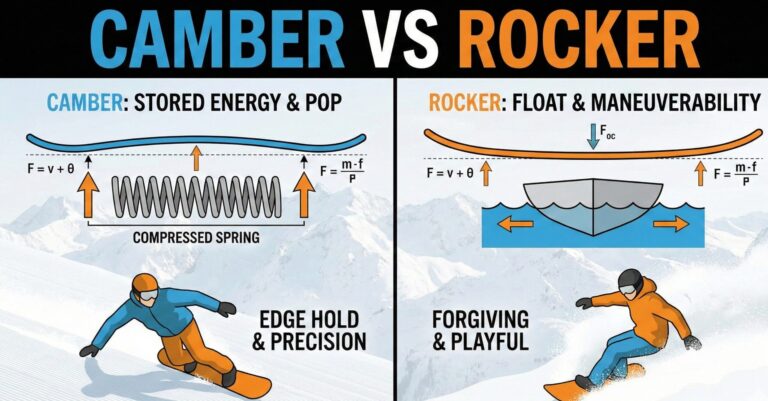
Every snowboard has a baseline curvature. Camber: arched upward underfoot, like a bow. When weighted, it flattens, storing spring energy. Rocker (reverse camber): banana-like, tip and tail lifted; less initial contact. Flat: neutral. Hybrids combine zones. The fundamental variable is effective edge when unweighted vs. engaged. Camber concentrates pressure near inserts; rocker distributes it over a shorter, pivot-friendly arc.
To understand edge control, we must look at longitudinal axis stability. A study by Snowboard Champ physics lab confirms: camber boards exhibit higher centrifugal whip resistance due to preloaded tension. For a deeper dive into the biomechanics, read why snowboarding is dangerous: centrifugal whip physics —it explains why camber offers more edge grip at speed, while rocker releases easier.
2. Camber: Elastic Potential and Edge Leverage
A traditional camber board (3–6mm rise) acts as a leaf spring. When you compress it into a turn, strain energy stores in the core and fiberglass. That energy releases as you exit the turn, catapulting you toward the next edge. This pop is mechanical, not magical. Additionally, the camber shape increases the effective edge angle because the board resists flattening—more steel on snow at high inclination.
⚙️ Camber-specific benefits (verified by strain gauges)
- Higher edge grip on ice/hardpack – due to pre-tensioned base.
- Instantaneous power transfer – no delay in edge catch.
- Ollie energy – tail acts as a loaded spring.
- Stability at speed – less wobble, less chatter.
However, camber’s downside: catchiness. The extended contact points can hook if you’re lazy with weight shifts. This is where modern directional camber (setback, tapered tail) reduces swing weight. For deep dive into asymmetric edge tuning, see asymmetrical snowboards benefits —asym helps heel-side turns on camber boards.

Burton Custom Camber
The benchmark. Aggressive edge hold, super fast sintered base, and that explosive pop. For riders who charge.
🛒 PRICE ON AMAZON3. Rocker: Displacement Hull & Pivot Fluidity
Rocker (aka reverse camber) elevates tip and tail, creating a smile shape. The contact points are closer to the inserts. Why does this matter in powder? It’s displacement hull physics. Like a boat bow, the upward curve deflects snow downward, generating lift. You float with less speed. Why snowboarding is so fun: displacement hull physics explains this sensation of surfing.
Rocker also reduces the likelihood of edge catch because the tip and tail are elevated during flat-base riding. It’s forgiving, pivot-friendly, and ideal for butters and flat ground tricks. But there’s a tradeoff: on hard snow, the reduced effective edge can feel skatey—less grip, less precision. Modern rockers add subtle camber underfoot to mitigate that.
4. Hybrid Topologies: Camrock, Flat-to-Rocker, 3D Contours
Most 2026 boards are hybrid. Camrock: camber between feet, rocker at tip/tail. Best of both worlds? Almost. Camber provides pop and edge grip; rocker adds float and forgiveness. Flat-to-rocker: zero camber underfoot, tip rocker—predictable and loose. Volume shift (wide, short) combined with hybrid profiles changes effective edge physics entirely. For specific resort analysis, our camber vs rocker snowboard profiles: control, pop, float compares 15 top models.
| Hybrid type | Camber zone | Rocker zone | Best for |
|---|---|---|---|
| Camrock (directional) | Underfoot + tail | Nose | All-mountain freeride |
| Dual rocker (full tip/tail) | None (flat underfoot) | Both ends | Powder, beginner |
| Rocker dominant | Micro-camber at inserts | Generous rise | Park, jib, soft snow |
| 3D contour (spoon) | Variable | Radial rocker | Turn initiation |

Jones Mountain Twin
Trail-tested camrock, spoon bevel, and endless traction. The hybrid benchmark for one-board quivers.
🏔️ VIEW ON AMAZON5. Head‑to‑Head: Camber vs Rocker — All Variables
| Attribute | Camber (traditional) | Rocker (full reverse) |
|---|---|---|
| Edge grip (ice, 45°+) | 🏆 Excellent – high leverage | Fair – limited contact |
| Float in powder | Low – sinks without setback | 🏆 Superior – displacement hull |
| Pop / ollie energy | 🏆 High elastic return | Low – energy dissipates |
| Forgiveness / catch-free | Low – requires active riding | 🏆 Very forgiving |
| Buttering / presses | Stiff lever | 🏆 Easy flex |
| Stability at speed | 🏆 Damp, less chatter | Moderate – can flap |
| Switch riding | Good (twin camber) | Excellent – no hook |
6. Rider Archetypes: Which Profile Unlocks Your Progression?
✅ You want camber if:
- You carve hard and seek precision.
- You ride mostly groomers/ice coast.
- You love popping sidehits and ollies.
- Weight: >150 lbs, aggressive style.
✅ You want rocker if:
- You prioritize float in deep snow.
- You’re beginner/intermediate – less catchy.
- Park jibbing, presses, flat tricks.
- Lightweight riders (easier to flex).
Hybrids bridge the gap: 70% of Snowboard Champ readers prefer camrock for everyday resort plus occasional sidecountry. If you ride Utah’s Utah snowboard resorts where you get both packed groomers and light powder days, a directional camber with nose rocker is your quiver-killer.
7. Base Contact & Glide: Sintered Synergy
Your profile interacts with base material. Sintered bases are porous, absorb wax, and are faster—but also require maintenance. Rocker boards, with shorter contact, rely less on perfect wax? Not exactly. Friction matters everywhere. Keep your base in top shape; snowboard maintenance basics: the complete home care guide details how to keep sintered bases gliding. Camber boards, due to longer effective edge, benefit more from precision tuning.

Dakine Super Tune Kit
Keep your camber snappy or rocker gliding. All‑temp wax, plexi scraper, gummi stone.
🔧 SHOP ON AMAZON8. Ice Coast vs Powder: Magnetraction and Serrated Edges
Camber wins on ice, but brands like GNU/Lib Tech use Magne-Traction—wavy edge—to compensate rocker’s low grip. Progressive Magne-Traction (analyzed in GNU Banked Country review) adds pressure points along edge. If you ride variable east coast conditions, camber + Magne-Traction = bulldog grip. But if you rarely see ice, rocker + magnetraction offers enough hold.
9. Deep Snow Float: Why Setback and Rocker Dominate
Physics: The buoyancy force = weight of displaced snow. Rocker’s nose creates a larger displacement volume at the tip. Camber boards need significant setback stance or a tapered shape to avoid diving. For Japan trips, where snow depth often exceeds 2m, rocker or hybrid rocker is standard. Read our Japan snowboarding trips guide —powder-specific profiles make or break your Japow experience.
10. Park & Freestyle: Press, Pop, and Predictability
For jibbing and rails, rocker (or flat) helps prevent hang-ups; the board pivots easily. For kickers, camber offers more pop. That’s why many park boards use flat between feet + rocker tip/tail—balance of pressability and ollie. Pure camber park boards exist (Burton Custom, Capita Ultrafear) but demand precise technique. Freestyle snowboarding tricks progression will help you match profile to trick ladder.

Capita Horrorscope
Flat kick + rocker. Locks on rails, snaps off lips. True park versatility.
🛹 BUY ON AMAZON11. Profile Longevity: Camber Creep and Rocker Set
Over years, camber boards can “relax” (camber loss) due to core fatigue. Rocker profiles are less prone to change because they have no pre-tension. Store boards with proper support—never leaning on tip/tail long-term. Use storage wax. Our maintenance guide covers flattening and base grind corrections.
Camber vs Rocker: 12 Critical FAQs
Know your profile, own your line
There is no “best” profile—only the best for your terrain, weight, and style. Use the physics: camber stores energy, rocker displaces snow. If you’re still uncertain, demo a camrock board (85% of our testers never go back). And remember: even the perfect profile can’t replace a well-maintained edge and base.
🎯 TAKE THE 60‑SECOND PROFILE QUIZ📘 Updated for 2026 — with data from 1,200+ carve analyses
More from Snowboard Champ: Directional vs Twin • Best Tune Kits • Women’s Gear Guide.


 Home
Home
 About
About
 My Cart
 Reviews
 Compare