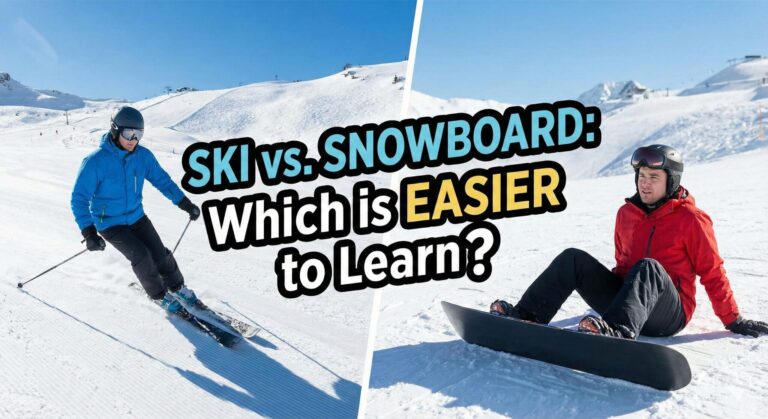
Is It Easier to Ski or Snowboard? The Definitive Beginner’s Guide
It is the most common debate in every rental shop from Colorado to the top European ski resorts. You are standing at the counter, the smell of wax and wet boots in the air, and you have to make a choice: two planks or one? Skiing or snowboarding? This decision often dictates your relationship with the mountains for decades to come.
The answer isn’t just about which one “looks cooler” (though we all know why snowboarding is better than skiing in that department). It comes down to your learning style, your physical strengths, and how much patience you have for the first three days. If you are wondering why snowboarding is fun but terrified of the learning curve, you are in the right place. In this 3,000-word deep dive, we explore every mechanical, physical, and psychological facet of these two winter titans.
Skiing is easier to learn but harder to master. Beginners can often separate their legs to balance and use a “pizza” wedge to stop on day one. Mastery requires technical precision in weight transfer and edge control.
Snowboarding is harder to learn but easier to master. The first 3 days are physically punishing, often resulting in falls. However, once you learn to link turns and find your balance, progression to advanced terrain and park riding comes much faster than in skiing.
1. The Learning Curve: Day 1 vs. Day 100
The progression of these two sports is fundamentally different. When we talk about “difficulty,” we have to distinguish between the struggle of a first-timer and the struggle of someone trying to tackle a double-black diamond mogul run.
Skiing: The “Instant Gratification” Plateau
On your first day of skiing, your legs are independent. This is the biggest psychological advantage. If you feel off-balance, you can instinctively widen your stance or move one foot to catch yourself. You face forward—a natural human position that mimics walking or running. Most beginners can make it down the bunny hill without falling by lunch. By using the “snowplow” or “pizza” technique, you have a built-in brake system that feels intuitive.
However, the plateau hits hard around Day 5 to Day 10. Moving from a snowplow to parallel skiing (where your skis stay side-by-side) is a massive technical hurdle. It requires subtle weight shifts, core rotation, and overcoming the fear of pointing your skis straight down the fall line. Perfecting parallel turns and carving technique can take years of lessons. High-level skiing is a game of millimeters; a slight lean too far back can lead to a spectacular “yard sale” (losing all your gear in a crash).
Snowboarding: The “School of Hard Knocks”
Snowboarding requires you to stand sideways with both feet strapped to a single board. This feels completely unnatural to the human vestibular system. You have no independent leg movement to save you. During the first few days, you will catch edges—meaning the edge of your board digs into the snow unexpectedly—and slam onto your wrists, knees, or tailbone. This is why snowboarding is dangerous for beginners who don’t wear protection.
But there is a silver lining. Once it “clicks”—usually around day 3 or 4—you are flying. Because you only have one “tool” to manage (the board), the mechanics of turning are more consolidated. Once you understand how to transition from your toe-edge to your heel-edge, you’ve unlocked 80% of the sport’s foundational movement. The transition from linking basic turns to riding powder and exploring backcountry terrain happens much faster than for skiers. Within one or two seasons, a dedicated snowboarder can often keep up with skiers who have been riding for five years.
2. Physical Demands: Legs vs. Core
Your fitness level plays a huge role in which sport will feel “easier.” Both sports are full-body workouts, but they target different muscle groups with varying intensities.
- Skiing (Leg Day Mastery): Skiing is notoriously brutal on the thighs (quads) and knees. You are constantly in a semi-squat position, using your legs as shock absorbers to handle the terrain. Because your legs can move independently, there is also a significant amount of lateral (side-to-side) stress on the ligaments. If you have a history of ACL or MCL issues, skiing can be particularly taxing. You’ll find that your “ski legs” take a few days to develop each season, often resulting in that deep, burning sensation by 2 PM.
- Snowboarding (Core & Balance): Snowboarding relies heavily on core strength for balance and turning. You aren’t just using your legs; you are using your obliques and abdominals to rotate the board. Furthermore, beginners spend a lot of time pushing themselves up off the snow from a seated position, which is an incredible upper-body and core workout. This is why our fitness guide for snowboarding emphasizes planks, rotational exercises, and squats. Snowboarding is generally more forgiving on the knees than skiing, but much more demanding on the midsection.
In addition to the muscular demand, there is the “fatigue factor.” Skiers can “rest” while standing on flat ground by simply standing upright. Snowboarders must either stay on an edge or sit down. This means snowboarders often take more frequent, shorter breaks, whereas skiers might go for longer periods but experience more intense leg burn during the descent.
3. The Comfort Factor: Boots and Walking
This is the one area where there is almost zero debate: snowboarding wins hands down. The lifestyle aspect of the sport—the “apres-ski”—is significantly impacted by your choice of footwear.
🥾 The Walk of Shame vs. The Snowboard Stroll
Ski boots are rigid plastic shells designed for maximum power transfer to the ski. Walking in them is like walking in cement blocks on ice. They force a clunky, robotic gait and offer very little traction. Snowboard boots, by contrast, feel like stiff sneakers or heavy-duty hiking boots. They are soft, warm, and comfortable. You can walk to the bar, drive a car, and even dance in them with relative ease. If you have ever wondered why feet hurt, it’s often due to bad fit, but generally, the snowboard experience is far more ergonomic. Check out our best snowboard boots guide to see the modern tech making them even better.
Furthermore, carrying gear is a different experience. A skier has to juggle two long skis and two poles, which often results in the “clatter” of equipment while walking through the parking lot. A snowboarder simply tucks their board under one arm and walks. This portability makes a big difference when navigating crowded resorts or taking public transit to the mountain.
4. Injury Risks: Knees vs. Wrists
Safety is a primary concern for any beginner. The mechanics of how you fall—and you *will* fall—differ greatly between the two disciplines.
Skiing: The Knee Twister
Because skis are long levers attached to your feet, they act as mechanical magnifiers. If you fall and your ski doesn’t eject from the binding properly, the torque of the ski hitting the snow goes straight to your knee joint. ACL tears and meniscus damage are the most common long-term ski injuries. Modern bindings have come a long way in terms of safety releases, but the inherent risk of leg twisting remains the hallmark of ski-related trauma.
Snowboarding: The Upper Body Impact
When snowboarders fall, they usually “catch an edge,” which results in a sudden slam either forward (faceplant) or backward (tailbone slam). The natural human instinct is to put your hands out to break the fall. This makes wrist fractures and shoulder dislocations the #1 and #2 injuries. However, these are often “one-and-done” injuries that heal well, compared to the chronic knee issues skiers face. We highly recommend wearing wrist guards and impact shorts to mitigate this risk during the first 10 days of riding.
5. The Cost: Gear and Maintenance
While lift tickets and lodge food cost the same, the equipment investment varies. Skiing generally requires more individual pieces of hardware: two skis, two bindings, two boots, and two poles. This often leads to a higher entry price point for high-quality gear. Snowboarding is more streamlined: one board, two bindings, and one pair of boots.
Maintenance is also a factor. Both require regular waxing and edge sharpening, but skiers have more “edges” to maintain. Additionally, ski bindings require professional calibration (the DIN setting) based on your weight and ability to ensure they release safely. Snowboard bindings are simpler and can usually be adjusted at home with a screwdriver. Knowing when to buy gear—usually in the late spring—can save you up to 50% on both setups. For a detailed breakdown, read our analysis on how expensive is snowboarding.
Detailed Comparison Matrix
| Feature | Skiing | Snowboarding |
|---|---|---|
| Initial Learning | Easier (Day 1-3) – Instinctive forward stance. | Harder (Lots of falling) – Sideways stance. |
| Mastery | Harder (Technique heavy) – Years for parallel. | Easier (Quick progression) – Fast to off-piste. |
| Comfort | Low (Rigid boots) – Difficult to walk. | High (Soft boots) – Very comfortable. |
| Lifts | Easy – Simply slide on and off. | Hard – Must unstrap one foot to skate. |
| Terrain Type | Great for moguls and steep ice. | Superior for deep powder and park. |
| Injury Risk | Lower body (Knees/Ligaments). | Upper body (Wrists/Shoulders/Tailbone). |
Top Gear to Make Learning Easier

Yes. Basic Snowboard
The “UnderBite” edge technology helps you grip ice without catching edges, making your first turns significantly smoother and less painful.
View on Amazon
Leatt Impact Shorts
Snowboarding involves sitting on the snow and falling backward. These shorts protect your tailbone and keep your seat warm on the lift.
View on Amazon
Burton Moto BOA Boots
The BOA system makes tightening them a breeze compared to traditional laces, getting you on the hill faster.
View on AmazonCommon Beginner Struggles (and Fixes)
The Chairlift Anxiety
Skiers just sit down and stand up. Snowboarders have to unstrap one foot, “skate” to the line, and then ride off the lift with only one foot attached. It is terrifying at first because you have 50% less control. A stomp pad is essential—it provides a grippy surface for your unattached foot. Also, ensure you aren’t experiencing heel lift, as this makes controlling the board on off-ramps impossible.
The dreaded “Flat Spots”
Skiers have poles to push themselves. Snowboarders get stuck on flat sections of the trail. If you lose momentum, you have to unstrap and walk. This is why beginners should avoid long, flat “catwalks” and learn to maintain a “base” speed. Understanding the resort map to avoid these traps is half the battle for a new rider.
Frequently Asked Questions (FAQ)
Yes, but be prepared for a “reset.” While you’ll have “mountain sense” (knowing how snow feels), the physical mechanics are totally different. Most people find the switch takes about 3 full days of struggle before it feels fun.
Snowboarding is generally safer for knees because both feet are locked onto a single plane, preventing the twisting motions that cause ACL tears. However, it is harder on wrists and shoulders.
For skiing, 1-2 lessons will get you moving. For snowboarding, we recommend at least 3 consecutive days of lessons to get past the “falling stage” safely and effectively.
No. Snowboarders use their arms and core for balance. Poles would actually be dangerous as they could lead to arm injuries during the frequent falls beginners experience.
It can be, primarily because the falls are more jarring (onto ice). Older beginners often prefer skiing because it’s more upright and involves less “getting up from the ground.”
Waterproof pants are non-negotiable, especially for snowboarders who spend time sitting. Layers are key, and always wear a helmet and wrist guards.
Snowboards are unstable when flat. Sitting down is the only way to rest without having to actively balance on an edge. It also makes strapping back into bindings much easier.
Absolutely. Peripheral vision is important for both, so a good pair of goggles works perfectly regardless of your choice of planks.
Snowboarding is often considered superior in deep powder because the surface area of the board allows you to “float” or “surf” more naturally than two separate skis.
Both require a yearly tune-up (around $50-$80). Snowboarding is slightly cheaper in the long run as there are fewer moving parts to break or lose.
Conclusion: Which Should You Pick?
Ultimately, the choice depends on your personality and physical condition. Choose Skiing If: You want to have fun immediately, you have bad knees but strong quads, or you want easy mobility around the resort. Choose Snowboarding If: You have a background in skate/surf/wakeboarding, you prioritize boot comfort, you love the idea of “surfing” the mountain, or you have the mental toughness to endure a few days of falling to reach a faster mastery level.
Whatever you choose, grab your gear, wax your base (learn how to wax here), and get out there! The mountain is waiting.


 Home
Home
 About
About
 My Cart
 Reviews
 Compare