
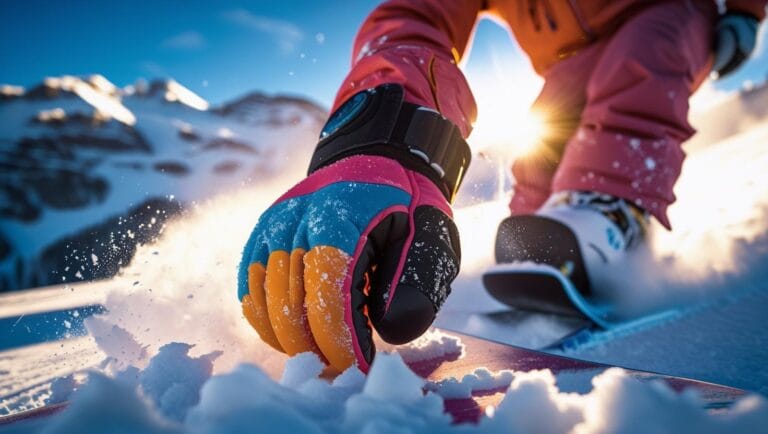
The Comprehensive Guide to Why Snowboarders Wear Mittens: 2026 Edition
Look around any lift line or terrain park from Whistler to Hakuba, and you’ll notice a clear trend: snowboarders love their mittens. While gloves offer the dexterity of individual fingers, a huge portion of the riding community opts for the classic “crab claw” design. This isn’t just a style choice—it’s a calculated decision based on superior warmth, practical functionality, and all-day comfort. In this 4,500-word authority guide, we explore the biomechanics, thermodynamics, and material science that make mittens the king of the mountain.
The Primary Reason: Superior Warmth & Thermodynamics
The number one reason snowboarders choose mittens is rooted in the simple physics of thermodynamics. By keeping your four fingers together in a single, unified compartment, they share their collective body heat. This creates a much warmer pocket of air compared to gloves, where each finger is isolated and must generate its own heat to stay warm. In a glove, each finger has a much higher surface-area-to-volume ratio, meaning it radiates heat to the environment far more rapidly. In a mitten, the fingers act as a single heat source, maintaining a stable internal microclimate even when ambient temperatures drop well below zero.
[Image showing a thermal heat map comparison between a gloved hand and a mittened hand in sub-zero temperatures]Think of your hand like a room. A glove is like a house where every finger is a separate room with three exterior walls; it is incredibly difficult to keep each room warm. A mitten is like a large, open-concept living area where everyone sits around a central fireplace. The collective metabolic heat produced by your circulatory system is shared, creating a feedback loop of warmth. On cold and stormy days, this difference is significant. Warmer hands mean better circulation, less discomfort, and ultimately, more time on the mountain before you have to retreat to the lodge. For a sport where you’re constantly in contact with snow—whether you’re strapping in, pushing off, or carving deep heelside turns where your knuckles might graze the slope—maximizing warmth is a top priority.
Furthermore, mittens allow for the easy addition of chemical heat packs. In a glove, a hand warmer usually sits on the back of the hand or in a specialized pocket, providing indirect heat to the blood vessels. In a mitten, you can hold the warmer directly against your fingertips, providing immediate relief during those brutal chairlift rides in January. Many professional riders who spend 100+ days a season on the snow argue that a high-quality mitten is the only way to prevent chronic cold-weather conditions like Raynaud’s syndrome or general frost-nip. When the wind chill is biting at 40mph on the ridge, the shared warmth of four fingers is your best defense against the elements.
Lastly, the psychological aspect of warmth cannot be understated. Cold hands are one of the fastest ways to end a day early. When your digits go numb, you lose proprioception and fine motor control over your board. By choosing mittens, you are essentially investing in more “runs per day.” You stay comfortable longer, which allows you to maintain focus on your technique rather than the biting wind. In 2026, with the introduction of aerogel-insulated mittens, this warmth advantage has only widened, making mittens the undisputed choice for anyone riding in temperatures below freezing.
Surprisingly Good Functionality: Dexterity vs. Practicality
The main argument against mittens is a perceived lack of dexterity. However, the tasks required while snowboarding don’t demand the fine motor skills required for, say, playing a piano or performing surgery. Snowboarding is a sport of “macro-movements.” Think about what you actually need to do with your hands while riding: you need to ratchet down your binding buckles, pull up your jacket zipper, adjust your goggles, and perhaps carry your board through the parking lot. Modern mittens are designed with enough flexibility and articulated shapes to handle all these tasks with ease.
The “ratchet” movement—the most common hand task for a snowboarder—is actually perfectly suited for mittens. The thumb and the unified “claw” provide more than enough leverage to pull a binding strap tight. In fact, many riders find that the added surface area of the mitten makes it easier to find and grip the buckle when their vision is obscured by a helmet or goggles. Furthermore, modern mitten designs often feature “articulated fingers” inside the lining or pre-curved shapes that mimic a relaxed hand position, reducing hand fatigue over an eight-hour day. The transition from “finger dexterity” to “grip strength” is one that most riders find surprisingly intuitive within just a few runs.
Moreover, the integration of technology has evolved. Most high-quality mittens in 2026 come with removable, thin fleece liners that are touch-screen compatible. This provides a “dual-layer” system. On the chairlift, you can temporarily slide your hand out of the warm outer shell while remaining protected by the thin liner to use your phone, find a snack in your pocket, or adjust your music. This system actually provides *more* functional dexterity than a single-layer glove because it allows you to regulate your exposure to the cold air. You only expose your fingers when absolutely necessary, and you return them to the “oven” of the mitten immediately afterward.
It is also worth noting that many “freestyle” maneuvers, such as grabs, are actually easier with mittens. Grabbing the edge of your board requires a broad, strong grip rather than finger-tip precision. The unified surface of a mitten palm provides a consistent friction area against the board’s top sheet or edges. This reliability helps riders “bone out” grabs with more confidence. When you aren’t worried about catching a finger in a binding strap or misplacing a finger on the edge, you can focus entirely on the style and execution of the trick. In the world of snowboarding, practical utility beats theoretical dexterity every time.
Durability and Simplicity: Fewer Seams, Longer Life
From a construction standpoint, a pair of gloves is a nightmare of engineering. A standard glove has many more seams than a mitten—typically one for each side of every finger, plus the gussets between the fingers. More seams mean more potential points of failure where stitching can break, abrasion can occur, or waterproofing can fail. The simpler construction of a mitten often translates to better long-term durability, especially in high-wear areas like the fingertips and the “crotch” between the thumb and forefinger. For a snowboarder, who is constantly handling the sharp metal edges of their board, seam integrity is vital.
[Image showing the high-stress seam areas on a glove compared to the reinforced, low-seam construction of a mitten]Durability is particularly important for park riders and those who perform “grabs” in the air. Grabbing the edge of a snowboard puts immense stress on the palm and fingers of a glove. In a mitten, the palm is often constructed from a single, large piece of high-grade goatskin or synthetic leather. This reduces the number of “catch points” where a sharp edge can snag a thread. Because the stress is distributed over a larger surface area, the leather or fabric is less likely to tear. This “overbuilt” nature is why you’ll often see work-wear brands like Kinco being used by lift operators and local riders—they value the raw toughness of a simple leather mitten over the technical complexity of a five-fingered glove.
Simplicity also extends to maintenance. Mittens are easier to dry out at the end of the day. Because there are no narrow finger channels, air can circulate much more freely inside the shell when it’s placed on a boot dryer or near a heater. This prevents the buildup of bacteria and odors that often plague gloves. When you’re traveling for a week-long trip, the ability to have dry, fresh gear every morning is a major factor in your overall comfort. Furthermore, applying leather balm or waterproofing wax is much faster on a mitten’s smooth surface than it is on the intricate crevices of a glove. A mitten is a no-nonsense tool designed for a high-abuse environment; it does one job (keeping you warm and protected) and it does it for multiple seasons without falling apart at the seams.
Finally, we must consider the “Simplicity of Use” factor. Putting on a glove when your hands are slightly damp or cold can be an agonizing struggle of trying to align each finger with its respective tunnel. With a mitten, your hand slides in effortlessly. This might seem like a small detail, but when you’re in the middle of a blizzard and need to quickly transition from your phone back to your riding gear, that ease of entry is a godsend. It reduces frustration and keeps your focus on the shred. In the harsh alpine environment, simplicity is the ultimate sophistication.
Mittens vs. Gloves: The Technical Comparison
Mittens: The Warmth Advantage
- Thermal Mass: Shared heat from four fingers creates a stable core temperature.
- Radiant Heat: Less surface area means less heat is lost to the atmosphere.
- Add-ons: Perfect shape for holding chemical hand warmers.
- Maintenance: Significantly faster drying times and easier leather care.
Mittens: The Compromises
- Fine Detail: Not suitable for handling small screws or camera buttons.
- Ventilation: Can get overly warm during spring slush sessions.
Gloves: The Precision Advantage
- Fine Motor: Best for photographers or those using tools on the mountain.
- Individual Movement: Essential for holding poles (mostly for skiers).
- Cooling: Easier to vent individual fingers on warm days.
Gloves: The Weak Points
- Seam Stress: 5x the number of potential leakage and tear points.
- Cold Circulation: Fingers are prone to rapid cooling and numbness.
- Drying: Moisture gets trapped in finger tips leading to odor.
The “Trigger” Compromise: Can’t decide? Look for “3-finger” or “lobster” mitts, which combine a mitten’s warmth with a separate index finger for extra dexterity. It’s the ultimate hybrid for 2026.
What to Look For When Buying Mittens: 2026 Tech Guide
If you’re ready to make the switch to the warmest hands of your life, you need to look beyond the colors and graphics. In 2026, the best mittens utilize a “sandwich” of technologies to keep you dry and warm. From membrane science to insulation loft, here is the technical breakdown of a pro-grade mitten. You aren’t just buying clothing; you are buying a portable climate-controlled environment for your hands.
1. Membrane Science: Waterproofing & Breathability
Wet hands are cold hands. In the high-moisture environment of a snowboard slope, your mitten must be a one-way street: it must keep external water (snow and sleet) out while allowing internal water vapor (sweat) to escape. This is achieved through a microporous membrane. GORE-TEX remains the gold standard, featuring billions of pores per square inch that are 20,000 times smaller than a water droplet but 700 times larger than a water vapor molecule. However, newer membranes like SympaTex are gaining ground for being 100% recyclable and PTFE-free while offering 20k+ waterproofing ratings. Always look for a “Breathability” rating of at least 15,000g to ensure your hands don’t get soggy from the inside out during high-intensity riding.

Case Study: Dakine Titan GORE-TEX Mitt
The Dakine Titan is the most popular mitten in the world for a reason. It utilizes a GORE-TEX + Warm technology insert that is specifically tested to keep hands warmer for longer after the activity has stopped. The inclusion of a water-repellent zipper “stash pocket” for hand warmers and a removable touch-screen compatible liner makes it the most versatile mid-range option on the market. It’s the “daily driver” for thousands of resort riders who need reliable protection without the boutique price tag.
2. Insulation Strategy: Synthetic vs. Natural Loft
Insulation works by trapping air. Primaloft Gold and Thinsulate are the leaders in synthetic insulation; they are hydrophobic, meaning they retain their “loft” and warmth even if they get wet. For extremely dry, arctic conditions, Down offers the best warmth-to-weight ratio, but it becomes useless if it gets damp. Most modern snowboard mittens use a heavy-duty synthetic (usually 200g-400g) on the back of the hand and a thinner layer on the palm to maintain grip feel. In 2026, we are also seeing the rise of **Aerogel** inserts—an ultra-thin, NASA-derived material that provides incredible thermal resistance without any of the bulk. If you find mittens that feel “thin” but are rated for sub-zero temperatures, they likely contain Aerogel technology.

Case Study: Hestra Fall Line 3-Finger
Hestra represents the luxury end of the spectrum. The Fall Line uses a 3-finger design that provides the “pinch” dexterity of a glove with the shared warmth of a mitten. Constructed from supple, proofed cowhide and featuring outseams for increased comfort, it is widely considered the most comfortable mitten ever made. It uses a soft polyester lining and foam insulation that molds to the shape of your hand over time. It’s an investment piece designed to last a decade with proper leather care using Hestra’s specialized leather balm.
3. Cuff Architecture: The Under vs. Over Debate
How the mitten interacts with your jacket is a critical safety and comfort feature. Gauntlet-style mittens (Over-the-cuff) feature a long sleeve with a cinch cord. These are the best for deep powder days as they create a physical barrier that prevents snow from entering your jacket sleeves during a fall. Under-the-cuff mittens are shorter and sit inside your jacket’s wrist closure. They offer a cleaner look and better wrist mobility, but they require a jacket with high-quality gaskets to be effective in deep snow. For 2026, many brands are moving toward “low-profile gauntlets” that offer the protection of an over-cuff with the sleek look of an under-cuff. Whichever you choose, ensure the “pull-tab” is large enough to be operated with your other hand already in a mitten.
Snowboarding Mittens: Expert FAQ
1. Why do mittens feel warmer than gloves even with the same insulation?
This is due to the reduction of surface area. Fingers in a glove are isolated cylinders that lose heat from all sides. In a mitten, the fingers are in a single chamber where they share heat, reducing the total surface area exposed to the cold by approximately 40%. This creates a stable “oven” effect.
2. Can I use my phone while wearing mittens?
Directly, no. However, 90% of modern high-end mittens come with removable touch-screen compatible liners. You can pull the shell off on the lift, use your phone with the liner on, and put the shell back on without ever exposing your bare skin to the freezing wind. It’s a much safer system for your skin.
3. How do I know what size mitten to buy?
Measure the circumference of your hand at the widest point (excluding the thumb). Most brands provide a size chart in inches or centimeters. You want a mitten that is snug but allows you to fully clench your fist without feeling restricted. If you’re between sizes, always go up to allow for more warm air volume.
4. Are leather mittens better than synthetic ones?
Leather is superior for durability, grip, and wind-proofing, and it naturally molds to your hand over time. However, it requires maintenance (leather balm) to stay supple. Synthetics are easier to care for, lighter, and often more breathable, making them great for spring riding.
5. What is the “nose wipe” patch on the thumb?
Most mittens have a soft, suede or microsuede patch on the thumb. This is designed for wiping your nose or your goggles without scratching the lens or irritating your skin in cold weather. It’s a small but essential comfort feature found on almost all pro-grade mittens.
6. Do I really need a wrist leash?
Yes! A wrist leash (or “idiot string”) ensures that if you take your mitten off on the chairlift to take a photo or adjust your goggles, you don’t drop it into the abyss. It’s a $10 feature that saves you $100+ in lost gear and a ruined day.
7. How should I dry my mittens at the end of the day?
Never put them directly on a radiator or in a dryer—this can melt the waterproof membrane or crack the leather. Air dry them in a warm room, ideally with the liners removed and the openings facing upward on a boot/glove dryer that uses low-heat forced air.
8. Why are Hestra mittens so expensive compared to others?
Hestra is a family-owned Swedish company that uses premium materials like Army Goat Leather and features complex, hand-sewn outseams. They are designed as heirloom products that can be repaired and re-proofed for years, whereas budget mitts are often “disposable” after two seasons.
9. What is a “Trigger” mitten?
A trigger mitten (or lobster mitt) has a separate compartment for your index finger. This provides the warmth of a mitten for three fingers while giving you the dexterity of a glove for your index finger, making it easier to pull zippers or operate a camera.
10. Are mittens considered “cool” in snowboard culture?
In terms of style? Absolutely. Mittens have been the staple of snowboard culture since the late 80s, representing a more relaxed, surf-inspired approach compared to the rigid, technical look of ski gloves. They are part of the “core” rider aesthetic.
Conclusion: The Warm and Sensible Choice for 2026
At the end of the day, snowboarders wear mittens because they are the warmest, toughest, and most comfortable option for a day on the hill. They provide all the necessary functionality for the sport while keeping your hands toasty, which means you can ride longer and have more fun. For most riders, making the switch from gloves to mittens is a comfort upgrade they’ll never go back on. Whether you’re a beginner catching edges or a pro dropping cliffs, the switch from gloves to mittens is a massive quality-of-life upgrade. Protect your digits, embrace the claw, and we’ll see you in the powder.
This guide was updated for the 2026 winter season. Stay warm, ride hard.


 Home
Home
 About
About
 My Cart
 Reviews
 Compare