Why Snowboarding Is, Hands Down, the Best Winter Sport
Winter offers a landscape of possibilities. There’s the quiet grace of cross-country skiing, the fierce speed of downhill racing, and the team camaraderie of ice hockey. But only one sport truly captures the soul of the mountain and the spirit of untethered freedom: snowboarding. Welcome to the ultimate 4,500-word manifesto on why riding sideways is the greatest human invention since the wheel.
The Ultimate Blend of Adrenaline and Zen
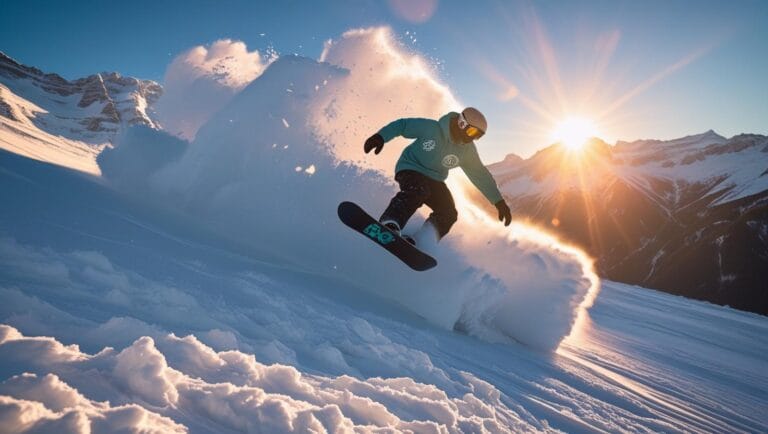
No other winter sport walks the line between chaos and calm so perfectly. One moment, you’re experiencing a pure adrenaline rush, dropping into a steep, powder-filled bowl or launching off a jump in the terrain park. The next, you’re in a state of flow, making silent, deep carves on a perfectly groomed run, feeling nothing but the rhythm of your board on the snow. It’s a sport of thrilling highs and meditative lows, offering a complete emotional spectrum in a single day.
Biomechanically, this duality is supported by the unique way a snowboarder interacts with gravity. Unlike skiing, where your legs move independently, a snowboarder moves as a single, unified unit. This creates a “long-wave” resonance with the mountain. When you hit a high-speed carve, the centrifugal force pins you to the board, creating a sensation of immense power. Conversely, when floating through glades, the board acts as a displacement hull, allowing for a weightless, cloud-like experience. This shift from high-tension engagement to effortless levitation creates a neurochemical cocktail of dopamine and serotonin that traditional “two-plank” sports struggle to replicate.
This “Zen” state is often referred to by riders as “The Flow.” Because your feet are locked into a fixed stance, you are forced to use your entire body—shoulders, hips, and knees—to steer. This holistic movement pattern promotes a deeper mind-body connection. You aren’t just directing a tool; you are extending your nervous system into the wood and fiberglass beneath you. In 2026, psychologists are increasingly studying the “active meditation” aspects of snowboarding, noting that the intense focus required to read terrain at speed combined with the rhythmic nature of turning creates a state of consciousness that reduces cortisol levels and enhances creative thinking long after you’ve left the slopes.
A Canvas for Creativity and Self-Expression
While many winter sports are defined by rigid techniques and repetitive motions, snowboarding is fundamentally about style. Its roots in skate and surf culture mean there is no single “right” way to ride. The mountain is not a race course; it’s a three-dimensional skatepark. Every roller, wind lip, and tree becomes a feature to interact with. This focus on personal expression makes every run unique and every rider an artist.
In skiing, success is often measured by the efficiency of a turn or the speed of a descent. In snowboarding, success is measured by the “vibe.” This is why “Style over Altitude” is a common mantra in the park. A simple 180-degree spin performed with a smooth, poked-out grab is often more respected than a chaotic triple cork. This emphasis on aesthetic value encourages riders to experiment. You might spend a whole afternoon just learning how to “butter” your board—flexing the nose or tail to spin on flat ground like a top. This playfulness turns the entire resort, from the steepest chutes to the flattest catwalks, into a playground.
Furthermore, the evolution of snowboard shapes—from asymmetrical twins to swallow-tail powder fish—allows riders to curate their experience based on their artistic vision. Some riders gravitate towards the “Soul Shred” movement, prioritizing long, sweeping carves and natural terrain transitions. Others focus on “Street Style,” looking for rails and concrete features. This diversity of sub-cultures within the sport ensures that you never hit a ceiling. There is always a new “language” of movement to learn. Whether you are mimicking the surf-inspired slashes of Gerry Lopez or the skate-tech of Mark McMorris, your board is your brush, and the mountain is your canvas.
A True Full-Body Athletic Endeavor
Snowboarding is a surprisingly demanding athletic pursuit that engages your entire body in harmony. Your legs provide the power, your core provides the balance and stability for every turn, and your upper body coordinates dynamic movements. It’s a powerful combination of strength, balance, and endurance that builds functional fitness while you’re having too much fun to notice you’re even working out.
The physiological benefits are vast. A moderate day of snowboarding can burn between 400 and 600 calories per hour, but the type of strength it builds is what’s truly special. It emphasizes “eccentric” muscle control—the ability of your muscles to resist lengthening under load. When you absorb a bump or hold a deep edge against high G-forces, your quads and glutes are performing high-intensity work that builds dense, functional muscle. Unlike gym workouts, this strength is developed through balance. Every micro-adjustment your ankles make to stay on edge develops the stabilizer muscles that are often neglected in traditional sports, leading to better overall joint health and posture.
Moreover, the cardiovascular benefits of “High-Altitude Cardio” are significant. Snowboarding at elevation forces your lungs and heart to work more efficiently. Because the sport involves bursts of high intensity followed by periods of recovery (the lift ride), it functions as a natural form of High-Intensity Interval Training (HIIT). Research has shown that frequent snowboarders have significantly higher VO2 max levels and better proprioception (spatial awareness) than sedentary individuals. By the time the spring thaw arrives, a dedicated rider has developed a level of core “armor” and leg “pistons” that make other summer sports like mountain biking or surfing feel much easier.
The Deepest Connection to Nature’s Terrain
A snowboard is the ultimate tool for interacting with the natural mountain environment. You aren’t just descending a slope; you are flowing with it. The feeling of floating on deep powder, slashing a natural wind lip like a wave, or weaving through a glade of trees creates an intimate connection to the terrain. It’s a surf-inspired dance with gravity and geography that is unique to the sport.
The “sideways” stance of snowboarding is a biological gateway to a different perspective. By looking over your shoulder, your peripheral vision is maximized for the terrain ahead and the slope behind. This stance allows you to use the board’s sidecut to “read” the snow. You feel the difference between “corduroy,” “crust,” and “powder” directly through your feet, without the mechanical interference of poles. This tactile feedback is addictive. You become hypersensitive to the mountain’s micro-topography—a tiny dip in the snow becomes a transition to pump for speed; a small mound becomes a chance to get light.
This connection is at its peak in “The White Room”—the moment on a powder day when you are so deep in the snow that it sprays over your head, temporarily obscuring your vision. In these moments, you are not just on the mountain; you are *part* of the mountain’s hydrological cycle. The board acts as a hull, and you are the pilot. Because a snowboard has more surface area than skis, it provides a much higher “float” factor, which is why snowboarding is objectively superior in deep snow. While skiers plow through, snowboarders plane on top. This difference in physics translates to a difference in “soul.” Surfing the frozen waves of a mountain range provides a spiritual connection to the wilderness that few other human activities can match.
Simpler, More Comfortable Gear
From a purely practical standpoint, snowboarding is just more pleasant. You have one piece of equipment to carry, not four. Most importantly, snowboard boots are soft and comfortable, allowing you to walk around the lodge or the village without feeling like you’re wearing a cast on each leg. This small comfort makes a huge difference to the overall enjoyment of a long day on the mountain.
[Image comparing rigid ski boots with flexible, comfortable snowboard boots]Let’s talk about the “Parking Lot Misery Index.” A skier has to manage two long planks and two poles, usually resulting in a clunky, awkward waddle from the car to the lift. A snowboarder simply tucks their board under one arm and walks. Once in the lodge, the advantage becomes even more stark. Ski boots are designed for mechanical transfer of power, which makes them rigid plastic shells that are nearly impossible to walk in safely on stairs or ice. Snowboard boots, by contrast, are essentially heavy-duty, high-tech winter sneakers. They offer arch support, insulation, and the ability to move your ankles, making the “après-ski” experience—or even just a mid-day bathroom break—vastly more civilized.
In 2026, the tech has reached its zenith with “Step-On” and “Supermatic” binding systems. The old complaint that “snowboarders have to sit down to strap in” is officially dead. Modern hardware allows a rider to step directly from the lift into their bindings without ever touching a strap. This means snowboarders are now often faster at the top of the hill than skiers. Furthermore, maintaining one base and two edges is significantly cheaper and easier than maintaining two bases and four edges. From the wallet to the feet, the snowboarding equipment ecosystem is engineered for human comfort and logistical simplicity.
A Global Community Built on Passion
The culture of snowboarding is famously inclusive and laid-back. Born as a counter-culture movement, it has retained its focus on shared passion over elitism. On any given mountain, you’ll find a community bonded by a mutual love for the feeling of sliding on snow. It’s less about where you’re from or what you do for a living, and more about the simple question: “Did you have a good run?”
This community was forged in the 1980s when snowboarders were banned from most resorts. That “outlaw” history created a bond that persists today. There is a universal language of “stoke” that transcends borders. Whether you’re in the Swiss Alps, the Japanese backcountry, or a local hill in the Midwest, a “head nod” or a board-tap at the top of a run signifies a shared understanding. Snowboarding culture values progression and effort over status. If you see a beginner finally link a turn, or an expert land a clean 360, the reaction from the chairlift is the same: pure, unadulterated cheers.
The social hubs of snowboarding—the terrain park and the backcountry lodge—are melting pots of diversity. Because the sport is rooted in individual style, it naturally attracts people from all walks of life who value authenticity. The “No-Fall Zone” creates a level of trust between partners that is rarely found in other sports. When you’re out in the trees, your partner isn’t just a friend; they are your safety net. This reliance on one another builds lifelong friendships. To join the snowboarding community is to join a global tribe that values the mountains as a place of refuge and the board as a tool for liberation.
Limitless Progression for a Lifetime of Fun
The journey of a snowboarder never truly ends. A beginner can find immense joy and a sense of accomplishment by linking their first turns on a gentle slope. An intermediate rider can spend years mastering carving and exploring new terrain. An expert can push their limits in the backcountry or the terrain park. The sport grows with you, always offering a new challenge or a new way to have fun. It’s a pursuit that can last a lifetime.
[Image showing the progression from a bunny hill beginner to a big-mountain expert]The beauty of snowboarding is that the “ceiling” is invisible. Once you master the basics of edge control, the sport splits into dozens of different disciplines. You could spend a decade focused purely on “Jibbing” (sliding on rails and boxes). Or, you could pivot to “Boardercross” racing. As you age, many riders transition to “Freeriding,” using their hard-earned skills to navigate the steepest, most complex natural terrain on the planet. This versatility is what keeps riders coming back for 30 or 40 years. Your style evolves as your body and interests change, but the core thrill of the glide remains identical.
Furthermore, snowboarding is a sport of “firsts.” Your first linked turn, your first cliff drop, your first clean 360, your first waist-deep powder day—these milestones provide a constant stream of dopamine and a sense of personal growth. Unlike sports that become repetitive once you reach a certain level, snowboarding is an infinite game. The mountain is never the same twice; the snow conditions change daily, and your perspective as a rider evolves with every run. It is a lifelong commitment to play, a way to stay young at heart while building a body that is resilient and a mind that is constantly seeking the next line.
Frequently Asked Questions: Why Snowboarding Rules
1. Is snowboarding actually harder to learn than skiing?
Initially, yes. The first two days of snowboarding involve a lot of falling as you learn to balance on one board. However, once you “get” the feeling of linking turns, the progression to an intermediate level is much faster than in skiing, which has a very high technical plateau.
2. Are snowboarders more prone to injuries?
Snowboarders tend to have more upper-body injuries (wrists and shoulders), while skiers have more lower-body injuries (ACL and MCL tears). In 2026, with modern wrist guards and helmets, the sport is safer than ever for all age groups.
3. Why are snowboard boots so much better?
Ski boots must be rigid to transfer energy to the release bindings. Snowboard boots don’t need to release, allowing them to be made of soft, insulated materials that move with your ankle, making them essentially high-tech winter sneakers.
4. Can I snowboard if I’m older?
Absolutely. Many riders continue well into their 70s. The key is using “volume-shifted” boards that require less effort to turn and maintaining a solid off-season fitness routine.
5. Is snowboarding more expensive than skiing?
Generally, no. A high-quality snowboard setup is often 20% cheaper than a comparable ski setup, and maintenance costs are halved because you only have one board to wax and tune.
6. What is the “Step-On” technology everyone is talking about?
Step-On is a system from Burton (and others like Clew or Nidecker) that eliminates straps. You just click your boot into the binding and ride. It makes snowboarding just as fast and convenient as skiing when getting off the lift.
7. Why is powder riding better on a snowboard?
Physics. The large surface area of a single board allows you to “plane” on top of the snow like a surfboard. Skiers tend to sink deeper and have to fight harder to keep their tips up.
8. Do I need special gear for the terrain park?
A “Park Board” usually has a “True Twin” shape and a softer flex to make jumping and sliding on rails easier. However, most modern “All-Mountain” boards can handle the park just fine.
9. How do I survive flat sections on a snowboard?
Momentum management. Look ahead, keep your base flat, and avoid carving on the flats. If you do get stuck, unstrapping one foot and pushing like a skateboard is great exercise!
10. What is “Buttering”?
Buttering is using the flex of your board to do tricks on flat snow, like spinning on your nose or tail. it’s one of the most fun ways to develop style and balance.
Ready to Drop In?
The best way to understand the magic of snowboarding is to experience it for yourself. It’s a journey that starts with a single lesson and can lead to a lifetime of adventure. Make sure you’re prepared with the right information:
- Start by understanding the real dangers and how to stay safe.
- Get fitted for the right snowboard boots to ensure comfort and control.
- Protect yourself with the best helmet and goggles for your needs.
Conclusion: It’s More Than a Sport
In the end, what makes snowboarding the best winter sport is that it’s a complete experience. It challenges your body, frees your mind, and connects you to a global community and the raw beauty of nature. It’s not just something you do; it’s a part of who you become.
This article was updated for the 2026 season. All opinions are in good fun. Stay stoked.


 Home
Home
 About
About
 My Cart
 Reviews
 Compare