
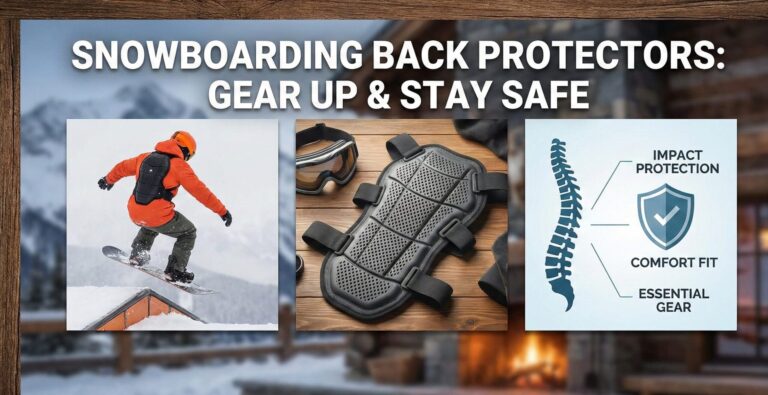
The Ultimate Guide to Back Protectors for Snowboarding: Safety, Tech & Performance (2026 Edition)
Snowboarding is a sport defined by progression, but progression inevitably involves falling. While helmets have become standard issue on the slopes—and for good reason, as we discuss in our breakdown of MIPS snowboard helmet technology—the spine remains surprisingly vulnerable for many riders. A back protector isn’t just for professionals hitting 60-foot jumps; it’s an essential piece of insurance for anyone navigating icy groomers, tree runs, or crowded parks.
In this comprehensive guide, we are moving beyond the marketing fluff. We will analyze the kinetic energy dissipation of modern materials, compare the ergonomic differences between vest and harness styles, break down the best options for women, youth, beginners, and backcountry riders, and help you decide if the investment is worth the longevity of your riding career.
Whether you are shopping for your first snowboard back protector, upgrading from an old harness model, or trying to find the right fit for your child, this is the only resource you will need in 2026.
2. The Physics of Impact: Why Your Spine Needs Armor
When you catch an edge—specifically the heel edge—the “whip” effect generates significant centrifugal force. Your head and upper back often take the brunt of this energy. Unlike a knee or wrist injury, trauma to the spinal column can have permanent, life-altering consequences.
A back protector functions similarly to a crumple zone in a car. It spreads the force of a point-impact (like a rock, a rail, or a skier’s knee) over a larger surface area. By increasing the duration of the deceleration and distributing the load, the peak force transferred to your vertebrae is drastically reduced.
To put this in numbers: an unprotected fall from a standing height onto ice can generate peak forces of 12–20 kN at the lumbar spine. A properly certified Level 2 back protector reduces that transmitted force to below 9 kN, often closer to 5–6 kN on modern materials like D3O or VPD. That gap is the difference between bruising and a compression fracture.
🔬 The Role of Vertebral Geometry
The thoracic vertebrae (mid-back) are particularly vulnerable in snowboarding because they are the apex of your torso’s arc when falling backwards. They have less natural muscular cushioning than the lumbar region, and the rib cage attachment actually limits their ability to flex and absorb shock. This is exactly why a good protector must cover from C7 (base of neck) all the way down through the lumbar spine.
Gear Up for Safety
Check out the best-selling impact protection vests currently available.
 See Prices on Amazon
3. Hard Shell vs. Soft Shell Protectors
The market is divided into two primary philosophies: rigid deflection (Hard Shell) and energy absorption (Soft Shell).
| Feature | Hard Shell | Soft Shell (Viscoelastic) |
|---|---|---|
| Mechanism | Deflects sharp objects; rigid plastic plates. | Hardens on impact; soft while riding. |
| Comfort | Lower. Can feel restrictive/stiff. | High. Molds to body heat. |
| Profile | Bulky. Requires looser jackets. | Slim/Low Profile. Fits under standard layers. |
| Best For | Rocky freeride terrain; motocross crossover. | Resort riding, park, freestyle. |
| Cold Weather Performance | Consistent. Shell stiffness unchanged. | Some materials stiffen when cold (VPD). |
| Price Range | $30–$150 | $60–$300 |
For 90% of snowboarders, modern Soft Shell protectors are the superior choice due to their ergonomic compliance. They allow you to twist, grab, and carve without feeling like a turtle.
There is also a third category emerging: Hybrid Hard/Soft systems that use a segmented hard-shell spine plate (for deflection) backed by a soft D3O or EVA foam layer (for absorption). These represent the best of both worlds, particularly for riders who spend time both in the park and in the backcountry. Products like the Demon Flexforce Pro use this exact architecture.
4. Materials Science: D3O, VPD, and Koroyd
The revolution in back protection comes from Non-Newtonian fluids. These are materials that are soft and pliable in their resting state but lock together on a molecular level when subjected to shock.
D3O (Orange Foam)
The most recognizable name in the game. D3O is soft and flexible but becomes rock-hard instantly upon impact. It resets immediately after, allowing for multiple impacts. D3O is available in multiple densities and thicknesses. The latest generation, D3O Ghost, is approximately 40% thinner than original formulations at the same protection rating, making it ideal for low-profile applications under fitted jackets.
VPD (Visco-Elastic Polymer Dough)
Used primarily by POC, this material is denser than D3O. It excels at progressive dampening. It feels stiffer when cold but becomes incredibly pliable once it warms up to your body temperature—typically within 10–15 minutes of wearing it. This is an important consideration: if you are heading out on a freezing morning, your POC VPD vest will be significantly stiffer for your first few runs than it will be by lunch. The trade-off is that VPD provides exceptional multi-directional protection once warmed.
Koroyd
Koroyd is a relatively newer entrant, originally developed for helmet liners by Smith and now appearing in some back protector constructions. It consists of thousands of thermally welded co-polymer tubes that crumple in a controlled, predictable manner on impact, similar to how an automotive crumple zone works. Koroyd is exceptionally lightweight and breathable (the tube structure allows air to flow through freely), but it does not reset after a significant impact the way D3O does. This means a major crash may require partial panel replacement.
EVA (Ethylene-Vinyl Acetate)
This is the classic, budget-friendly foam found in many entry-level and children’s back protectors. EVA is not a non-Newtonian material—its protection mechanism is simply compression and distribution. It works adequately for low to moderate impacts but compresses permanently over time, meaning it loses protection capacity with each significant hit. Budget protectors using EVA are better than nothing, but serious riders should upgrade to D3O or VPD.
| Material | Reset After Impact | Cold Weather | Profile | Best Use |
|---|---|---|---|---|
| D3O | ✅ Yes | Minimal change | Thin | Park, resort, all-mountain |
| VPD (POC) | ✅ Yes | Stiffer when cold | Medium | All-mountain, freeride |
| Koroyd | ⚠️ Partial | Consistent | Thin & breathable | Spring riding, breathability priority |
| EVA Foam | ❌ Compresses | Hardens slightly | Thicker | Beginner/budget |
| Hard Shell PP/ABS | ✅ Yes (deflection) | Consistent | Bulky | Freeride, rocky terrain |
Combining a quality back protector with impact shorts creates a full “armor system” for your core and hips, essential for learning new tricks in the park.
5. Safety Ratings: EN 1621-2 Explained
If a product doesn’t list an EN 1621-2 certification, do not buy it. This is the European standard for motorcycle back protectors, adopted by winter sports. It has two levels:
- Level 1: Must transmit less than 18kN of force on average. Adequate for general cruising.
- Level 2: Must transmit less than 9kN of force. This absorbs twice as much energy as Level 1. Highly recommended for park riders and high speeds.
The test methodology involves dropping a 5 kg striker from a height of 500mm onto the protector three times, measuring the peak transmitted force each time. The reported value is the average of all three tests, meaning a protector that barely passes Level 2 on average might still transmit over 9kN on an unlucky hit.
Some brands now label products as “Level 2+” indicating they consistently test below 7kN—a meaningful step above the minimum requirement. Look for this on premium products from POC, Forcefield, and Alpinestars.
6. Fit & Sizing Guide
A back protector that doesn’t fit correctly can be more dangerous than wearing nothing. If it’s too long, the bottom will hit the saddle of your binding when you sit, pushing the entire unit up into your helmet and neck.
The Torso Measurement: Measure from your C7 vertebrae (the bony bump at the base of your neck) to your waistline (iliac crest). Most manufacturers size based on this length, not your overall height.
- Stand upright and locate your C7 vertebra — the prominent bone at the base of your neck when you tilt your head forward.
- Measure straight down to your natural waistline (the iliac crest, not your pants waistband).
- Cross-reference this measurement with the brand’s size chart. Most brands offer XS through XL with roughly 2-inch increments.
- When between sizes, go smaller. A protector that rides up is more dangerous than one that feels slightly snug. You can adjust harness straps to lengthen slightly, but you cannot shorten a protector that is too long.
- Try it with your actual layering system. If your jacket is loose-fit, you have more room; if it’s a race-cut shell, even 5mm of extra thickness matters.
Additionally, pay attention to width coverage. Some budget protectors cover only the vertebral column in a narrow strip, leaving the flanks exposed. Premium options use a curved “butterfly” shape that covers the erector spinae muscles on both sides of the spine—this wider coverage is far more effective at distributing the force from oblique falls.
7. Vest vs. Strap Systems
Vest Style Pros
- Stays perfectly in place during crashes.
- Adds a layer of warmth.
- Often includes chest/rib protection pads.
Vest Style Cons
- Can be too hot in spring conditions.
- Requires washing the whole garment to clean.
Strap/Harness Style Pros
- Lighter weight, better ventilation.
- Less expensive on average.
- Easy to put on/remove without changing layers.
Strap/Harness Style Cons
- Tends to ride up over the course of a day (the “turtle shell” effect).
- Can create pressure points under backpack straps.
- Less coverage; usually no chest protection.
Strap/Harness Styles are cooler and lighter but tend to ride up (the “turtle shell” effect) after a few runs. For consistent safety, the vest style is generally preferred by seasoned riders.
There is a third, growing category: Integrated protectors built directly into specialized jackets or softshells. Brands like Arc’teryx, Oakley, and Burton have released technical shells with removable EN 1621-2 certified spine inserts. These eliminate the layering problem entirely but lock you into a specific jacket. They work best for riders who own a dedicated “safety jacket” for park days and a separate shell for touring or casual riding.
8. Integration with Your Layering System
A back protector changes how your other gear fits. If you wear a vest protector, it effectively replaces your mid-layer or fleece on warmer days. On cold days, it should sit directly over your base layer but under your insulation.
Ensure your jacket has enough room in the shoulders. A tight fit here restricts arm movement, which is critical for balance. Furthermore, if you are wearing a backpack, ensure the straps don’t cause pressure points on the protector’s edges.
Layering Order (Cold Day): Recommended Sequence
- Moisture-wicking base layer (merino wool or synthetic)
- Back protector vest (over base layer)
- Mid-layer insulation (only if truly cold; skip on warmer days)
- Waterproof/breathable shell jacket
The protector vest between the base and mid-layer ensures it stays in position and doesn’t interfere with your outerwear’s waterproofing seams or lift tabs.
9. Choosing a Back Protector by Riding Style
One of the most overlooked aspects of back protector selection is matching the product to your actual riding discipline. A freestyle park rider and a backcountry splitboarder face completely different impact scenarios, and the gear that protects one may be inadequate or impractical for the other.
Park / Freestyle
You need Level 2 EN 1621-2 protection, slim profile, and maximum mobility. Falls here are often high-speed and involve rails, boxes, and kickers. A D3O vest with rib coverage is ideal. Prioritize a vest style so it doesn’t shift mid-trick.
Freeride / Big Mountain
High-speed falls on variable terrain (rocks, ice, trees) demand hard/soft hybrid protection. A longer protector covering the sacrum is critical. Consider airbag integration for avalanche terrain.
Groomed / Carving
Ice catching an edge is the primary risk. A Level 1 or 2 soft shell vest is perfectly adequate. Prioritize low profile so it doesn’t interfere with the precise body angles of aggressive carving.
Tree Runs
The hazard here is direct tree trunk and root impact — unpredictable, sharp, and high-energy. A hard-shell or hybrid protector is strongly recommended. Fuller coverage is more important than slim profile in the trees.
Backcountry / Touring
Weight and packability matter as much as protection. Consider a backpack with integrated CE-rated back panel (from Ortovox, Black Diamond, or Evoc). Saves weight and removes the layering complexity of a separate vest.
Learning / Beginner
Beginners fall more and with less predictability. Any certified Level 1 or 2 vest or harness is a huge improvement over nothing. Focus on fit over features — a protector that stays in place is worth more than an expensive one that slides around.
10. Best Back Protectors for Women Snowboarders
For years, women’s back protection was simply “men’s products in smaller sizes with different colors.” The industry has thankfully matured significantly, but it’s still important to know what to look for when shopping as a woman snowboarder.
The key anatomical differences are:
- Narrower shoulder width relative to torso length — many men’s protectors gap at the sides when fitted by torso length, leaving the flanks unprotected.
- Higher waist position — a protector fitted to a man’s torso length may sit too low on a woman’s equivalent measurement, pushing the bottom plate uncomfortably against the sacrum during strap-in.
- Chest accommodation — vest-style protectors need to account for breast tissue in both strap placement and front panel geometry. Poorly designed women’s vests ride up or gap in the front.
Top Women-Specific or Women-Fit Options for 2026
POC VPD Air Vest (Women’s)
The gold standard for women’s fit. The curved seaming and adjusted strap geometry solve most of the chest accommodation issues. VPD material is excellent once warmed. Available in XS–L with true women’s torso proportions.
Dainese Pro-Armor Vest (Women’s)
Italian-engineered with narrower shoulder width and adjusted rib geometry. Articulated plates allow excellent mobility during toe-side turns. Ships in European sizing — size up if in-between.
Demon Flexforce X2 (Women’s)
Good budget-to-mid-range option. The women’s version has adjusted front panel shaping. D3O spine and rib pads. Level 2 certified. A reliable choice for park and all-mountain riding.
G-Form Pro-X3 Vest
Extremely low-profile, fits under the tightest women’s cut jackets. Reactive Protection Technology (RPT) foam stiffens on impact. Machine-washable (remove inserts first). Great for spring riding or warmer resorts.
11. Youth & Kids Back Protectors: What Parents Need to Know
Children’s spines are still developing and fundamentally different from adult spines. The ossification of vertebral growth plates is not complete until the mid-20s in some individuals. This means that a child’s spine, while more flexible than an adult’s, is also more susceptible to certain types of trauma — specifically axial compression and shear forces from backwards falls.
Despite this, youth back protection is often deprioritized because parents assume children are “more flexible” and therefore less at risk. The reality is that children fall more frequently, have less developed proprioception, and have less muscular support around the spine than adults. A child learning to snowboard is among the highest-risk populations for back injury per hour of riding.
Key Features to Look for in Youth Protectors
- EN 1621-2 certification — yes, even in children’s sizes. Some budget youth products skip certification entirely. Insist on it.
- Adjustable straps — children grow quickly. A harness or vest with 2–3 inches of adjustment range extends usable life significantly.
- Lightweight construction — children tire more easily with heavy gear. Aim for products under 500g (about 1 lb).
- Integrated vest over harness — children are more likely to pull a harness out of position when fidgeting or falling. A vest-style stays more reliably in place.
- Washable — kids’ gear gets dirty. A vest with removable/wipeable inserts is far more practical.
Recommended Youth Back Protectors (2026)
| Product | Sizes | Certification | Material | Best For |
|---|---|---|---|---|
| Demon Flexforce Junior | XS–M (Youth) | EN 1621-2 Level 1 | D3O | All-round resort riding |
| POC VPD System Vest Junior | XS–M (Youth) | EN 1621-2 Level 2 | VPD | Park and terrain park |
| Alpina Flexiback Junior | 110–164cm height | EN 1621-2 Level 1 | Soft EVA + PP Shell | Beginner/intermediate |
| BenKen Kids Spine Guard | S–XL (Adjustable) | EN 1621-2 Level 1 | EVA + PE Shell | Budget-friendly entry |
A note on sizing youth protectors: use the same C7-to-waist torso measurement method described in section 6, scaled down. Do not size by age — children of the same age can have significantly different torso lengths. Many families find it useful to measure every season at the start of the season, as a half-size jump in torso length can mean the previous year’s protector is now unsafe.
12. Back Protectors for Beginner Snowboarders
If you are just getting into snowboarding, back protection should arguably be your second purchase after a helmet. Here is why: beginners spend a disproportionate amount of time falling. Early learning involves heel-edge catches, toeside catches, and unpredictable transitions that send riders backwards onto the snow with almost zero warning or preparation. Without a reflexive understanding of how to fall, your spine absorbs impacts that an experienced rider would redirect through muscle activation and technique.
The good news: you do not need the most expensive protector on the market to be well protected as a beginner. A solid mid-range vest providing EN 1621-2 Level 2 protection is all you need during the learning phase. Here is what to prioritize:
Mid-Range D3O Vest
$80–$150. Level 2. Stays in place. Works with standard beginner rental jacket sizing.
Budget Harness
$30–$60. Level 1. Gets the job done. Rides up over time.
Premium D3O Vest
$150–$250. Level 2. Excellent — but overkill for a beginner’s first season.
Common beginner mistakes with back protectors:
- Wearing it over the jacket — the protector must be worn under your jacket to function correctly. Over-the-jacket placement eliminates the impact absorption geometry the pad is designed to provide.
- Not re-tightening mid-day — straps loosen over the course of a day, especially with harness-style protectors. Check fit at lunch.
- Buying the wrong torso length — as discussed, size by torso measurement not clothing size or height.
Combining a back protector with wrist guards and a helmet gives beginner snowboarders protection across the three highest-risk injury zones: wrists, head, and spine. This full protective setup costs less than a single day of ski patrol assistance and medical evacuation.
13. Brand Deep-Dive: Comparing the Major Players
The back protector market has consolidated around a handful of key brands, each with a distinct design philosophy. Understanding what each brand does best helps you align your purchase with your riding priorities.
🟠 Demon United
Philosophy: Snowboard-specific, value-driven.
Strength: The best dollar-per-protection-level ratio on the market. The Demon X D3O line consistently outperforms more expensive competitors in lab tests. Excellent for all-mountain and park.
Weakness: Less focus on women’s-specific fit. Limited breathability options in warmer conditions.
Best Products: Demon Flexforce X2 D3O, Demon Spine Guard X D3O.
🔵 POC Sports
Philosophy: Swedish safety engineering, premium materials.
Strength: VPD material provides exceptional protection once warmed. Industry-leading certification ratings (many products exceed Level 2). Excellent women’s fit options. Trusted by World Cup athletes.
Weakness: Premium price. VPD stiffness in cold temps requires warm-up time. Bulkier profile than D3O alternatives.
Best Products: POC VPD Air Vest, POC Spine VPD 2.0 Vest.
⚫ Dainese
Philosophy: Motorsport-derived, rigidly engineered.
Strength: Italian motocross heritage. Articulated hard/soft hybrid systems. Excellent for freeride and tree-line riding where deflection from sharp objects matters. Long lifespan.
Weakness: Designed for motorcycle ergonomics first; snowboard flexibility second. Sizing runs small (Italian sizing).
Best Products: Dainese Active Vest Evo, Dainese Pro Armor Safety Jacket.
🟢 G-Form
Philosophy: Ultra-low profile, multi-sport.
Strength: Their Reactive Protection Technology (RPT) foam is among the thinnest certified protection available. Machine-washable (inserts removed). Extremely comfortable for spring/warm weather riding. Great for riders who hate feeling any bulk.
Weakness: Not always Level 2 rated at thinner profiles. Less durable than D3O or VPD under repeated hard impacts.
Best Products: G-Form Pro-X2 Back Guard, G-Form Pro-X3 Vest.
🟡 Forcefield
Philosophy: British-engineered, motorsport-certified.
Strength: CE Level 2 across nearly their entire range. Nitrex foam compound is softer at rest than VPD but offers comparable protection. Trusted by pro snowboarders and motocross athletes alike. Excellent torso length range.
Weakness: Less accessible retail distribution; primarily online purchase. Less marketing investment means underappreciated outside core safety enthusiast community.
Best Products: Forcefield Body Armour EX-K, Forcefield Pro Sub 4 Vest.
🔴 Alpinestars
Philosophy: MotoGP-heritage, technically advanced.
Strength: BNS (Bionic Neck Support) system pairs back protection with neck brace functionality — unique on the market. Suitable for riders recovering from cervical spine injuries. Rigorous quality control from motorsport standards.
Weakness: Heavy and bulky by snowboard standards. Full system cost is high. Overkill for resort riding but compelling for big-mountain or injury-return scenarios.
Best Products: Alpinestars Nucleon KR-Cell Back Protector, Alpinestars BNS Tech-2 System.
14. Motorcycle Back Protectors vs. Snowboard-Specific Protectors
This is a question that comes up frequently in forums and has a nuanced answer. The short version: yes, a motorcycle back protector certified to EN 1621-2 Level 2 will protect your spine in a snowboard fall. But it may not be the best tool for the job.
Where They Overlap
Both use the same EN 1621-2 certification standard. A motorcycle protector that passes this test has been evaluated to the same impact criteria as a snowboard-specific one. Many pro snowboarders, particularly in the UK and Europe, have historically worn motocross protectors like the Forcefield Body Armour EX-K or the Alpinestars Nucleon precisely because these products were ahead of snowboard-specific gear in terms of CE certification stringency.
Where They Diverge
The differences are practical rather than protective:
- Weight: Motorcycle protectors are designed to withstand motorcycle-speed impacts and are consequently heavier, often 800g–1.5kg versus 300–600g for snowboard-specific options.
- Ergonomics: Motorcycle-specific ergonomics assume a seated, forward-leaning posture. Snowboarders need full rotational range for grabs, carves, and powder turns. Moto protectors can restrict this movement.
- Temperature management: Motorcycle protectors often lack breathability engineering for aerobic activity. They are designed for passive use at speed on a bike, not for the sweat-generating effort of snowboarding.
- Jacket integration: Most snowboard jackets have a protector sleeve or loop designed for snowboard-specific form factors. A moto protector may not sit correctly in these systems.
Bottom line: if you already own a quality motorcycle back protector certified to EN 1621-2 Level 2, it is a perfectly reasonable snowboard protector. If you are buying new, a snowboard-specific product is almost always the better choice for comfort and practicality.
15. Back + Chest Combination Armor: When You Need Full Upper Body Coverage
A spine-only back protector leaves the chest, ribs, and clavicle exposed. For most resort riders this is an acceptable risk trade-off — rib impacts are painful but rarely life-threatening at resort speeds, and a chest protector adds significant bulk. But for certain riding scenarios, full upper body armor becomes genuinely important.
Scenarios Where Chest + Back Combo Protection Is Worth It
- Sending large park features (70ft+) — falls from this height at high speed create enough force to cause rib fractures on unprotected impact with the snow surface.
- Tree riding in tight terrain — a face-first impact with a tree trunk without chest protection can result in serious trauma.
- Big mountain / competitive freeride — mandatory in many competition formats above a certain terrain category.
- Riders with prior rib or clavicle injuries — returning to riding after a rib fracture with only back protection leaves a known weakness exposed.
Top Back + Chest Combination Products
| Product | Back Rating | Chest Rating | Weight | Best For |
|---|---|---|---|---|
| Demon Flexforce X2 D3O Full Top | EN 1621-2 Level 2 | Rib + Chest D3O | ~700g | Park, all-mountain |
| POC VPD System Jacket | EN 1621-2 Level 2 | EN 1621-3 Level 2 | ~900g | Big mountain, freeride |
| Dainese Trail Skins Pro | EN 1621-2 Level 2 | EN 13158 (equestrian standard) | ~1.1kg | Aggressive freeride, race |
| Alpinestars A-10 V2 Chest/Back | EN 1621-2 Level 2 | CE Chest Armor | ~1.3kg | Big air, competition |
When evaluating chest protection separately from back protection, look for products that carry the EN 1621-3 standard (chest protectors) in addition to EN 1621-2 (back protectors). Products marketed as “chest and back” that only carry a single certification are typically certifying just the back panel, not the chest component.
16. Backcountry Snowboarding: Back Protectors and Airbag Pack Integration
The backcountry rider faces a unique set of competing demands: the need for lightweight and packable gear (since every kilogram matters on a skin track), avalanche preparedness (an airbag backpack can be life-saving), and spine protection for falls on variable ungroomed terrain.
Wearing both a separate back protector vest and a loaded airbag backpack creates a layering and comfort problem. The backpack straps compress the vest, can displace it during a fall, and the combined weight is significant for uphill travel. The industry has responded with two main solutions:
Option 1: Backpacks with Integrated CE-Rated Back Panels
Several premium airbag backpack manufacturers now integrate EN 1621-2 certified back protector panels directly into the lumbar/back panel of their packs. These typically remove the need for a separate vest entirely.
Ortovox Free Rider 26 S
Airbag-compatible harness system with a removable CE-certified back protector. The protector panel pops out for resort days and slides back in for backcountry objectives. Smart dual-use system.
Evoc Line R.A.S. 20
R.A.S. (Removable Airbag System) pack with an integrated CE Level 1 back panel in the Liteshield design. Extremely lightweight for touring. The airbag deploys without interference from the back panel.
Black Diamond Jetforce Tour 26
Uses a fan-based airbag inflation system with a CE-rated back panel. The electronic inflation system means no cartridge to replace, but requires charging. Good Level 1 back protection built in.
Option 2: Dedicated Back Protector + Regular Backpack
If you ride both resort and backcountry and want a single protector that transitions between both worlds, wear a thin D3O vest under your pack. The key is to choose a vest that does not have protruding hardware (clips, hard harness adjusters) on the back surface where the pack sits. G-Form and Demon’s thinner strap-on models work well here, as the smooth surface interface with the pack back panel.
17. Tailbone & Sacrum Protection: The Often-Forgotten Zone
Most back protector reviews focus exclusively on lumbar and thoracic coverage. But for snowboarders — where the sitting-down fall (catching a heel edge while traversing) is one of the most common beginner and intermediate accidents — the coccyx (tailbone) and sacrum are at just as much risk as the mid-back.
A standard back protector ends at the waistline/iliac crest. This leaves the entire sacral region exposed. The sacrum and coccyx are vulnerable to compression fractures and severe bruising in direct posterior falls, and a coccyx fracture is one of the most chronically painful snowboard injuries — slow to heal and affecting virtually every sitting, standing, and bending movement for months.
Two Ways to Add Coccyx Protection
1. Impact Shorts with Tailbone Pad: The most practical solution. Impact shorts worn under your snowboard pants include a dedicated coccyx/tailbone pad in addition to hip protection. Products like the Demon Hyper Short D3O, Forcefield Body Armour Shorts, and POC VPD 2.0 Shorts all include a coccyx guard. This separates the coverage zones — spine/back handled by the vest, coccyx/hips handled by the shorts — and gives you modular control over your protection system.
2. Extended-Length Back Protectors: Some back protectors, like the Pro-Tec IPS Back Pad and certain Dainese models, extend below the waistline to cover the sacrum. These require careful sizing to ensure the lower extension doesn’t bottom out when you sit to strap your bindings. Measure your C7-to-top-of-sacrum distance for these extended models rather than C7-to-waist.
We strongly recommend reviewing our complete guide on impact shorts as a companion to this article. The combination of a chest-length back vest plus impact shorts creates what protection engineers call a “full posterior armor system” — covering coccyx, sacrum, lumbar, thoracic, and cervical zones comprehensively.
18. Returning to Snowboarding After a Back Injury
Spinal injuries are among the most psychologically as well as physically challenging injuries to recover from. The fear of reinjury is real, and the question of which back protector to use when returning to riding after a fracture, herniated disc, or surgery is one we receive regularly from our readers.
⚕️ Medical Disclaimer
Nothing in this section constitutes medical advice. Always consult your orthopedic surgeon or physiatrist before returning to snowboarding after a spinal injury. The information here is for general educational purposes and applies to riders who have been cleared by their medical team to resume snowboarding.
Compression Fractures (Most Common Snowboard Spine Injury)
Compression fractures of the thoracic vertebrae (particularly T4–T12) typically heal with conservative management over 6–12 weeks. Once cleared for return, a semi-rigid or rigid back protector is generally recommended over soft-shell options. The rationale: a compression fracture site is vulnerable to repeat trauma, and a protector that provides some structural support (in addition to impact absorption) reduces the mechanical load at the fracture level during a fall. Products like the Dainese Active Vest Evo or the Alpinestars Nucleon KR-Cell are appropriate in this scenario.
Lumbar Disc Herniation
A herniated disc is sensitive to flexion (forward bending), extension (backward bending), and torsional load. Snowboarding involves all three, which is why disc injuries require particularly careful management. Upon medical clearance, focus on a back protector that covers the full lumbar region (L1–L5) without restricting your ability to flex forward for toeside turns — a restriction that leads to compensatory movements that increase torsional load. A long soft-shell vest with good lumbar coverage but unrestricted forward flex is ideal.
Post-Surgical Return (Fusion, Discectomy)
Post-fusion riders should work with both their surgeon and a physical therapist familiar with snowboarding biomechanics before selecting protective equipment. Generally, the fused segment is more protected (it cannot flex/extend to create shear stress) but adjacent segments above and below the fusion are at elevated risk. A protector that covers 2–3 vertebral levels above and below the fusion site is preferable.
Psychological note: many injured riders report that wearing a back protector after injury provides significant psychological confidence to ride more naturally, which paradoxically reduces the stiff, tense body mechanics that actually increase fall risk. The protection itself is valuable; the confidence it provides has its own safety benefit.
19. Budget Guide: The Best Back Protectors at Every Price Point
Back protection doesn’t have to cost a fortune to be effective. Here is an honest breakdown of what your money actually buys at each tier.
Under $50: The Baseline
At this price point, you are working with EVA foam or basic PE shell constructions. You will typically find EN 1621-2 Level 1 certification (if any certification at all — verify carefully). These products are better than nothing and are appropriate for beginners, children getting their first season of experience, or riders who want the absolute minimum coverage at the lowest possible cost.
Best Option Under $50: BenKen Body Armor or Cienfy Spine Protector. Both carry basic Level 1 certification and use a dual-layer EVA + PE construction that provides adequate protection for low to moderate falls at beginner speeds. Replace every 2 seasons or after a significant impact.
$50–$100: The Sweet Spot
This is where the quality jump becomes significant. At this tier, you start accessing genuine D3O and similar non-Newtonian foam constructions, Level 2 certification, and vest-style designs that stay in place reliably. This is the recommended tier for any regular snowboarder.
Best Options $50–$100: Demon Spine Guard X D3O (Level 1, excellent value), G-Form Pro-X2 (Level 1, ultra-slim), or entry-level Forcefield products (excellent certification at accessible price).
$100–$200: Performance Tier
Level 2 D3O or VPD with full vest construction, often including chest/rib panels, proper women’s-specific fit options, and premium breathability. This is where the POC VPD Air Vest, Demon Flexforce X2 D3O, and mid-range Dainese models live. If you ride more than 20 days a season, this tier is worth the investment.
$200+: Professional and Specialty
This tier includes full upper body armor systems (chest + back at Level 2), airbag-integrated backpacks with certified back panels, and specialist products for injury recovery or competition. For the majority of recreational snowboarders, the performance difference above $150 is marginal. However, if you are competing, riding big features, or returning from injury, the extra engineering in this tier is genuinely justified.
💡 The Cost-Per-Protection Calculation
A $120 Level 2 D3O vest that lasts 5 years costs $24/year or roughly $1 per riding day (at 25 days/year). A single emergency room visit for a spinal injury without serious damage runs $3,000–$8,000 in the United States, not counting loss of income, physical therapy, or long-term disability costs. The economics of back protection are unambiguous at any price point.
20. Back Protectors in Competition: Rules & Requirements
If you compete in any sanctioned snowboard discipline, understanding back protector regulations is essential. The rules vary significantly by discipline and governing body.
FIS (International Ski Federation) Regulations
FIS mandates back protection for all competitors in slopestyle, big air, and halfpipe disciplines at FIS-sanctioned events. The minimum standard required is EN 1621-2 Level 1, but most top competitions (World Cup and above) effectively require Level 2 through event safety officer discretion. FIS regulations are updated annually; always check the current season’s rulebook for the specific discipline you are competing in.
TTR (Ticket to Ride) Slopestyle & Big Air Events
TTR events generally follow FIS safety standards with additional event-specific requirements determined by the head of safety for each individual event. At TTR 6-star events and above, Level 2 back protection is effectively mandatory. Failing a safety gear inspection results in disqualification from the event, not just a time penalty.
Freeride World Tour (FWT)
The FWT, governed by IFSA (International Freeride Skiing & Snowboarding Association), has among the most rigorous safety gear requirements in competitive snowboarding. Full back and chest protection is mandatory at all qualification and main event levels. Airbag backpacks are mandatory in the backcountry-specific event formats. IFSA recommends specific brands in partnership agreements, but any product meeting EN 1621-2 Level 2 is eligible.
USASA (United States of America Snowboard and Freeski Association)
At domestic amateur competition level in the US, USASA helmet rules are stricter than back protector rules. Back protection is strongly recommended but not universally mandatory below a certain feature size threshold. Check with your specific USASA region and series organizer for current requirements — rules have been tightening in recent seasons.
The Full Safety Ecosystem
A back protector is just one piece of the puzzle. Snowboarding involves complex biomechanics. While the spine is crucial, extremities often take the first hit. Wrist fractures are the #1 injury in snowboarding.
We highly recommend reviewing our guide on FOOSH (Fall On Outstretched Hand) prevention and wrist guards. Integrating wrist protection with back protection covers the two most common trauma vectors for intermediate riders.
21. Top Picks by Category (2026)
- Best Overall: Demon United Flexforce X2 D3O. Offers full rib, chest, and spine protection with extensive D3O coverage.
- Best Low Profile: Burton Total Impact Short. (G-Form technology). Extremely thin, great for those who hate bulk.
- Best for Breathability: POC VPD Air Vest. Uses a perforated mesh structure that vents heat incredibly well.
- Best Budget: BenKen Body Armor. Good hard/soft hybrid protection at a lower entry price point.
- Best for Women: POC VPD Air Vest (Women’s). True anatomical fit, VPD protection, excellent shoulder geometry.
- Best for Kids/Youth: Demon Flexforce Junior. Lightweight D3O, Level 1 certified, adjustable for growth.
- Best for Backcountry: Ortovox Ascent 30 with integrated back panel. Airbag-compatible pack with built-in CE protection.
- Best for Beginners: Demon Spine Guard X D3O. Slim, reliable, stays in place, won’t break the bank.
- Best Hard/Soft Hybrid: Dainese Active Vest Evo. Plates flex on forward bend, rigid on backward impact. Excellent for freeride.
- Best Chest + Back Combo: POC VPD System Jacket. Full EN 1621-2 and EN 1621-3 dual certification.
22. Durability and Care
Soft shell protectors, specifically those using D3O or VPD, are sensitive to chemicals. Never wash the insert. Most vests have removable pads. Take the pad out, wash the vest fabric, and wipe the pad down with a damp cloth.
Also, store them at room temperature. Leaving a VPD protector in a freezing car overnight makes it brittle and uncomfortable until it warms up against your skin.
Signs Your Back Protector Needs Replacing
- After a major crash: Even if D3O “resets” after impact, structurally significant crashes (falls from 10+ feet, high-speed impacts with hard objects) may cause internal damage not visible to the naked eye. When in doubt, replace.
- After 5 years: All protection foams degrade with age, UV exposure, sweat, and repeated compression/release cycles. The molecular structure of non-Newtonian polymers changes over time. A 7-year-old D3O insert is not providing the protection of a new one, even if it looks fine.
- If the foam takes a permanent set: If your protector feels hard or stiff in its resting state (when cold or at room temp) and does not return to soft pliability, the material has degraded and is no longer functioning as designed.
- If the harness or stitching fails: A protector that cannot stay in place is worse than useless — it creates false confidence while providing no actual protection in a fall.
23. Is a Back Protector Actually Worth It? A Cost-Benefit Analysis
We understand the hesitation. Back protectors add cost, bulk, and a step to your gear prep routine. Here is a genuine cost-benefit analysis for snowboarders at different stages of the sport:
For Beginners
The cost-benefit is overwhelmingly positive. Beginners sustain a disproportionate share of back injuries because they lack the body mechanics to fall correctly. A $80–$120 protector during the learning phase is one of the highest-ROI safety investments in any sport.
For Intermediate Riders
Intermediate riders often feel they have “figured out” falling safely and skip back protection. But intermediate riding also opens up faster speeds, larger terrain, and park features — all of which dramatically increase the consequence of a fall. This is the population group most likely to sustain significant spinal injuries, and most likely to be unprotected when it happens.
For Advanced Riders
Advanced riders and professionals who push progression are the population most aware of back protection. World Cup slopestyle and big air competitors universally wear certified back protection. The data from sport injury epidemiology studies consistently shows that protective equipment use increases (not decreases) with athlete skill level among those who have experienced or witnessed serious injuries.
Whether you choose a harness for spring riding or a full D3O vest for mid-winter park laps, protecting your spine ensures you’ll be riding for decades to come. Don’t wait for a bad fall to make the investment.
Conclusion
Back protection for snowboarding has come a long way from the bulky, restrictive neoprene contraptions of the early 2000s. Today’s options — from ultra-thin D3O vests that disappear under a fitted shell jacket to full chest-and-back systems that pass the same certification standards used in motorcycle racing — give riders at every level and every budget the ability to protect their spine without compromising their riding.
The key decisions are: choose your riding style first, then select the right protection level (Level 1 for casual resort, Level 2 for anything involving speed or park features), and size by torso measurement, not clothing size. If you have specific needs — women’s fit, youth sizing, backcountry integration, or return from injury — use the specific sections of this guide to narrow your shortlist.
The best back protector is the one that fits correctly, that you actually wear every day on the mountain, and that gives you the confidence to ride at your best. Invest in one this season. Your future self will thank you.


 Home
Home
 About
About
 My Cart
 Reviews
 Compare