Skiing vs. Snowboarding for Kids: Which is Easier to Learn?
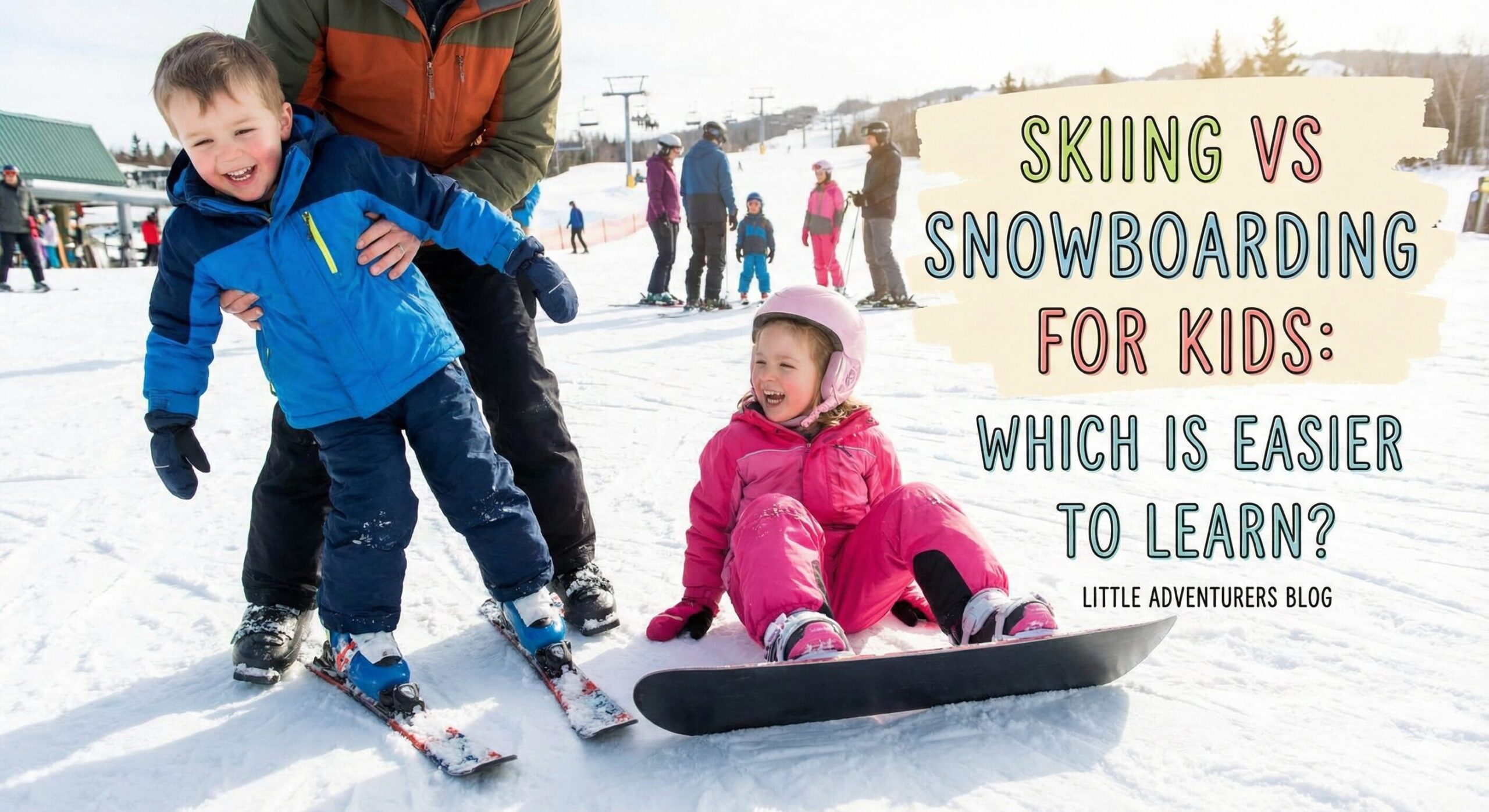
The ultimate showdown for winter families. We break down the learning curves, the gear struggles, the age-by-age guide, and the “fun factor” to help you decide how to start your mini-shredder.
The Big Picture: Why This Question Matters
It is the classic winter dilemma. You want to introduce your child to the mountains, but you are torn. Do you strap two planks to their feet or one? If you are a snowboarder, you naturally want them to join the “dark side.” If you are a skier, the choice seems obvious. But personal bias aside, which sport is actually easier for a child to pick up?
The answer involves physics, biomechanics, developmental psychology, and a little bit of parental sanity. We have previously explored the best age to teach a child to snowboard, but today we are pitting the two sports directly against each other across every dimension that matters for a family: the learning curve, the gear struggle, safety, cost, and the all-important “fun factor” on the first few days.
The bottom line, supported by research from PSIA (Professional Ski Instructors of America) and echoed by virtually every experienced ski school instructor: skiing is generally easier for children under 7, while either sport works equally well for children 7 and older. But that headline answer misses a lot of nuance. A highly motivated 5-year-old who thinks snowboarding looks cool may outperform a reluctant 5-year-old on skis. Motivation is the wild card that can override every biomechanical advantage. Keep that in mind as we go through the full comparison.
PSIA-accredited ski schools and multiple independent studies consistently show that children under 6 have a significantly better first experience on skis due to their independent-leg coordination advantage. Children 7 and older show roughly equal learning rates across both sports when taught by a qualified instructor in proper progression.
At a Glance: The Full Comparison
Before we dive deep, here is the cheat sheet for busy parents across every major factor.
| Factor | ⛷️ Skiing for Kids | 🏂 Snowboarding for Kids |
|---|---|---|
| Days 1–3 (Initial ease) | ✅ Easier — immediate balance | ❌ Harder — many falls |
| Mastery Curve | Harder to perfect advanced technique | ✅ Easier once basics click |
| Boot Comfort | ❌ Stiff, heavy, hard to walk in | ✅ Soft, warm like sneakers |
| Balance System | ✅ Independent legs (natural) | ❌ Feet bound (unnatural) |
| Chairlift Experience | ✅ Easy — slide on, slide off | ❌ One foot out, awkward |
| Walking / Mobility | ❌ Skis very awkward off snow | ✅ Walk normally in boots |
| Gear Complexity | ❌ Poles, skis, boots, bindings | ✅ Board, boots, bindings only |
| Recommended Min Age | ✅ 3–4 years old | 5–6 years old |
| Primary Injury Risk | Knees (ACL/MCL twisting) | Wrists, tailbone (falls) |
| Cold / Wet Bottom | ✅ Stay standing more often | ❌ Sitting in snow to buckle |
| Park / Freestyle Progression | 🤝 Comparable | 🤝 Comparable |
| Daily Rental Cost | ~$25–$45/day | ~$25–$45/day |
| Best for Shy/Cautious Kids | ✅ More immediate control | Requires higher frustration tolerance |
| Best for Adventurous Kids | Good | Equally good — faster progression |
⛷️ The Case for Skiing: Instant Gratification
For toddlers and very young children (ages 3–6), skiing has a massive mechanical advantage that most parents don’t fully understand until they see it in action. The reason is simple: walking is natural. Skiing mimics walking. Your legs move independently, providing a wider base of support and a built-in recovery system. When a child starts to fall to the left on skis, they can instinctively step their right foot outward to re-establish balance. On a snowboard, that option doesn’t exist — you’re committed to going down when gravity wins.
Why Skiing is Easier to Start
- The “Pizza” Wedge (Snowplow): Kids can intuitively learn speed control by making a wedge (pizza slice) shape with their ski tips touching. This is a stable, mechanically sound position that young children can achieve within the first hour on snow. It works almost immediately and gives them genuine control over their speed.
- The Edgie-Wedgie Tool: A small rubber connector clips between the tips of children’s skis to hold them in a wedge shape automatically. This tool is a game-changer for 3–5 year olds — it removes the muscle coordination requirement for maintaining the wedge so they can focus purely on turning and stopping.
- Balance Recovery: If a kid tips sideways, they can step a foot out to catch themselves. This instinctive response transfers from walking and is immediately available on skis.
- Forward-Facing Direction: Humans are designed to look where they are going. Skiing faces forward; snowboarding requires looking sideways, which introduces an immediate biomechanical awkwardness that takes time to habituate.
- No Cold, Wet Sitting: Skiers rarely need to sit on the snow. Young snowboarders sit constantly — to buckle bindings, to rest, when they fall. Wet, cold bottoms are misery accelerators for children.
If your child is easily frustrated or prone to giving up when things get physically tough, skiing is often the safer bet for a positive first day. The early control skiing provides reduces the frustration gap dramatically for younger or more anxious children.
Skiing-Specific Learning Tools for Kids
- Edgie-Wedgie: Connects ski tips in a wedge. Removes the muscle effort of maintaining the pizza position. Available at most ski shops.
- Ski Harness: A padded harness with a handle or reins that the parent holds from behind. Gives parents control and children confidence. Works brilliantly for ages 3–5.
- Magic Carpet: The conveyor belt beginner lift found at most resorts. Kids step on, ride up, and step off without needing any lift technique. Essential for the first few days.
- Poles (age 6+): Younger children (under 6) should NOT use poles — they become trip hazards and distract from balance development. At 6–7, poles help with initiating turns on more advanced terrain.
A PSIA-certified instructor demonstrates the wedge progression and how parents can guide their children’s first runs safely.
🏂 The Case for Snowboarding: The Long-Term Win
If skiing is easier to start, why is snowboarding fun for so many kids? Because once they get over the initial hump — typically about 3 full days of riding — the progression is remarkably rapid and the plateau problem that hits many intermediate skiers simply doesn’t exist in the same form for snowboarders.
Why Snowboarding is Harder Initially
- The Bound-Feet Sensation: Having both feet locked to a single board feels claustrophobic to many children initially. They cannot step to catch their balance, which triggers panic and leads to falls.
- The Heel-Edge “Scorpion”: A “scorpion” is the classic snowboard wipeout — the board slides out on the toe edge and the rider falls backward, somersaulting head over heels. This happens most when beginners try to look down the hill and inadvertently load their heel edge. It is painful, surprising, and demoralizing on the first day.
- Edge-Catching Forward Fall: The reverse of the scorpion — catching the toe edge causes an abrupt, hard, face-first fall with little warning. This is where wrist injuries happen most frequently, which is why impact shorts and wrist guards are absolutely essential investments, not optional accessories.
- The Sideways Stance: Riding with your body turned 90° to your direction of travel is genuinely unnatural. It takes multiple sessions for the brain to re-map spatial awareness and balance responses to this new orientation.
Why Snowboarding Wins in the Medium Term
Once a child successfully links their first toe-edge-to-heel-edge turn sequence — the foundational skill that unlocks independent snowboarding — the progression accelerates dramatically. They don’t need to worry about crossing ski tips. No poles to drop. No separate legs to coordinate. The gear is simpler, the boot is more comfortable, and the overall system is more intuitive once the initial sideways orientation is internalized.
The Falling Leaf is the essential first snowboard skill after stopping. The rider traverses across the slope on their heel edge (facing uphill), stops, then traverses back the other way while still facing the same direction — moving sideways like a leaf falling in a zigzag. This technique teaches edge control and directional change without requiring a full turn, and is the gateway skill before linking turns. Most beginners spend their entire first day on the Falling Leaf before attempting full turns.

🏆 Top Pick for Learners: Burton Chopper
The convex base lifts edges off the snow slightly, making it almost impossible to catch an edge accidentally. Perfect for children learning to ride. The J-easyrider tip and tail add forgiveness.
Check Price on AmazonSnowboarding-Specific Learning Tools for Kids
- Burton Riglet Reel: A retractable tow reel that attaches to the nose of a child’s snowboard. The parent pulls the child along flat terrain and gently guided slopes, allowing them to learn balance and turning without independent speed management. Works for ages 3–5. This tool is arguably the single biggest equalizer for young snowboard beginners.
- Burton Riglet Park: An indoor/outdoor miniature snowboard park system designed to teach young children (as young as 2–3) the fundamentals of edge control and balance on a snowboard in a controlled, low-speed environment.
- Snowboard Harness: Similar to ski harnesses, these allow parents to guide and brake a young snowboarder from behind. Particularly useful on the beginner slope’s first descents.
- Beginner-Specific Boards: Look for boards with a convex (slightly domed) base like the Burton Chopper. This design physically lifts the edges off the snow when the board is flat, dramatically reducing accidental edge catches that cause the most common beginner falls.
Step-by-step kids’ snowboard progression using the Falling Leaf technique and the Burton Riglet system — a must-watch for parents before the first lesson.
Age-by-Age Breakdown: What to Expect at Every Stage
The right sport at the right age is one of the most actionable pieces of advice in this guide. Here is a structured breakdown of developmental readiness by age group, based on PSIA guidelines and expert consensus from certified mountain instructors.
Too young for snowboarding. On skis with a harness and Edgie-Wedgie, 2–3 year olds can slide on gentle terrain with parent support. Set expectations low — this is exposure, not formal learning.
Ski lessons now have real value. Most resorts start group ski lessons at 4. Wedge stopping and basic turning are achievable. Magic carpet is the primary lift. Snowboard not yet recommended.
The sweet spot for learning to ski. Good muscle control, follows instruction, moves from magic carpet to beginner chairlift. Snowboarding possible for very motivated/coordinated children but skiing is easier.
Genuine crossroads age. Coordination, strength, and frustration tolerance make either sport equally accessible. Decision should follow the child’s enthusiasm. Lessons for both are equally effective at this age.
Older kids can start either sport quickly if motivated. Pre-existing balance sports (skateboarding, surfing, gymnastics) accelerate snowboard learning. Pre-existing other ski/skate sports help skiing.
Teens learn snowboarding as fast as skiing. Their greater physical strength, higher frustration tolerance, and social motivation (peer groups often snowboard) make snowboarding very accessible.
Age 5–6 is when the skiing recommendation is strongest — but it comes with an important caveat. A 5-year-old who has prior balance experience from skateboarding, surfing, or gymnastics will learn to snowboard significantly faster than an athletically inexperienced child. Developmental readiness varies widely. Trust your knowledge of your own child over any age-based generalization.
Learning Techniques: What Kids Are Actually Doing
Understanding the actual techniques children are taught helps parents set realistic expectations and support progress at home. Here is what each sport’s beginner progression looks like in practice.
⛷️ Ski Beginner Progression
🏂 Snowboard Beginner Progression
“The ‘click’ moment in snowboarding — that first linked turn — is one of the most euphoric experiences in all of winter sports. Kids who experience it are hooked for life.”
— Widely reported by PSIA-certified snowboard instructorsThe Gear Battle: Comfort, Convenience & Cost
Boots: Snowboarding Wins Decisively
Ask any parent who has tried to jam a toddler’s foot into a hard plastic ski boot — it is a legitimate nightmare. Ski boots are rigid, heavy, slippery on icy pavement, and actively uncomfortable to walk in. Getting a small child to the lodge bathroom and back in ski boots is a genuine operational challenge that most ski parents laugh about ruefully. Snowboard boots, on the other hand, are essentially warm, sturdy winter sneakers. Kids can run, jump, play, and use the bathroom independently in them. The boot comfort alone is a significant quality-of-life factor for young children who have not yet internalized “suffering for the sport.” Read our guide on best snowboard boots to understand the construction difference.
Warmth & Waterproofing: The Wet Bottom Problem
Because snowboarders must sit on the snow to buckle in at the top of every run, they experience significantly more snow contact on their backsides than skiers. For young children who fall frequently and rest often, this means wetter, colder pants — unless the waterproofing is absolutely top-tier. Snow bibs (one-piece pants with suspenders and a high waist) are strongly preferred over regular snow pants for child snowboarders because they prevent snow from entering at the waistband during falls. For skiers, waterproofing is still critical but the wet-bottom problem is less severe. For both sports: don’t forget mittens vs gloves — mittens are always warmer for children whose hands are cold constantly.
The Layering System for Kids
Cold children stop having fun. Understanding the three-layer system is critical for any winter sport with children. Base layer (moisture-wicking, NOT cotton — wet cotton is hypothermia-adjacent for small children), mid-layer (insulating fleece or down), and outer layer (waterproof, windproof shell). For toddlers and young children, a one-piece insulated suit that combines mid and outer layers is often the most practical solution. Warm hands and feet are the difference between a great day and an early departure — hand warmers in gloves and boot warmers for ski boots are not luxuries for young children.
Goggles: Non-Negotiable for Both Sports
Children’s eyes are significantly more vulnerable to UV radiation than adult eyes, and the reflective nature of snow amplifies UV exposure dramatically. Quality goggles with UV400 protection are essential for both skiing and snowboarding from the very first day on the mountain. Beyond UV protection, goggles protect against wind, ice crystals, and the disorientation of snow-bright glare that makes it difficult for children to see the terrain ahead. Avoid cheap goggles with plastic lenses — they fog instantly and the UV protection is often inadequate.
The Lift Challenge: The Most Stressful Part of the Day
For children new to either sport, the lift line is often the most anxious and challenging part of the day — even more stressful than the actual slopes. The mechanics differ significantly between the two sports.
⛷️ Skiing: Simple and Intuitive
For the beginner chairlift, skiing children simply ski to the loading zone, wait for the chair, sit down as it scoops them up, and slide off at the top by pointing their skis forward and standing. The process is mechanically similar to sitting on a moving chair — the concept is immediately intuitive. Magic carpet lifts (conveyor belts found in beginner areas) are even simpler — children just step on and stand.
🏂 Snowboarding: A Multi-Step Skill
For snowboarders, the chairlift process is genuinely complex for children. They must: unstrap the rear foot from the binding, skate one-footed to the lift line, stand correctly in the loading zone, sit on the chair with one foot free, ride up, and then — most critically — stand up from a moving chair on a downhill slope with one foot unstrapped and skate away without falling. This process takes multiple sessions to feel comfortable. Falling off the chair exit is a common beginner experience. Most children under 8 benefit significantly from a parent or instructor riding with them on the chair until the exit is fully mastered.
For snowboard beginners of any age, insist on magic carpet access for the first full session (or longer if available). The magic carpet eliminates the chairlift challenge entirely and allows children to focus 100% of their mental energy on riding technique. Even if your child is desperate for the “real” chairlift, the magic carpet day will accelerate their overall learning dramatically.
Ski School vs Parent Teaching: What Research Shows
One of the most common parental debates is whether to pay for professional instruction or teach children yourself. The research on this is fairly clear, and it’s worth understanding before you commit to either approach.
Why Ski School Wins (Usually)
PSIA-certified and AASI (American Association of Snowboard Instructors) certified instructors are trained specifically to teach children using age-appropriate progression methods. They also have a crucial advantage over parents: no emotional investment. A child is more likely to try something scary for a friendly stranger than for a worried parent. Multiple studies on children’s sports learning confirm that parent anxiety transmits directly to children — if you are tense while teaching, your child will be tense while learning.
Instructors also benefit from teaching the same material repeatedly — they know exactly where every child is likely to struggle, exactly which cue resolves each specific problem, and exactly when to push and when to back off. This efficiency means that a professional lesson often produces more learning per hour than multiple hours of parent coaching.
When Parent Teaching Works
Parent teaching works well when: the parent is an experienced instructor themselves, the child is highly motivated and low-anxiety, the resort has excellent beginner terrain, and the family has the financial constraint that makes lessons impractical. Many children have learned to ski or snowboard perfectly well from a parent. The key is patience — your child will fall, cry, refuse, and dramatically announce they want to go home. Your response to these moments is the entire ballgame.
Safety: Injury Profiles by Sport
We often discuss why snowboarding is dangerous, but skiing has its own very real risks. Understanding the different injury profiles helps you equip your child appropriately — because the protective gear that matters differs significantly between the two sports.
⛷️ Skiing Injury Profile
- Knee injuries — the long lever of a ski twists the leg during falls, putting enormous rotational force through the knee
- Thumb injuries — gripping ski poles causes UCL (skier’s thumb) in falls
- Lower leg injuries — less common in modern release bindings but still occur
- Head injuries — from high-speed falls and collisions
🏂 Snowboarding Injury Profile
- Wrist fractures/sprains — the most common snowboard injury (hands instinctively reach out to break falls)
- Tailbone (coccyx) injuries — hard heel-edge falls land directly on the coccyx
- Shoulder injuries — from high-speed falls
- Head injuries — from edge-catch scorpion falls and backward falls
Essential Protective Gear for Kids (Both Sports)
- Certified helmet (MIPS recommended): Non-negotiable for any child in any mountain sport. For a detailed explanation of why MIPS technology matters, see our MIPS snowboard helmet guide.
- Wrist guards (snowboarding especially): Dramatically reduce the severity of FOOSH (Fall On OutStretched Hand) wrist injuries. Essential for snowboard beginners of any age.
- Impact shorts: Protect the tailbone and hips from the hard, repeated falls of snowboard learning. Children typically don’t complain about wearing them — they just hurt less when they fall.
- Goggles with UV protection: Protect eyes from UV radiation (snow is a powerful UV amplifier) and wind.
- Knee pads (skiing, age 7+): Optional but worth considering for highly active young skiers who are progressing into faster terrain.
Cost Comparison: What to Budget
Cost is a real factor for families, and the actual price difference between skiing and snowboarding for children is worth understanding clearly. Remember to check when is the best time to buy gear to avoid full retail prices on equipment children may outgrow in one season.
| Cost Item | ⛷️ Skiing | 🏂 Snowboarding |
|---|---|---|
| Daily Equipment Rental | $25–$45/day | $25–$45/day |
| Beginner Lesson (group) | $75–$150/day | $75–$150/day |
| Lift Ticket (child, varies by resort) | $40–$120 | $40–$120 |
| Helmet (purchase) | $50–$150 | $50–$150 |
| Wrist Guards (snowboard essential) | Not typically needed | $15–$40 |
| Impact Shorts (snowboard recommended) | Optional | $25–$60 |
| Edgie-Wedgie (ski tool) | $15–$25 | N/A |
| Burton Riglet (snowboard tool) | N/A | $50–$80 |
| Purchase (board/skis) — kids | $150–$400 (skis + boots + bindings + poles) | $120–$350 (board + bindings + boots) |
Buy end-of-season (March–April) for 30–50% off. Check Facebook Marketplace and local ski swaps for children’s gear — kids outgrow equipment so fast that used gear is often in near-new condition. Many resorts offer free or heavily discounted tickets for children 5 and under — always check before purchasing. Rental equipment is often the best choice for children under 8 who will outgrow it quickly.
The Family Dynamic Factor
One factor that has an enormous practical impact on children’s learning — but rarely appears in generic “skiing vs snowboarding” articles — is the family’s own skill mix. The simplest, most practical answer to the question “what should my kid learn?” is often just: what does the parent who will be supervising them know how to do?
If you are an experienced snowboarder and your spouse is a skier, you have a choice to make about who will be with the child on beginner terrain. A parent who knows how to snowboard will be far more effective at guiding their child on a snowboard than a ski-only parent trying to shadow their child from the side while snowboarding for the first time themselves. The communication, the demonstrations, the on-the-spot coaching all work better when parent and child are on the same type of equipment.
For families where both parents ski, the path of least resistance is usually to start children on skis. For families with mixed or snowboard-only parents, snowboarding may be the more natural family choice — even if it means a tougher first day for the child. The long-term family skiing experience (everyone on the same runs, sharing the same lift, speaking the same gear language) is a significant quality-of-life factor that justifies the short-term learning difficulty.
Children with older siblings who snowboard are significantly more motivated to learn snowboarding than children without that reference point. Peer and sibling modeling is one of the most powerful motivational forces in children’s sports adoption. If your 12-year-old snowboards and your 6-year-old idolizes them, that 6-year-old will endure significantly more beginner frustration on a snowboard than a child without that inspiration.
Motivation Strategies: The Real Secret to Success
The “easier” sport is ultimately the one the child wants to do. Motivation is the most powerful variable in children’s learning — far more powerful than any biomechanical advantage. Here are concrete, proven strategies for keeping children engaged through the difficult first days on either sport.
Practical Motivation Tactics
- Snacks and treats as milestones: Sound trivial, but it works consistently. “When we get to the bottom, we get a hot chocolate” is genuinely motivating for children aged 3–8. Set small, achievable goals with tangible rewards at the end.
- Keep sessions short: Young children (under 6) should not ski or snowboard for more than 2–3 hours before a substantial indoor break. Tired children stop learning and start crying. Finishing the session before exhaustion hits is always the right call.
- Let them lead (sometimes): Give children some control over the experience — which run to do, whether to go down one more time or stop. This reduces resistance dramatically when you do need to make decisions for them.
- Video games, X Games, YouTube: Exposure to compelling snowboard and ski content at home builds anticipation and the mental model of what success looks like. Children who have watched compelling snowboarding footage arrive at the mountain with clearer goals and higher motivation.
- Celebrate falls: Reframe falling as “good attempts” rather than failures. Children who are not afraid to fall learn both sports faster. “You fell because you were trying — that’s exactly right” is more effective than “you’ll get it next time.”
Every successful ski parent knows the Hot Chocolate Rule: always have a warm reward waiting at the end of a session, and always announce it at the beginning. “After three more runs, hot chocolate” creates a time-bounded commitment that even 4-year-olds can process and work toward. It sounds simple because it is simple — and it genuinely works.
When & How to Switch Sports: Skills That Transfer
Many parents worry that starting their child on skis will “lock them in” to skiing forever, or that starting on a snowboard will disadvantage them if they later want to ski. The reality is more encouraging: a significant portion of the skill set for both sports transfers directly.
Skills that transfer from skiing to snowboarding: Edge awareness and edge pressure (fundamental to both), reading terrain and slope angle intuitively, speed management strategies, mogul and variable terrain navigation, lift etiquette and mountain awareness. Children who learn to ski first typically progress through snowboard beginner stages faster than non-skiers because their terrain intuition is already developed.
Skills that transfer from snowboarding to skiing: Terrain reading, speed judgment, the mental model of linking turns, general mountain confidence. Skateboarders and surfers who take up snowboarding first often find skiing somewhat easier to pick up later because the edge-feel vocabulary is already internalized.
When to suggest switching: If a child has completed a full season on one sport and shows genuine interest in the other, the transition season is typically the following year. Children who switch at age 8–10 after 2–3 seasons on their original sport almost always find the transition surprisingly easy — the fundamental mountain skills transfer comprehensively.
The Final Verdict
🏆 For Kids Under 5: SKIING is significantly easier — start here.
🏆 For Kids 5–6: SKIING is still preferred — but motivated kids can snowboard.
🤝 For Kids 7–9: IT’S A TIE — pick whatever they are excited about.
🏂 For Kids 10+: EITHER WORKS FAST — follow their passion completely.
The “easier” sport is usually the one the child wants to do. Motivation is the biggest single factor in learning — bigger than age, bigger than biomechanics, bigger than the quality of their equipment. If your child thinks snowboarding looks cool because they watched the X Games or saw an older sibling doing it, let them snowboard. Their enthusiasm will carry them through the bumps and bruises of the first three days faster than any structural advantage skiing provides.
If they are indifferent, start with skiing to build fundamental confidence on snow. Then, if they show interest in snowboarding later, the terrain awareness and mountain intuition they develop on skis will significantly accelerate their snowboard learning. Many of the world’s best snowboarders spent their first few winters on skis. The two sports are more complementary than competitive.
Get them geared up safely for either sport:
Shop Kids Winter Sports Gear on Amazon


 Home
Home
 About
About
 My Cart
 Reviews
 Compare