
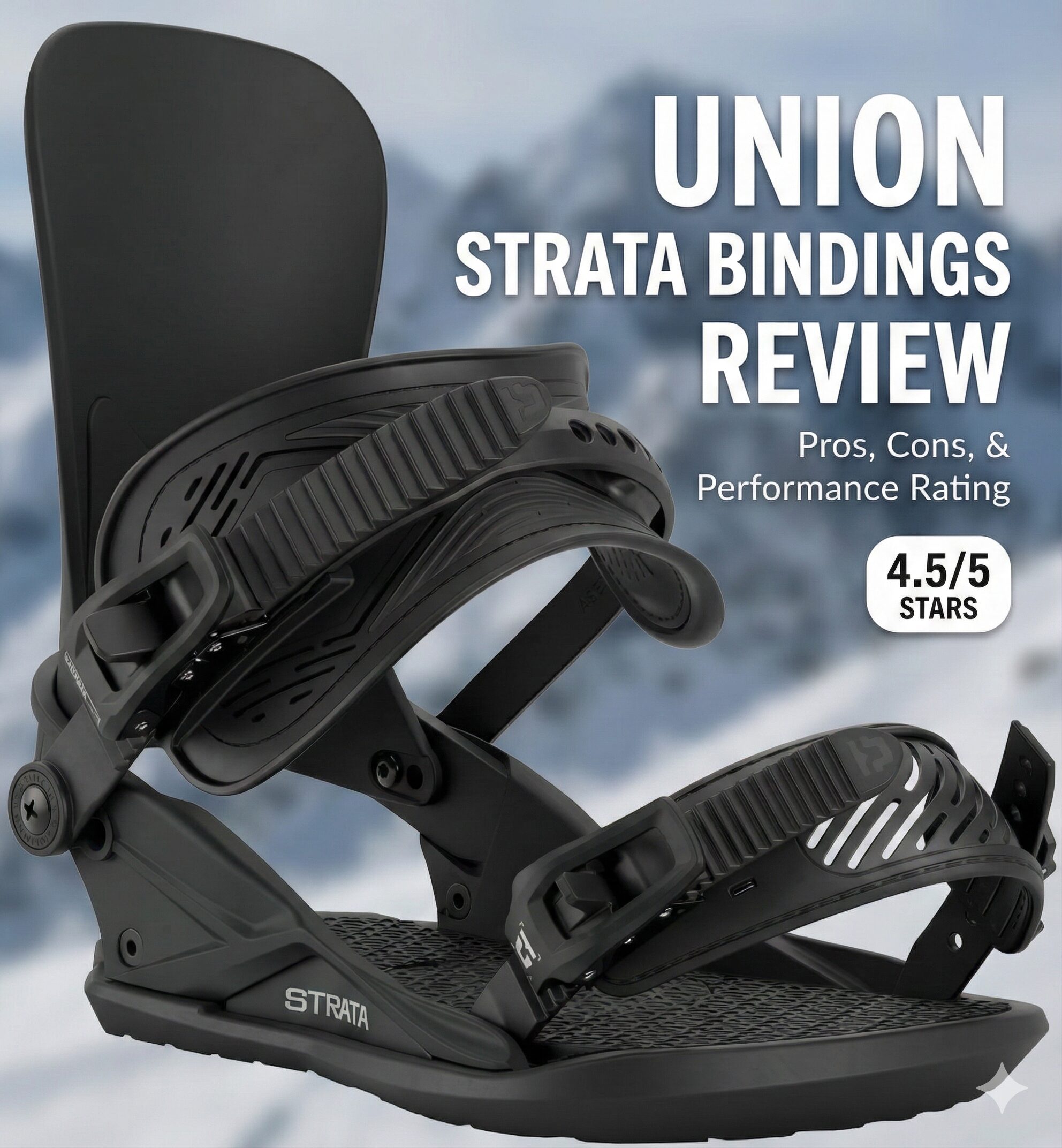
Union Strata Bindings Review: The King of Freestyle Snowboarding
- Introduction: The Union Legacy
- Who is the Union Strata For?
- Tech Specs & Materials
- The Stage 6 Duraflex ST Baseplate
- OTE Fused Vaporlite: The Secret Sauce
- Straps & Ratchets: Comfort Meets Lock
- Performance Breakdown
- Union Strata vs. The World
- Durability & Warranty
- Installation & Setup Guide
- Frequently Asked Questions
In the world of snowboarding hardgoods, few categories inspire as much debate, loyalty, and technical scrutiny as bindings. They are the critical interface between your body and your board, the transmission system that translates your physical intentions into mechanical action. And in this crowded marketplace, one name has risen to a near-mythical status over the last two decades: Union Binding Company. Known as the “Nike of Bindings” for their dominance and focused product line, Union has consistently pushed the envelope of material science. Within their extensive lineup, one binding has emerged as the definitive choice for the modern freestyle rider: The Union Strata.
Released initially as a replacement for the beloved Contact Pro, the Strata had massive shoes to fill. The Contact Pro was the “surf” binding of choice for years, championed by legends like Gigi Rüf. When the Strata hit the market, it wasn’t just an update; it was a reimagining of what a mini-disc binding could be. It introduced the snowboarding world to Fused Vaporlite bushings, a technology that promised to damp vibrations better than traditional EVA foam while remaining water-resistant and durable.
But does it live up to the hype years later? Is it truly the “quiver killer” for park rats who also like to dabble in powder? In this comprehensive review, we are going deep. We will dissect the molecular composition of the Duraflex nylon, analyze the physics of the mini-disc system, and compare it head-to-head against its fiercest rivals. Whether you are looking to upgrade your setup for the upcoming season or simply nerding out on gear specs, this is the only guide you will need. Before we dive in, if you are new to binding mechanics, you might want to brush up on slang terms for snowboarding to keep up with the jargon.

Who is the Union Strata For? (The Rider Profile)
Not every binding is for every rider. Buying the wrong equipment is the fastest way to ruin a season. The Union Strata occupies a very specific, albeit wide, niche in the snowboarding ecosystem. It is designed primarily as a Freestyle / All-Mountain binding. But what does that actually mean?
The Ideal Candidate:
- The Park Rat: If you spend 50% or more of your day hitting jumps, sliding rails, or buttering on the knuckles of rollers, this binding was engineered for you. The lateral flex allows for tweaking grabs, while the damping saves your knees on flat landings.
- The Side-Hit Hero: You don’t necessarily live in the park, but you view the entire mountain as a skatepark. You are constantly looking for natural features to launch off. You need a binding that is responsive enough to carve between hits but playful enough to land sketchy.
- The Surf-Style Rider: You prefer a loose, surfy feel over a rigid, locked-in race feel. You want to be able to move your knee over your toes and really lean into your turns without fighting a stiff highback.
Who Should Avoid It? If you are a dedicated big-mountain charger who rides 165cm stiff boards and bombs double-black diamonds at Mach 10, the Strata might feel too soft. The mini-disc system has more flex than a standard disc, which can feel “loose” at extreme speeds on icy terrain. For those riders, the Union Atlas or Force would be a better fit. Additionally, if you are a complete beginner, the price point might be overkill; check out our guide on best budget snowboard bindings for entry-level options.
Tech Specs & Materials Breakdown
Union owns their own factory (The Box) in Italy, which allows them to control every aspect of their material science. They don’t just buy plastic; they engineer custom nylon blends. Here is what is under the hood of the Strata.
| Component | Material / Technology |
|---|---|
| Baseplate | Stage 6 Duraflex ST (Super Tough) |
| Bushing | OTE Fused Vaporlite |
| Heelcup | Extruded 3D Aluminum |
| Highback | Strata Duraflex ST |
| Ankle Strap | Forma Lab |
| Toe Strap | TS 2.0 Hexgrip |
| Ratchets | Magnesium |
| Disk Type | Mini Disk (Compatible with 2×4 and The Channel) |
| Flex Rating | 6/10 (Medium) |
The Science of the Stage 6 Duraflex ST Baseplate
The heart of any binding is the baseplate. It determines how energy flows from your foot to the board. The Strata features the Stage 6 Duraflex ST baseplate. “ST” stands for Super Tough. This is a blended nylon material that is specifically designed to maintain its flex properties in extreme cold. Cheap plastic gets brittle and snaps when the temperature drops below zero; Duraflex retains a consistent feel whether it’s a sunny spring day or a frigid mid-winter morning.
The Mini-Disc Revolution
The defining feature of the Strata’s baseplate is the Mini-Disc system. Traditional bindings use a large disc that creates a massive “dead spot” under your foot where the board cannot flex naturally. This interrupts the arc of your turn and makes the board feel stiffer and more plank-like.
The Mini-Disc reduces the contact area between the binding and the board to a bare minimum (effectively just 5%). This allows the board to flex naturally under your feet, unlocking the true potential of your snowboard’s camber profile. This is crucial for camber vs rocker performance nuances. If you ride a board with a complex flex pattern, the Strata allows you to actually feel it.

OTE Fused Vaporlite: Why Your Knees Will Thank You
If you look at the bottom of the Strata baseplate, you will notice it doesn’t look like plastic. It looks like foam. This is OTE (Over The Edge) Fused Vaporlite. Most competitors use EVA foam for damping. EVA is cheap and effective, but it absorbs water, freezes, and packs out over time (loses its squish).
Vaporlite is a proprietary material developed by Union that is waterproof, durable, and functions more like a high-end running shoe sole than a snowboard binding. It provides incredible vibration damping. When you are riding through “chunder” (choppy, frozen snow), the binding absorbs the high-frequency vibrations before they reach your skeletal system. If you struggle with joint pain, this feature alone justifies the price. Learn more about common pains in our article why do my feet hurt when I snowboard.
Straps & Ratchets: Comfort Meets Lock
A binding is only as good as its straps. If they pinch, you’re miserable. If they slip, you’re in danger.
Forma Lab Ankle Strap
The Strata uses the Forma Lab ankle strap. It is a minimalist, injection-molded strap that uses a stiff exterior frame for power transfer and a soft, pillowy interior for comfort. Because it is molded rather than stitched, there are no seams to tear or soak up water. It distributes pressure evenly across the boot, eliminating the dreaded “pressure points” that cause foot numbness.
TS 2.0 Hexgrip Toe Strap
This is arguably the best toe strap on the market. The Hexgrip material is rubbery and sticky. It conforms to the toe box of any boot brand, gripping it like a gecko. It features a multi-positional design, so you can run it over the top of the foot (old school) or over the toe cap (modern). It is lightweight, secure, and virtually indestructible.
Performance Breakdown
We tested the Union Strata across a variety of conditions, from icy groomers to deep powder. Here is the verdict:
Flex & Response (6/10)
The Strata is rated as a “Medium” flex, but it feels softer laterally (side-to-side) than edge-to-edge. This is the magic formula. The stiff highback and heel cup provide instant response when you lean back on your heels, giving you power in carves. However, the mini-disc allows the binding to roll side-to-side, making it incredibly easy to press, butter, and tweak grabs.
Butterability
This is where the Strata shines. Because the binding flexes with the board, nose and tail presses feel natural and locked in. You don’t feel like you are fighting the binding to get the board off the ground.
Shock Absorption
10/10. The Vaporlite bushing is unmatched. Landings that should have hurt felt mellow. Riding over ice chunks felt smoother than usual. It is a damp, quiet ride.
Union Strata vs. The World
How does it stack up against the competition?
Union Strata vs. Union Force
The Union Force is the workhorse. It uses a standard full-size disc and a stiffer baseplate. It is more responsive and stable at high speeds but less playful.
Verdict: Get the Force for charging hard/jumps. Get the Strata for park/jibbing/surf feel.
Union Strata vs. Burton Cartel
The Cartel is stiffer and has a more “locked-in” feel. The Strata feels damper and surfier underfoot. The Cartel Re:Flex disc is good, but the Strata’s Vaporlite bushing offers better shock absorption.
Verdict: Cartel for all-mountain precision. Strata for freestyle creativity.
Durability & Warranty
Union is famous for its bombproof construction. The Strata features Magnesium ratchets, which are four times stronger than aluminum and half the weight. They don’t freeze up and they don’t strip ladders. The heel cup is extruded aluminum, which is virtually indestructible.
The Warranty: Union offers a Lifetime Warranty on baseplates and heel cups. If you manage to crack the chassis of the binding (highly unlikely), they will replace it. Straps and highbacks are covered for one year. This level of support is rare in the industry.
Installation & Setup Guide
Setting up the Strata is slightly different due to the mini-disc.
- Compatibility: The Strata fits 2×4 insert patterns and the Burton Channel system. It does NOT fit the old 4×4 pattern (found on very old boards). Ensure your board is modern.
- Centering: Use the adjustable heel cup to center your boot. Loosen the screws on the side, slide the aluminum heel cup in or out, and retighten. This ensures your boot is centered over the board edges.
- Angles: Rotate the mini-disc to your desired angles (e.g., +15 / -15 for duck stance).


 Home
Home
 About
About
 My Cart
 Reviews
 Compare