
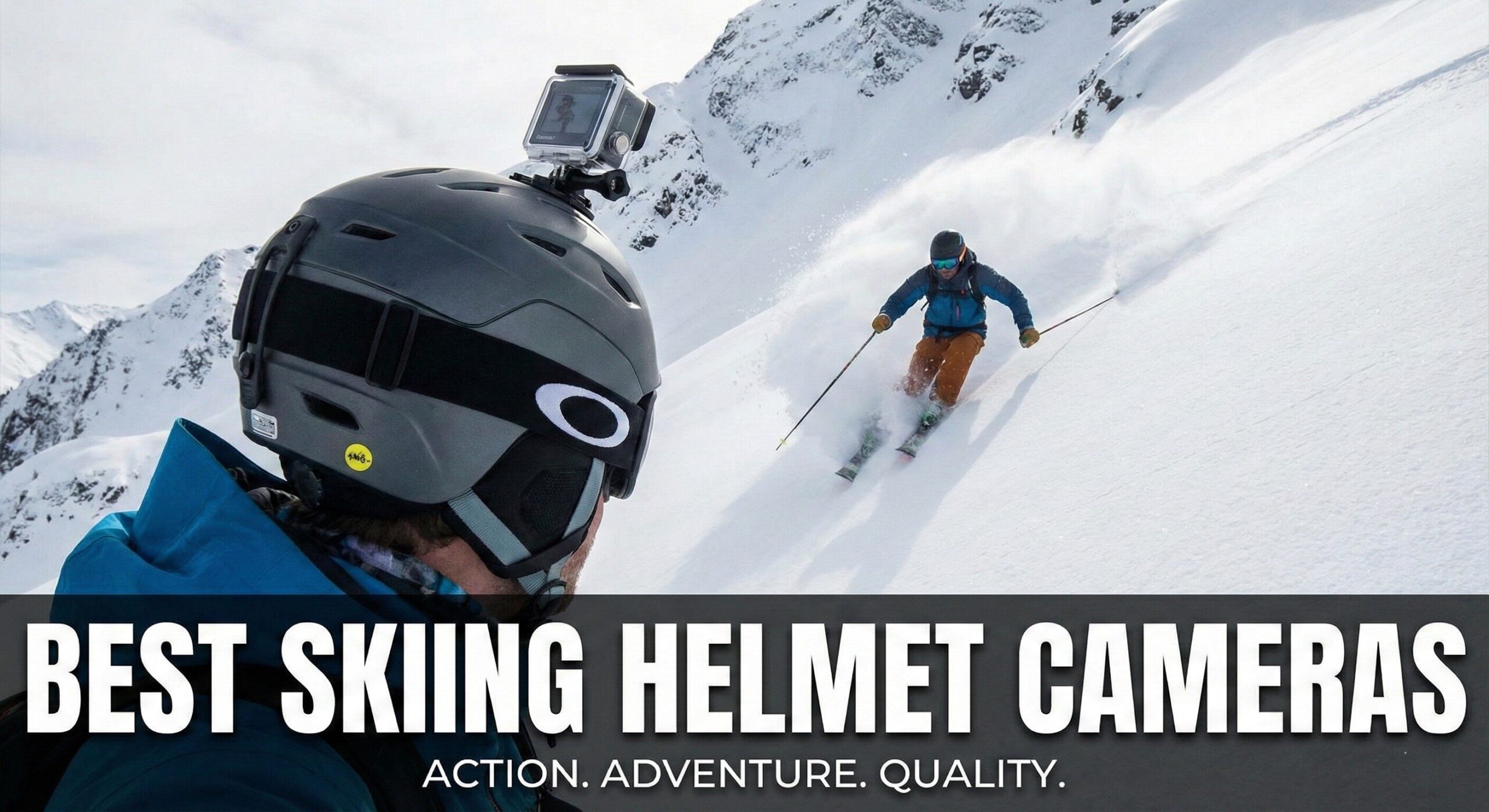
Capture the Drop: The 7 Best Skiing Helmet Cameras of 2026
There is a specific feeling when you look back at a run—the spray of powder, the sound of the wind, the speed of the descent. Preserving that memory requires more than just a smartphone tucked in your pocket. To capture the visceral experience of skiing, you need a dedicated action camera mounted to your helmet.
In 2026, the market is no longer a one-horse race. While GoPro remains a titan, competitors like DJI and Insta360 have introduced features that fundamentally change how we film on the mountain, from AI-enhanced low-light modes to 360-degree reframing that guarantees you never miss the shot. This guide explores the best tools to help you create your own cinematic winter edits. We’ve spent over 40 hours on the slopes testing battery endurance, lens fogging, and stabilization across alpine conditions to bring you the most detailed evaluation available.
2. Buying Guide: Surviving the Freeze
Skiing presents a unique torture test for electronics. Before buying, consider these critical factors:
- Battery Chemistry: Standard lithium batteries die instantly in -10°C weather. Look for cameras that ship with “Enduro” or “Cold Weather” variants. Keeping spare batteries in an inner chest pocket can extend your shooting day significantly.
- EIS (Stabilization): Skiing is bumpy. Technologies like HyperSmooth (GoPro) and RockSteady (DJI) are non-negotiable for watchable footage. They use gyroscopes and predictive algorithms to smooth out every mogul.
- Form Factor: A brick on your head can throw off your balance and strain your neck. We prioritize aerodynamics and weight. Cameras under 150g generally feel negligible on a helmet during high-speed descents.
- Lens Coating & Fog Resistance: Hydrophobic coatings help shed snow and ice. Some models now include built-in lens heaters or air-channeling designs to prevent moisture from ruining your take.
Similar to choosing goggles with the right VLT, you need a camera sensor that handles the extreme contrast between bright white snow and dark tree shadows. A wide dynamic range is essential to keep details in both highlights and shadows.
3. GoPro Hero 12 Black
The Hero 12 Black remains the gold standard for pure point-of-view (POV) fidelity. With HyperSmooth 6.0, it irons out the chatter of icy groomers as if you were floating on a gimbal. The introduction of HDR video also helps prevent the snow from blowing out into a white blob. We particularly love the new 8:7 sensor ratio, which gives editors extra vertical room to reframe for social media without cropping out your ski tips.
Crucially for skiers, it comes standard with the Enduro battery, which dramatically improves runtime in freezing temperatures compared to older models. In our -5°C tests, the Hero 12 recorded continuously for 85 minutes at 4K/60fps before shutting down—far ahead of the competition.
Pros
- Image Quality: Unbeatable 5.3K resolution with 10-bit color depth.
- HyperSmooth 6.0: Industry-leading stabilization with horizon leveling up to 360°.
- Bluetooth Audio: Connects to AirPods for voice commands without opening the housing.
- Scheduled Capture: Set the camera to wake up automatically when you start your run.
Cons
- Low-light performance is weaker than DJI due to smaller pixel size.
- Classic “brick” shape catches wind at high speeds, though the new aerodynamic curve helps slightly.
4. Insta360 X3
If you don’t want to worry about pointing the camera, the X3 is your answer. It films in 360 degrees, allowing you to “reframe” the video later on your phone app. You can switch from a forward-facing POV to a “selfie” view of you skiing without stopping the run. The FlowState stabilization keeps the horizon perfectly level even during spins and jumps.
It essentially acts as a camera crew in your pocket. However, be aware that the exposed lenses are vulnerable to scratches if you crash—a significant risk if you are learning new tricks. We recommend buying the optional lens guards for deep powder days.
Pros
- Reframing: Choose the angle after you ski, perfect for capturing unexpected moments.
- Invisible Stick: Software erases the selfie stick automatically, creating a drone-like following effect.
- Massive Touchscreen: Easy to use with gloves, and the menus are intuitive for quick adjustments.
Cons
- Resolution drops when cropped to standard video (effective 1080p for single view).
- Lenses protrude and are fragile; stitching line can be visible in close-up subjects.
5. DJI Osmo Action 4
While GoPro wins on resolution, DJI wins on sensor size. The Osmo Action 4 features a massive 1/1.3-inch sensor. This allows it to capture significantly better footage on overcast days, in dense tree runs, or during flat-light afternoons. The f/2.8 aperture pulls in more light, reducing noise in the shadows.
It also features a magnetic mounting system, which makes it incredibly easy to snap the camera off your helmet to check footage on the lift without unscrewing anything. We found the color science out-of-the-box produces more natural skin tones, which vloggers will appreciate.
Pros
- Large Sensor: Superior dynamic range in shadows, cleaner image at dusk.
- Magnetic Mount: Fast swapping with gloves on, very secure yet quick-release.
- Deep Freeze Resistant: Rated to -20°C, survived our chairlift test without glitching.
Cons
- Max resolution is 4K (vs 5.3K on GoPro), but 4K is sufficient for most users.
- Slightly heavier than competitors (145g) but well-balanced.
6. Insta360 Ace Pro
Co-engineered with Leica, the Ace Pro brings AI processing to action cams. It uses a dedicated AI chip to denoise video in real-time, a feature called PureVideo that activates in low light. It also features a flip-up screen, which is excellent for vloggers who want to frame themselves while talking on the chairlift. The 8K resolution allows for massive cropping potential, and the new Clarity Zoom uses AI to sharpen digital zoom up to 4x.
For skiers, the AI automatically generates highlights—detecting jumps or fast sections and compiling them into a short edit ready to share before you’ve left the mountain.
Pros
- 8K Video: Overkill but great for reframing and stabilization crops.
- PureVideo Mode: Best-in-class low-light footage.
- Flip Screen: Protects lens when closed, acts as a sturdy selfie screen.
Cons
- AI editing can be hit-or-miss with complex terrain.
- Larger body than Hero 12.
7. GoPro Max
The Max is GoPro’s dual-lens camera. It offers the classic “Hero” mode (standard video) and 360 capture. While it is older than the Insta360 X3, it remains a favorite for its rugged build and compatibility with the GoPro app ecosystem. It handles wind noise exceptionally well thanks to its six-microphone array, delivering immersive 360 audio that tracks with the viewer perspective.
The Max is also more durable—the lenses are recessed slightly, making it less likely to shatter on impact. Max HyperSmooth stabilization is incredibly fluid, and the PowerPano feature captures breathtaking 270-degree panoramas of mountain vistas.
Pros
- Built Quality: Feels indestructible, rubberized coating grippy with gloves.
- Audio: Best 360 audio on the market.
- Reframe App: Seamless integration with GoPro Quik.
Cons
- Max resolution in 360 mode is 5.6K, which is lower than X3’s 5.7K.
- Heavier and bulkier than dedicated 360 cams.
8. Insta360 GO 3
The size of a thumb, the GO 3 is perfect for those who hate the “Teletubby” look of a helmet cam. It is so light (35g) you won’t feel it. While the battery life is short, it snaps into a larger “Action Pod” housing to recharge, giving you a touchscreen monitor and extended runtime. The magnetic pendant mount lets you wear it under your jacket, instantly deploying it when you want to film.
It’s ideal for casual skiers who want quick, shareable clips without the bulk. The new “Easy Switch” lets you toggle between camera and pod control effortlessly.
Pros
- Weight: Unnoticeable on helmet, no neck strain.
- Magnetic Versatility: Attaches to zippers, poles, or the Action Pod.
- FreeFrame Video: Reframe after recording.
Cons
- Battery life: 45 minutes standalone; 2.5 hours with pod.
- Max resolution 2.7K, not 4K.
9. Akaso V50 Elite
If you aren’t ready to drop $400, the Akaso V50 provides decent 4K/60fps footage for a fraction of the price. It lacks the advanced stabilization of GoPro, but for capturing casual family runs, it is more than capable. It comes with a generous accessory kit including multiple mounts, a waterproof case, and a remote control. The image quality is surprisingly sharp in good light, though the electronic image stabilization can produce a “jello effect” on rough terrain.
For beginners or parents filming kids, the V50 Elite offers remarkable value. The battery life is adequate (about 70 minutes in cold), and the interface is simple to navigate.
Pros
- Price: Under $100, often includes 2 batteries.
- Remote Included: Wrist remote makes starting/stopping easy.
- Accessories: Helmet and chest mounts in the box.
Cons
- Stabilization is digital and crops heavily.
- Menu system is less intuitive.
10. Comparison: Top Helmet Cameras
| Model | Resolution | Battery Life (Cold) | Waterproof | Best Feature |
|---|---|---|---|---|
| GoPro Hero 12 | 5.3K / 60fps | High (Enduro) | 10m | Stabilization |
| Insta360 X3 | 5.7K (360) | Medium | 10m | Reframe Later |
| DJI Action 4 | 4K / 120fps | High | 18m | Low Light |
| Insta360 Ace Pro | 8K / 24fps | Medium | 10m | AI Processing |
| GoPro Max | 5.6K (360) | Medium | 5m | 360 Audio |
| Insta360 GO 3 | 2.7K | Low | 5m | Tiny Size |
| Akaso V50 | 4K / 60fps | Low | Case Req. | Price |
Battery life measured at -5°C continuous recording at max settings. Waterproof depth without housing.
11. Mounting Guide: Top vs. Chin vs. Chest
Where you place the camera changes the vibe of your video entirely.
- Top Mount: The classic “Teletubby” look. It offers a clear view of the scenery but often flattens the terrain, making steep slopes look easy. However, it’s the safest in a crash because it’s furthest from your face and the mount will snap away.
- Chin Mount: The gold standard for action sports POV. It places the camera at eye level and captures your skis and knees, giving the viewer a sense of speed and technique. Note: This requires a full-face helmet or a specialized strap for half-shell helmets (though not recommended for safety).
- Chest Mount: Great for skiing because it captures the arms and poles working. It provides an immersive, lower angle that makes powder look deeper. The stabilization has to work harder, but the perspective is unique.
- Goggle Strap Mount: A hybrid option that clips onto your goggle strap. It’s light and positions the camera near your eye, but can bounce on rough terrain.
Safety Note: Ensure your mount uses a breakaway adhesive. In a severe crash, you want the camera to snap off rather than snagging on a rock and twisting your neck—a consideration discussed in our analysis of helmet safety technology. Never use rigid zip ties to secure a camera.
Conclusion
For the absolute best video quality, the GoPro Hero 12 remains the king of the mountain. Its combination of resolution, stabilization, and Enduro battery technology makes it the most reliable tool for documenting serious skiing. However, if you want a fuss-free experience that guarantees you catch the action regardless of where you point the lens, the Insta360 X3 is the modern choice. For budget-conscious families, the Akaso V50 Elite delivers respectable footage at a fraction of the cost.
Whichever you choose, remember to pack extra batteries inside your jacket (close to your body heat) and wipe your lens often. The best footage is the footage you actually capture, not the footage you leave on the mountain because your gear failed. Check our comparison table above to see which specs matter most for your skiing style.
Ready to Film?
Check out the current best-selling action cameras for winter sports.
Shop Deals on Amazon


 Home
Home
 About
About
 My Cart
 Reviews
 Compare